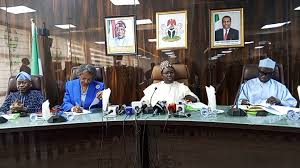
…cancels withholding tax to farmers, manufacturers
Two announcements on Tuesday put a shine on Nigeria’s local and international investment image and promise to give some tonic to trade and enterprise within and across the country’s borders going forward.
The European Union Ambassador to Nigeria and the ECOWAS, Samuela Isopi, declared at the 9th edition of the Nigeria-EU Business Forum in Abuja, that the Federal Government has paid up the backlog of debts to European airlines to the tune of $850m.
Similarly, the chairman of the Presidential Committee on Fiscal Policy and Tax Reforms, Taiwo Oyedele, announced that the Federal Government has exempted farmers, small businesses, and manufacturers from the payment of withholding tax.
Faced with a downturn in the economy in recent times, the Federal Government had struggled to provide FX to enable foreign airlines operating into the country to repatriate their revenues back home.
This led to strained relations, put a veil over the country’s business image and led to a number of the airlines eventually suspending or reducing operations into Nigeria.
Speaking as the government refocused attention on redeeming its foreign exchange obligations to the airlines, Mrs. Hakama Sidi-Ali, spokesperson for the Central Bank of Nigeria, had said the move aligned with the CBN’s commitment to clearing the backlog of pending matured foreign exchange in deposit money banks.
Sidi-Ali further said the CBN had successfully redeemed outstanding forward liabilities amounting to nearly $2 billion.
She added that the initiative underscored the CBN ’s commitment to the resolution of pending obligations and a functional foreign exchange market.
“These payments signify the CBN’s ongoing efforts to settle all remaining valid forward transactions, to alleviate the current pressure on the country’s exchange rate,” Sidi-Ali said.
“It is anticipated that this initiative would provide a considerable boost to the naira against other major world currencies and further increase investor confidence in the Nigerian economy,” she said.
Foreign companies operating in Nigeria had faced challenges in repatriating profits or capital due to a shortage of USD in the CBN, leading to a significant backlog amounting to billions of USD.
Meanwhile, the EU Ambassador to Nigeria and the ECOWAS, Isopi on Tuesday commended the Federal Government for its intervention in clearing the backlog as well as the removal of foreign exchange restrictions on the import of forty-three items.
Isopi observed that Nigeria remains the EU’s largest trading partner with about 35 billion Euros in trade relations in the last year.
She also said that Nigeria is the EU’s biggest foreign investor with a stock estimated at 26 billion Euros, representing one-third of Nigeria’s foreign direct investment.
She further observed that over 230 EU companies operate in Nigeria, providing jobs for youths and women.
The 9th edition of the Nigeria-EU Business Forum has the theme ‘Investing in Jobs and Sustainable Future’.
Others in attendance include the Director General at the EU, Myriam Ferran; the Minister of Budget and National Planning, Atiku Bagudu, and the Permanent Secretary at the Ministry of Industry, Trade and Investment, Nura Rimi.
The forum is expected to create a platform for dialogue between the public and the private sector as well as highlight the role of government in supporting businesses towards achieving inclusive development.
In a related development, the Federal Government has exempted farmers, small businesses, and manufacturers from withholding tax.
This is according to the Chairman of the Presidential Committee on Fiscal Policy and Tax Reforms, Taiwo Oyedele.
Oyedele said in a post on his X handle that, “As part of the ongoing fiscal policy and tax reforms, a new withholding tax regime has been approved.
“The key changes introduced are to address the identified challenges and specifically include the exemption of small businesses from withholding tax compliance; reduced rates for businesses with low margins; exemptions for manufacturers and producers such as farmers; measures to curb evasion and minimise tax avoidance and the ease of obtaining credit and utilisation of tax deducted at source.”
Others are, “Changes to reflect emerging issues and adopt global best practices and clarity on the timing of deduction and definition of key terms. The approved regulation is expected to be published in the official gazette in the coming days.”
He said withholding tax came into effect in Nigeria in 1977 and was meant to serve as an advance payment of tax on specified transactions.
“It was designed to provide the government with regular revenue flow and to serve as a means of curbing tax evasion,” he said.