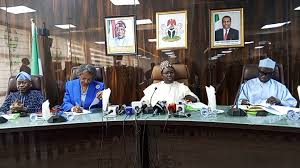
…targets 25,000MW
…in partnership with Siemens
The Federal Government says it is concluding plans to release $800 million under the Presidential Power Initiative (PPI) to ramp up power generation and supply nationwide.
The $800m financing by the Federal Government which is part of a three-phased project to expand Nigeria’s electricity generation to 25,000MW when completed, is believed to be another part payment of the counterpart funding by the country.
While the country currently generates about 5,000 MW of power, the Association of Nigerian Electricity Distributors (ANED) says Nigeria needs about 33,000 Megawatts to have stable electricity.
Adebayo Adelabu, Nigeria’s Minister of Power, said the $800 million funding will be utilised for the construction of electricity substations and distribution lines under the PPI scheme also known as the Siemens Project. Adelabu did not give a timeline for the release of the funds.
According to a statement from the power ministry, Adelabu spoke during a facility tour of TBEA Southern Power Transmission and Distribution Industry in Beijing, China, while attending the China-Africa Cooperation Summit.
The PPI deal with the German Government aims to modernise, rehabilitate and expand the national grid by investing in the electricity value chain, including generation, transmission and distribution systems.
“The money will ensure the construction of substations for Lot 2, as well as substations and distribution lines for Lot 3 at a cost of $400 million each. Lot 2 covers Benin, Port Harcourt, as well as Enugu Distribution Companies’ (Discos) franchise areas, while Lot 3 covers Abuja, Kaduna, Jos and Kano Discos franchise areas,” the statement added.
Now long delayed, in July 2019, the Federal Government signed the power project deal with the German engineering firm, Siemens to deliver 7,000 megawatts of electricity to the national grid by 2021, and 11,000 megawatts by 2023 — in phases one and two of the initiative, respectively.
A year later, the Federal Government approved the payment of €15.21 million and N1.708 billion as counterpart funding for the project. In December 2021, the Federal Executive Council (FEC) also approved $1.9 million and €62.9 million for phase one of the project.
Adelabu lamented the rejection of load supply by Discos in the country, noting that just last Friday, for instance, when generation peaked at over 5,170 megawatts, it had to be ramped down by 1,400 megawatts due to the inability of the Discos to pick the supply.
He highlighted the fragility of the transmission and distribution infrastructure which he said have become old and dilapidated as partly responsible for the sector’s challenges.
“This has led to historical epileptic supply of power to households, industry and businesses. More than 59 per cent of industries in Nigeria are off the grid. They do not see the national grid as reliable and dependable. So a lot of them now operate their own captive, self-generated power,” he stated.
“This is really regrettable considering that the government is on course to increase generation to 6,000 megawatts by the end of the year,” Adelabu was quoted as saying.
He assured of the Federal Government’s commitment to working with world class organisations like TBEA to achieve the vision of President Bola Tinubu for the power sector.
He stressed that this was especially in areas of transmission and distribution of the entire power sector value chain, as well as Nigeria’s renewable energy segment.
Adelabu said the administration of Tinubu was determined to transform the power sector, adding that a lot of activities had started that are gradually bringing back confidence in the sector.
Acknowledging the different initiatives of the government, Adelabu explained that in 1984, Nigeria was able to generate 2,000 megawatts, but added that it took the country over 35 years to add another 2,000 megawatts.
“When this administration came in last year, we met around 4 gigawatts (4,000 megawatts) of power but within a year, we were able to generate a milestone of 5,170 megawatts, adding about 1,000 megawatts of power within the first year. It may look small, but compared to the history of the country, this is commendable.
“Our plan is that by the end of the year, we aim to achieve 6,000 megawatts of power through a combination of hydroelectric power plants and our gas-fired power plants. We are also targeting 30 gigawatts of power to be generated, transmitted and distributed by 2030, out of which 30 per cent would be renewable energy”.
The minister said the renewable energy segment will come from a combination of hydroelectric power from small dams, solar energy sources and wind farms from onshore and offshore winds.
On the issue of the construction of the super-grid, the minister said the national grid in its present state cannot support the vision for the power sector.
“If we look at the strength, the capacity and the age of our existing network on the national grid, it cannot really support our vision for the power sector, hence the need for the construction of the Western and Eastern super grid.
“Though we have been on this since my resumption, I can also tell you that the president is in full support of this because this will improve our transmission network, stabilise the grid and also expand the capacity and the flexibility of the national grid,” he said.
He said 90 per cent of the approval required was already in place and would be concluded soon.
Speaking earlier, President of TBEA, Huang Hanjie assured of the organisation’s continued support for Nigeria’s government vision for the power sector, disclosing that TBEA operates across 100 countries in the world and would be willing to share its experience in the provision of energy.
He said TBEA was not new in Nigeria, adding that the company is presently working with the Omotosho Power Plant in Ondo State, owned by the Niger Delta Power Holding Company (NDPHC).
Hanjie also commended the minister for what the statement described as the improvement in the power sector as evidenced in improved generation and transmission since his assumption of office.
While also acknowledging the short-term improvement to 6 gigawatts by December 2024 and 30 gigawatts by 2030, he said TBEA would be willing to work with the Nigerian government to achieve the vision and contribute to the ongoing efforts in the country.
On the proposed super-grid by the Nigerian government, he also indicated TBEA’s interest in participating by contributing its expertise to guarantee its success.