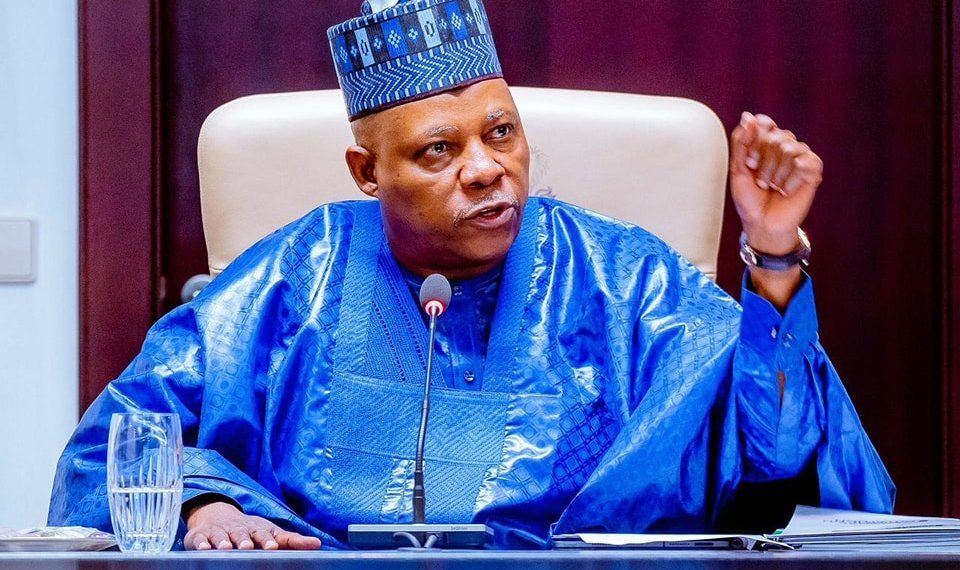
ABUJA – Vice-President Alhaji Kashim Shettima has expressed concern over the data and information gap between the National Bureau of Statistics (NBS), state governments, and local government areas.
Speaking at the 2025 Workshop of the Chartered Institute of Stockbrokers (CIS) on Tuesday in Abuja, Shettima—represented by Dr Tope Fasua, Special Adviser to the President on Economic Matters—highlighted the discrepancy in economic data at different levels of government.
The vice-president was reacting to the rebased Gross Domestic Product (GDP) figures released by the NBS on Monday, which showed that Nigeria’s economy grew by 3.13 per cent in the first quarter of 2025, up from 2.27 per cent in the same period in 2024.
Shettima questioned whether the new growth rate accurately reflects the true state of the economy, particularly in light of increased Internally Generated Revenue (IGR) reported by several states.
“If the states have increased their IGRs by between 100 and 300 per cent, how come the GDP is still where it is? And if the GDP is still growing at about three per cent, then there’s clearly much more to discuss at that level,” he said.
“You would be shocked at the extent of information gaps in data repositories, especially from the state and local government levels,” Shettima added.
Turning to capital markets, the vice-president described capital formation as the engine of infrastructural development, economic growth, and improved living standards.
He noted that in 2023, Nigeria’s All-Share Index (ASI) stood at 55,000 points with a market capitalisation of around N28 trillion. As of July 2025, the ASI had surged to 131,000 points, with market capitalisation climbing to N75 trillion.
Shettima said the threefold increase in market value over two years, driven by renewed investor confidence, had spurred business expansion and significantly boosted national wealth, pointing to a clear path of recovery and sustainable economic growth.
Echoing Shettima’s concerns, Plateau State Governor Caleb Mutfwang also called for greater collaboration among stakeholders.
He noted that despite a significant rise in Plateau’s IGR, NBS data did not accurately reflect the economic reality of the state.
“To achieve a $1 trillion economy, we must first evaluate where we truly are. Our data collection often flows top-down instead of bottom-up,” Mutfwang said.
“We need deeper collaboration. Every subnational must grow its own economy. We also need capital to de-risk investment, boost production, and foster creative ideas that can uplift living standards in rural areas,” he added.
Minister of State for Finance, Dr Doris Uzoka-Anite, emphasised the importance of capital formation in providing affordable financing for Small and Medium Enterprises (SMEs).
She stressed the need for strong and resilient institutions to reach the $1 trillion economy target.
Uzoka-Anite also disclosed that the federal government was working to eliminate bottlenecks preventing companies from listing on the Nigerian Exchange Ltd.
“We must align long-term capital with long-term development goals,” she said.
Chairman of the Ministry of Finance Incorporated, Dr Shamsudeen Usman, emphasised that achieving a $1 trillion economy would require concerted efforts from federal and state governments, as well as the private sector.
Usman, a former Minister of Finance, cited policy inconsistency and frequent personnel changes as challenges that could hinder economic progress.
Also speaking, the Accountant-General of the Federation, Mr Shamseldeen Ogunjimi, stressed the need to strengthen institutions, which he described as the backbone of thriving economies.
Ogunjimi said deepening the capital market and prioritising investment in agriculture and technology would be crucial to realising the $1 trillion goal.
He urged the CIS to maintain ethical standards and promote policies that support market liquidity.
Director-General of the Securities and Exchange Commission (SEC), Dr Emomotimi Agama, said the capital market’s core purpose was capital formation.
He described the Investment and Securities Act (ISA 2025) as a call to action for innovation, responsible investing, and forward-thinking regulation.
“Our mission is to operationalise the Act with speed and precision. Every rule, every policy must be measured by one metric, does it bring us closer to the $1 trillion mark?” he said.
Agama stressed that the responsibility of the SEC and other stakeholders was to build a capital market that could drive national economic growth.
President of CIS, Mr Oluropo Dada, noted that accelerating capital formation across all sectors was key to ensuring long-term economic stability. He described capital formation as a national necessity and said a vibrant industrial sector was essential to sustaining it.
He praised the workshop’s theme as timely, underscoring the need for real capital investment to raise citizens’ living standards and support overall development.
Also contributing, former CIS President, Mr Olutola Mobolurin, said developing risk capital formation would significantly advance Nigeria’s journey toward a $1 trillion economy.
The workshop, themed “Capital Formation in Nigeria: Strengthening Industry, Institutions and Markets to Bolster a $1 Trillion Economy,” brought together financial and capital market stakeholders from across the country