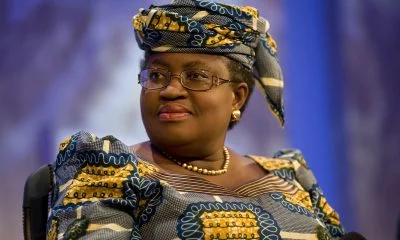
… Launches $50m digital trade fund for Nigerian women
ABUJA — Nigeria’s economic reform programme under President Bola Tinubu has earned global commendation, with the World Trade Organisation (WTO) rating the administration’s policy direction as aligned with international best practices and vital for long-term growth.
WTO Director-General, Dr. Ngozi Okonjo-Iweala, gave the endorsement on Thursday after a courtesy visit to the President at the State House, Abuja.
She praised the administration for swiftly stabilising the economy, saying such macroeconomic stability was an essential foundation for attracting investment and expanding growth.
According to her, the President and his team had worked hard to stabilise the economy, and that no economy could truly improve without stability, adding that the reforms had been in the right direction. Okonjo-Iweala stressed that the next phase must focus on accelerating growth and protecting the vulnerable, noting that social safety nets were necessary to help citizens cope with the hardship of reforms.
The WTO chief was in Abuja for the official launch of the Women Exporters in the Digital Economy (WEIDE) Fund, a $50 million global initiative jointly managed by the WTO and the International Trade Centre (ITC) to support women-owned businesses in developing countries.
Okonjo-Iweala explained that the fund would help women entrepreneurs gain the skills, resources and market access to compete in the global value chain, particularly in the fast-growing area of digital trade, and would provide grants, technical assistance and mentoring to help scale women-led businesses.
Nigeria is one of only four countries, alongside Jordan, Mongolia and the Dominican Republic selected this year for the programme after a competitive process involving over 600 business support organisations worldwide.
Okonjo-Iweala said that the Nigerian Export Promotion Council, led by Mrs. Nonye Ayeni, submitted one of the strongest applications.
Out of 67,000 Nigerian applicants, 146 women entrepreneurs were selected. Sixteen of them in the “booster track” will each receive up to $30,000 in grants and 18 months of technical and business support, while another 130 in the “discovery track” will each get $5,000 and one year of mentoring.
The beneficiaries operate in diverse sectors including agriculture, information technology, fashion, tourism, beauty, hospitality and manufacturing.
Okonjo-Iweala warned that Nigeria’s current digital infrastructure could limit the country’s ability to seize opportunities in the $4.25 trillion global digital trade market.
She noted that only 45 per cent of Nigerians are connected to the internet, compared to the global average of 67 per cent, and called for urgent investment in affordable, reliable broadband and steady electricity.
She acknowledged the government’s $2 billion fibre optic project to connect rural and secondary cities but said more needed to be done, urging coordination between the ministries of power, communications, women’s affairs and trade.
She also noted that women remain underrepresented in Nigeria’s booming ICT sector, which contributed 18 per cent to GDP in 2022, up from less than 4 per cent in 2001.
Okonjo-Iweala said only 30 per cent of Nigerian tech firms are owned by women and the country ranks 128th out of 148 nations in the Global Gender Gap Report.
She urged policymakers to avoid measures such as customs duties on cross-border digital trade, warning that such policies could choke small exporters and undermine women’s access to global markets. Addressing the awardees, Okonjo-Iweala urged them to dream bigger, scale higher and go further, saying she looked forward to returning in two years to see how many more people they had employed, how many new markets they had reached and how many women they had inspired.
She added that when women succeed, communities succeed and economies succeed, stressing that the case for women’s empowerment was not just moral but economic.