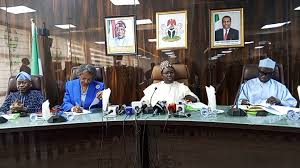
ABUJA: President Bola Tinubu has urged the Nigerian judiciary to remain steadfast, impartial, and incorruptible in dispensing justice.
Tinubu, represented by the Vice-President, Kashim Shettima, made the call on Monday at the Economic and Financial Crimes Commission (EFCC) and National Judicial Institute (NJI) Workshop for Justices and Judges in Abuja.
He warned that the breakdown of any society begins when those entrusted with interpreting its laws become compromised.
Tinubu said his administration is committed to improving the welfare and working conditions of judicial officers, noting that recent remuneration reviews were part of a broader effort to strengthen judicial independence.
The President said the moral foundation of the Nigerian nation rests squarely on the integrity of its judicial system.
“We draw our moral distinction as a people from the judiciary, and we owe it the reverence and autonomy to remain the last sanctuary of our collective conscience,” Tinubu said.
He addressed public concerns about delayed adjudication in high-profile corruption cases while cybercrime matters are resolved more swiftly.
“The theme of this year’s workshop, ‘Enhancing Justice in the Fight Against Economic and Financial Crimes’, will resonate among many in this audience. It comes at a time when the fight against corruption evokes anger over delayed adjudication of high-profile matters while cases involving cybercrime masterminds are determined with dispatch.
“There is also consternation over certain court decisions in serious corruption matters that leave society feeling short-changed,” he said.
Tinubu defended his administration’s non-interference policy, stressing:
“There is no person or group who can accuse this administration of shielding political actors on account of their affiliation with this government or the political party. We have allowed both the judiciary and the anti-graft agencies to exercise their constitutional and statutory powers.”
Highlighting achievements in the anti-corruption drive, Tinubu disclosed that the EFCC “has recorded over 7,000 convictions in the first two years of my administration and recovered assets in excess of five hundred billion naira.”
He added that the recovered proceeds are being channelled into social investment programmes, including the Students Loan and Consumer Credit Schemes.
On technological challenges facing the judiciary, Tinubu noted the shift from simple email evidence to complex blockchain analysis in financial crime cases.
“How does one do justice in a cryptocurrency fraud case except one is grounded in such matters? Learning and relearning is no longer a buzz phrase but an essential undertaking for continued relevance in this digital age,” he said.
He reminded judicial officers that corruption affects everyone equally.
“Your vantage position on the Bench does not insulate you from the consequences of corruption. There are no special roads, hospitals, or communities for judges. A Nigeria free of corruption is possible if we all commit to doing what is right in our respective spheres of influence,” Tinubu said.
The Chief Justice of Nigeria (CJN), Justice Kudirat Kekere-Ekun, maintained that the decisions of judicial officers have a profound impact on Nigeria’s growth and stability.
Kekere-Ekun, who is also the Chairman of the Board of Governors of the National Judicial Institute (NJI), urged judicial officers to apply constitutional tools effectively and ensure that justice is neither delayed nor partial.
President of the Senate, Godswill Akpabio, said that while corruption remains an enemy of the state, fighting it requires joint efforts from the legislature, a vigilant citizenry, and a courageous judiciary.
Represented by the Chief Whip of the Senate, Mohammed Monguno, Akpabio assured that the National Assembly will continue to equip law enforcement agencies to combat corruption.
EFCC Chairman, Ola Olukoyede (SAN), noted that the recent Supreme Court judgment upholding the Commission’s powers has further strengthened anti-corruption institutions.
“The record of 4,111 convictions and humongous asset recoveries could not have been achieved by a lazy or ineffective judiciary,” he said.