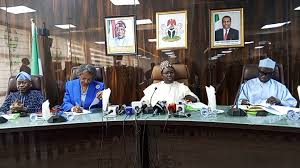
President Bola Ahmed Tinubu on Friday assured Nigerians that 2026 would mark a turning point in fiscal discipline, accountability and effective budget execution, as he formally presented the 2026 Appropriation Bill to a joint session of the National Assembly.
Presenting the budget, titled “Budget of Consolidation, Renewed Resilience and Shared Prosperity,” the President said his administration would enforce stricter compliance with budgetary timelines and appropriations to ensure value for money and improved service delivery.
Tinubu disclosed that he had issued firm directives to the Minister of Finance and Coordinating Minister of the Economy, the Minister of Budget and Economic Planning, the Accountant-General of the Federation, and the Director-General of the Budget Office to ensure that the 2026 budget is implemented strictly in line with approved provisions.
“2026 will be a year of stronger discipline in budget execution, and better accountability, monitoring and reporting,” the President said.
He described the presentation as a defining moment in Nigeria’s reform journey, noting that the last two and a half years had been dedicated to confronting structural weaknesses, stabilising the economy and restoring investor confidence.
While acknowledging that the reform process had imposed hardships on citizens and businesses, Tinubu said the sacrifices were yielding results and would ultimately translate into improved living standards.
The President said the 2026 budget was prepared against signs of economic stabilisation, citing improved macroeconomic indicators. According to him, Nigeria’s economy grew by 3.98 per cent in the third quarter of 2025, while inflation moderated for eight consecutive months, declining to 14.45 per cent in November 2025 from 24.23 per cent in March.
He also noted improvements in oil production, expansion of non-oil revenues through better tax administration, rising investor confidence, and an increase in external reserves to about $47 billion as of mid-November 2025.
“These outcomes are not accidental. They reflect deliberate and sometimes difficult policy choices. Our task now is to consolidate these gains so that stability becomes prosperity, and prosperity becomes shared,” Tinubu said.
Reviewing the implementation of the 2025 budget, the President disclosed that as of the third quarter, the government recorded ₦18.6 trillion in revenue, representing 61 per cent of the target, and ₦24.66 trillion in expenditure, equivalent to 60 per cent of projected spending.
He said the transition period necessitated prioritising the completion of 2024 capital projects, which affected capital releases in 2025, adding that lessons learnt would guide stricter execution in 2026.
Tinubu announced that the 2026 budget projects total revenue of ₦34.33 trillion and total expenditure of ₦58.18 trillion, including ₦15.52 trillion for debt servicing.
The budget proposes recurrent non-debt expenditure of ₦15.25 trillion, capital expenditure of ₦26.08 trillion, and a fiscal deficit of ₦23.85 trillion, representing 4.28 per cent of Gross Domestic Product (GDP).
The fiscal framework is based on a crude oil benchmark of $64.85 per barrel, daily production of 1.84 million barrels, and an exchange rate of ₦1,400 to the US dollar.
The President said the budget prioritises security, human capital development and infrastructure, with allocations of ₦5.41 trillion for defence and security, ₦3.56 trillion for infrastructure, ₦3.52 trillion for education, and ₦2.48 trillion for health.
He emphasised that security spending would be tied to measurable outcomes, noting that the government is resetting the national security architecture and adopting a new counterterrorism doctrine to tackle banditry, terrorism and other violent crimes.
On education and health, Tinubu highlighted expanded access to tertiary education through the Nigerian Education Loan Fund, which has supported over 418,000 students, and increased healthcare funding, accounting for six per cent of the total budget.
The President reiterated his administration’s resolve to block revenue leakages, particularly among government-owned enterprises, through digitised revenue collection, real time monitoring and performance based evaluations.
“The greatest budget is not the one we announce; it is the one we deliver,” Tinubu said, pledging improved revenue mobilisation, prudent spending and stronger accountability.
He urged lawmakers to support the budget proposals, expressing confidence that cooperation between the executive and legislature would ensure the successful delivery of the Renewed Hope Agenda.
Tinubu then formally laid the 2026 Appropriation Bill before the National Assembly for consideration.