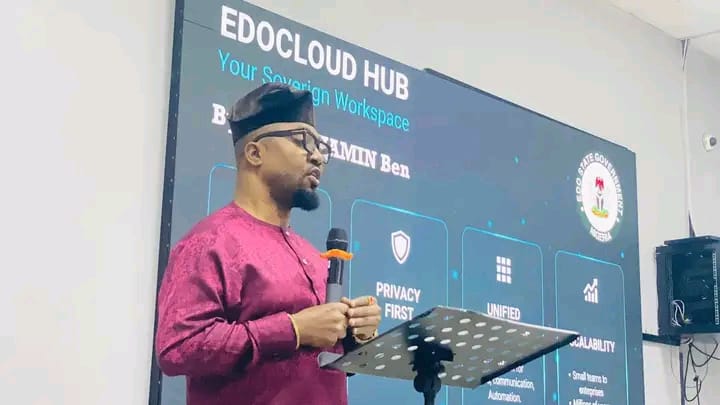
Edo State is steadily repositioning itself as a more competitive and investor-friendly destination through the rollout of Edo Cloud, the digital infrastructure powering the state’s e-Gov 2.0 platform, under the administration of Governor Monday Okpebholo.
Among other strategic objectives, the reform is designed to improve ease of doing business, strengthen investor confidence and modernise public service delivery by embedding digital efficiency across government institutions.
In today’s investment climate, the quality of a government’s digital systems plays a decisive role in business location and expansion decisions.
Investors increasingly assess how quickly approvals are processed, how transparent regulatory processes are, how secure their data will be and how responsive public institutions are to private-sector needs.
Edo Cloud provides a state-owned digital backbone that is intended to institutionalize these efficiencies across Ministries, Departments and Agencies (MDAs).
Before this reform, Edo State operated a digital governance system that was neither fully owned nor controlled. This limited scalability, restricted backend access and created dependence on external service providers.
Through investing in a fully state-owned platform, the Okpebholo administration has signalled a long-term commitment to digital sovereignty, administrative continuity and institutional reliability, which are key factors in building a predictable business environment.
A major driver of the reform is the development of Edo Business Connect, a flagship government-to-business digital platform being deployed on Edo Cloud.
When fully launched, Edo Business Connect is expected to become Nigeria’s first comprehensive digital public platform dedicated to structured business engagement, complaint resolution and MSME data integration at the sub-national level.
Edo Business Connect was conceived to address longstanding structural gaps in the state’s business ecosystem. With an estimated over one million MSMEs operating across Edo State, business data has historically been fragmented across multiple MDAs, while many entrepreneurs remain unaware of government support services such as grants, loans, tax incentives and training programmes.
The platform is designed to serve as a single digital interface through which businesses can engage government and access opportunities.
Facilitated by the Edo State Investment Promotion Office (ESIPO), which is the ease of doing business secretariat, Edo Business Connect was technically developed by the Edo State Digital Governance and Data Management Agency (EDODiDA) with support from the German development agency, (GIZ), an international partner, which has supported the state in various ways in ensuring improvement in the business environment.
While ESIPO plays a coordinating role, the platform is structured to be driven collectively by multiple business-facing MDAs, reflecting the understanding that ease of doing business is a whole-of-government responsibility.
Significant progress has already been recorded. Edo Business Connect is currently estimated to be about 80 percent completed, with key milestones achieved, including stakeholder mapping, extensive public- and private-sector engagements, user research, prototype development for both MSME and MDA dashboards, and the establishment of a Technical Working Group. Supporting privacy and data security policies have also been developed to ensure trust and compliance.
The platform has consolidated substantial MSME datasets from MDAs such as the Edo State Internal Revenue Service, the Ministry of Business, Trade and Investment, EdoJobs, the Ministry of Budget and Economic Planning and ESIPO. This data integration is expected to eliminate silos, improve evidence-based policy making and enable government to track business growth, employment creation and investment trends across all local government areas.
For businesses, Edo Business Connect is designed to enable digital complaint lodging and tracking, access to government programmes, business visibility through directories and improved communication with relevant agencies. For MDAs, it introduces real-time dashboards, analytics and performance tracking tools that improve responsiveness and accountability.
The recent circular directing MDAs to nominate e-Gov Champions further strengthens the reform. These officers will support deployment, user onboarding and inter-agency coordination, ensuring that Edo Cloud and its associated platforms are not merely technological projects but institutional systems embedded within the public service.
Through Edo Cloud and platforms such as Edo Business Connect, the Okpebholo administration is laying the groundwork for a more transparent, efficient and business-friendly governance framework. While deployment is ongoing, the structure, scale and progress recorded so far point clearly in one direction. The direction is, Edo State is building the digital capacity required to reduce bureaucratic friction, attract investment and sustain long-term economic growth.