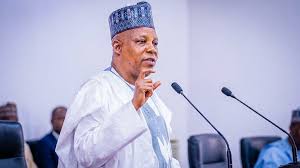
ENUGU: Vice-President Kashim Shettima on Wednesday inaugurated a 25-year development blueprint for the South-East, declaring the region a central pillar of Nigeria’s economic future and unveiling new investment mechanisms to drive long-term growth.
The blueprint, christened South-East Vision 2050, was launched at a stakeholders’ forum convened by the South-East Development Commission (SEDC) in Enugu, with the participation of federal and state governments, traditional institutions, the private sector, civil society and development partners.
Shettima announced that President Bola Tinubu had approved the establishment of the South East Investment Company Limited, a special-purpose vehicle designed to mobilise capital from the diaspora, capital markets and development finance institutions to fund infrastructure and human capital development across the region.
According to the vice-president, the initiative signals a deliberate shift from short-term governance cycles to a structured, multi-decade development framework anchored on planning, coordination and delivery.
“This is not an afterthought or a concession. The South-East matters to this administration as a core pillar of Nigeria’s economic future,” Shettima said, describing the forum as a decisive break from reactive governance.
He said the new investment company would work in synergy with the SEDC to close infrastructure gaps and strengthen the region’s long-term competitiveness, stressing that the commission was created as a delivery institution rather than another bureaucratic layer.
“This is about tangible outcomes — jobs, productivity and growth. Nigeria is strongest when its regions thrive,” he added.
Shettima noted that the South-East’s entrepreneurial culture, vast global diaspora and historical experiences made deliberate regional planning both urgent and necessary.
He praised the inclusive nature of the forum and acknowledged the participation of Umu Igbo Unite, a United States-based network of over 10,000 young professionals, noting that the region’s future would be built both at home and abroad.
Addressing young people, the vice-president said they were central to the national journey, not spectators, and urged them to channel their energy, creativity and ambition into the country’s renewal.
Earlier, Enugu State Governor Peter Mbah endorsed the Vision 2050 framework, describing it as an opportunity for the South-East to align with the national development agenda and awaken what he called an “economic giant.”
He proposed the creation of a South-East common market and urged a paradigm shift in regional planning, stressing the need for unity of ideas, pooled resources and a new mindset about development.
Mbah also called for improved security across the region to complement ongoing federal efforts.
Ebonyi State Governor Francis Nwifuru pledged his state’s support for the implementation of the blueprint, saying it would help close unemployment and poverty gaps while unlocking sectoral potentials.
He said Ebonyi was consolidating gains in agriculture, agribusiness, education and solid minerals.
Other governors at the forum echoed calls for deeper regional integration.
Anambra State Governor Chukwuma Soludo emphasised the need to prioritise regional security, interstate highways, gas pipelines and seaports, urging the Federal Government to ensure full funding for the SEDC.
Abia State Governor Alex Otti stressed the importance of investing in energy to power the private sector and small and medium-scale enterprises, while Mbah also called for coordinated planning of logistics corridors, roads, rail, inland waterways and multimodal transport systems as shared regional assets.
Imo State was represented by the Speaker of the State House of Assembly, with the Minister of Regional Development, National and State Assembly members, traditional rulers and organised private sector leaders in attendance.
Shettima said the Vision 2050 agenda was an invitation to think beyond immediacy and design the kind of South-East that would be competitive, connected and prosperous over the next 25 years.