… NLC demands FG’s intervention
LAGOS/BENIN: Motorists and commuters across Lagos and Benin City are groaning following rising transportation costs occasioned by another increase in the pump price of petrol, which now sells for between N1,250 and N1,350 per litre at filling stations.
A survey by our newsmen on Sunday showed growing concern among road users as the increase, driven largely by global supply pressures and domestic price adjustments, continues to influence transportation expenses.
The latest increase follows another upward review of petrol prices by the Dangote Petroleum Refinery, which raised the gantry price of Premium Motor Spirit (PMS), commonly known as petrol, to N1,175 per litre from N995 early last week.
The adjustment represents an increase of N180, about 18.1 percent within three days, marking the refinery’s third price review within the week and prompting swift adjustments across the downstream market.
Industry sources attribute the rise partly to heightened geopolitical tensions in the Middle East, particularly the escalating standoff between Israel and Iran, as well as attacks linked to Yemen’s Houthi movement on the Red Sea corridor.
The instability has forced many oil tankers to reroute from traditional shipping lanes, pushing global freight costs up by roughly 40 percent, according to market data from the Baltic Exchange.
At the same time, international oil prices have risen, with Brent crude approaching 99 dollars per barrel, while the Nigerian currency trades at about N1,650 to the dollar, factors analysts say are contributing to higher domestic fuel prices.
However, with the emergence of the Dangote refinery, Nigeria continues to rely significantly on imported refined petroleum products.
A spokesperson for the refinery said the price adjustment reflects rising feedstock and logistics costs associated with developments in the global energy market.
Checks revealed that retail prices have increased across several outlets in Benin City and Lagos, with petrol selling between N1,200 and N1,350 per litre depending on location.
Major marketers in Lagos have also adjusted their pump prices.
MRS Oil Nigeria Plc and Matrix Energy Group sell petrol at about N1,250 per litre, while outlets of Ardova Plc (formerly AP) retail the product at around N1,300 per litre.
Some independent stations charge slightly higher prices.
A NorthWest outlet in the Gbagada area dispensed petrol at about N1,250 per litre, while several other stations across the metropolis sold the product close to the N1,200 mark.
At a Mobil Station along the LASU–Isheri Road corridor, petrol was sold at N1,250 per litre, while Petrocam Station nearby dispensed fuel at the same price.
Similarly, MRS stations in parts of Alimosho sold petrol at about N1,250 per litre, while Mobil outlets in Alaguntan and Iyana Ipaja recorded prices of N1,250 and N1,350 per litre respectively.
Other stations, including Heyden outlets in Iyana Ipaja and along the Oshodi–Abeokuta Expressway, also sold petrol at about N1,250 per litre, reflecting a broad market trend.
At Ugbowo, Sapele Road and Upper Sakponba Road axis in Benin City, petrol sells for between N1,250 and N1,300 per litre, even though all the petrol stations visited were selling the product.
As at 6.20pm, NNPC Mega Station on Sapele Road was selling petrol at N1,265 per litre; MRS, N1,247; Rain Oil and Raptor petrol stations, N1,250, while diesel at Raptor petrol station sells for N1,650 per litre.
Meanwhile, market insiders have said pricing differences were increasingly influenced by variations in product sourcing, particularly between coastal marine lifting arrangements and gantry loading operations.
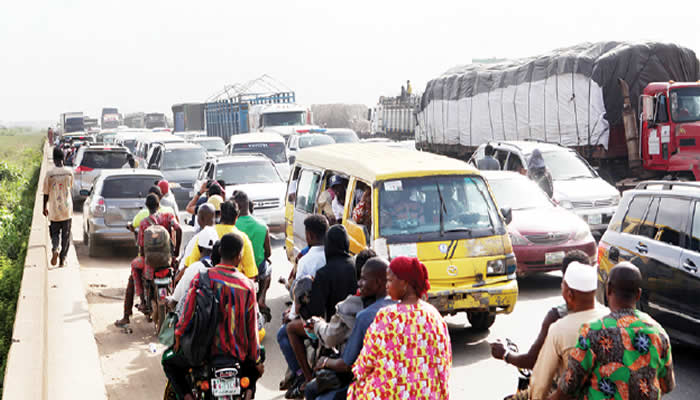
The increase in fuel prices has already led to higher transportation fares across Lagos and Benin City for inter and intra city movement with commuters reporting increases of more than 30 percent on several routes.
In Lagos, a commercial driver, Mr Sodiq Olarenwaju, said the rising cost of petrol had made daily operations more demanding.
“We are the ones passengers blame for increasing fares, but they don’t realise how much we now spend on petrol.
“If we buy fuel at over N1,000 per litre, we have no option but to adjust fares,” he said.
Another motorist, Mrs Funke Oladipo, described the experience of searching for fuel as stressful.
“I have been driving around since morning with my Jerry can looking for petrol. Some stations that opened earlier have already shut their gates,” she said.
A private car owner, Dr Adewale Suleiman, said fuel price increases often had wider economic implications.
“When fuel goes up, transport fares rise and the prices of goods follow immediately,” he said.
The Chief Executive Officer of the Centre for the Promotion of Private Enterprise (CPPE), Dr Muda Yusuf, said geopolitical tensions in the Middle East often lead to volatility in global oil markets.
According to him, disruptions in the Strait of Hormuz, through which roughly 20 percent of global crude oil shipments pass daily, can quickly push up oil prices, shipping costs and insurance premiums worldwide.
He noted that higher fuel prices could affect multiple sectors of the economy, particularly industries that rely heavily on energy and transportation.
“For manufacturers, the consequences can be significant, as many factories rely on diesel-powered generators due to electricity supply challenges,” Yusuf said.
The CPPE boss explained that rising fuel prices might increase costs of logistics; transporting raw materials and finished goods, potentially adding to inflationary pressures.
“As manufacturers absorb higher energy and logistics costs, firms may adjust pricing structures or production levels,” Yusuf said.
He also noted that Nigeria might not fully benefit from higher oil prices because crude production remains below capacity, fluctuating between about 1.4 million and 1.6 million barrels per day.
The organisation recommended measures such as strengthening crude production, building fiscal buffers from higher oil revenues and expanding domestic refining capacity.
It also emphasised the importance of sustained foreign exchange reforms, targeted support for vulnerable households and continued economic diversification.
“The evolving situation in the global energy market presents both opportunities and challenges for Nigeria,” Yusuf said.
In Abuja, the Nigeria Labour Congress (NLC) has called for government intervention to address the surge in petrol prices between N1,170 and N1,300 per litre across the country.
The demand was contained in a statement signed by Mr Joe Ajaero, President of the NLC
Ajaero said the rising cost of petrol had worsened the hardship faced by Nigerian workers, particularly in transportation, food prices and general cost of living.
“The sudden increase in petrol prices between N1,170 and N1,300 per litre has further deepened the economic hardship faced by Nigerian workers and the general populace.
“The rising cost of fuel has made transportation increasingly unaffordable for workers, while food prices and other essential commodities continue to surge beyond the reach of ordinary Nigerians.
“The government must urgently introduce measures, including wage support and cost-of-living relief, to cushion the devastating impact of the current fuel price crisis on workers and vulnerable citizens,” he said.
The NLC boss urged the Federal Government to introduce immediate relief measures, including wage support and policies to cushion the impact of the price increase on workers and vulnerable citizens.
Ajaero said the current situation had exposed the vulnerability of Nigeria’s downstream petroleum sector to global market volatility.
He stressed the need for the government to ensure that public refineries in the country become fully operational to reduce dependence on imported petroleum products.
According to him, reviving the nation’s refineries will help stabilise domestic supply and shield Nigerians from sudden price shocks.
The NLC president also called for tax relief for low-income earners and expanded social support programmes for vulnerable Nigerians.
He said such measures would help cushion the harsh economic realities confronting workers and their families.
Ajaero further urged the government to ensure transparency in the management of expected oil revenue gains arising from current global developments.
He noted that any windfall from rising crude oil prices should be channelled toward improving the welfare of Nigerians.
He also called for sincere dialogue between government and organised labour to address the growing economic challenges facing workers