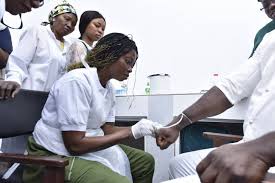
BENIN CITY: No fewer than 120 indigenes of Edo State are set to benefit from free breast, cervical and prostate cancer screenings, alongside general medical checks, at the Centre for Disease Control, Department of Public Health and Community Medicine, University of Benin Teaching Hospital, Benin City.
The one-month screening exercise, which commenced on Friday, February 27, 2026, is being organised in collaboration with UBTH and sponsored by the National Association of Seadogs (NAS) chapters, including Arabella, Batavia Subsea, Hispaniola X and Terra Kona.
Speaking to journalists, a member of the Project Execution Committee, Comrade Mowang Eddie George, said the initiative was informed by the high prevalence, morbidity and mortality rates associated with cancer and other common diseases in the country.
He noted that the collaboration between NAS and UBTH was aimed at providing free, accessible and professional screening services to members of the public.
According to him, many cancer-related deaths could be prevented if cases were detected early and treated promptly.
He stressed that a significant number of Nigerians lack adequate awareness about cancer and other prevalent ailments, making the screening programme not only a medical intervention but also an avenue for public education.
“As an advocacy group, NAS will continue to lead the fight against cancer and other diseases responsible for avoidable deaths through deliberate and systematic efforts, including collaborations, sponsorships and partnerships,” he said.
George described the initiative as part of efforts to give back to underserved communities across the state and called on well-meaning individuals and corporate organisations to support the campaign against cancer and other preventable or manageable diseases.
He also urged residents to take advantage of the free screening and referral services to UBTH, particularly for cases that may be detected at early, non-critical stages.
Representing the Chief Medical Director of UBTH, Prof. Idia Ize-Iyamu, Dr. Adebola Ozi commended NAS for underwriting the cost of the screenings.
She expressed the management’s appreciation of the gesture and appealed to other organisations to emulate the group in supporting the fight against cancer and other prevalent diseases.
The Assistant Coordinator of the Centre for Disease Control, Department of Public Health and Community Medicine, UBTH, Dr (Mrs) Oby Okwara, explained that the exercise goes beyond breast, cervical and prostate cancer screenings.
She disclosed that tests for Hepatitis B and C, HIV, hypertension, cholesterol levels, blood sugar, glaucoma, as well as optical and dental conditions, are also being conducted.
Okwara emphasised that the importance of early detection of cancer cannot be overstated and applauded NAS for its sustained humanitarian contributions to public health.
Beneficiaries of the programme expressed gratitude for the intervention. Mrs Ijeamaka Helen recounted her earlier difficulty in accessing screening services before learning about the NAS initiative.
“When I came previously, I was asked to return the following month for one of the tests. Luckily, I saw the NAS banner and participated. May God bless them richly,” she said.
Another participant, Mrs Regina George, also lauded the sponsors, praying for greater blessings upon the association for easing the financial burden on residents seeking essential health checks.