Elders and senior citizens say the wave of infrastructure development sweeping across Edo State recalls the enduring legacy of Samuel Ogbemudia in the defunct Bendel State.
Many of Ogbemudia’s projects still dot Edo and Delta states, which were carved out of the old state in 1991.
Against this backdrop, the development blueprint of Governor Monday Okpebholo — the SHINE Agenda — appears particularly fitting.
The governor says his goal is to recreate the spirit of purposeful governance of the past, but in a modern form that brings renewed hope and progress to the people of Edo State.
Indeed, Okpebholo wasted little time after assuming office. His early moves signalled a government driven by vision, mission and clear direction.
Little wonder residents and stakeholders have praised his one year and three months in office, describing him as “Mr Projects”.
Across the state’s 18 local government areas, infrastructure projects are currently underway. Okpebholo has been deliberate in pursuing road construction and rehabilitation as a key driver of development.
As of early 2026, verifiable data show that 28 new road projects covering about 255 kilometres have been awarded, targeting improved connectivity in both urban and rural communities.
Among the most prominent are the ongoing flyover projects at Ramat Park and along Sapele Road near Adesuwa Junction in Benin City.
Other major projects include the 36-kilometre road linking eight communities in Akoko-Edo and the rehabilitation of failed portions of the Benin–Auchi Road.
Construction and upgrade works are also progressing in Ogba-Evbuodia, Uholor, Irhue-Obagie and Amufi communities, where residents have praised the noticeable improvement in road conditions.
Additional projects include Upper Airport Road, Temboga Road, Uteh-Ekiuwa Road, Palace Road in Uteh, and drainage works along the Benin–Auchi Expressway.
Notably, several of these projects incorporate modern drainage systems aimed at tackling the persistent flooding that has plagued communities such as Uteh for years — an intervention that has drawn widespread commendation.
Determined to accelerate grassroots development, Governor Okpebholo recently procured 54 pieces of heavy equipment and distributed them across the state’s 18 local government councils.
The equipment — including graders, excavators, rollers and other heavy-duty machines — is expected to boost road construction, improve rural access, support drainage rehabilitation and strengthen community-driven infrastructure projects.
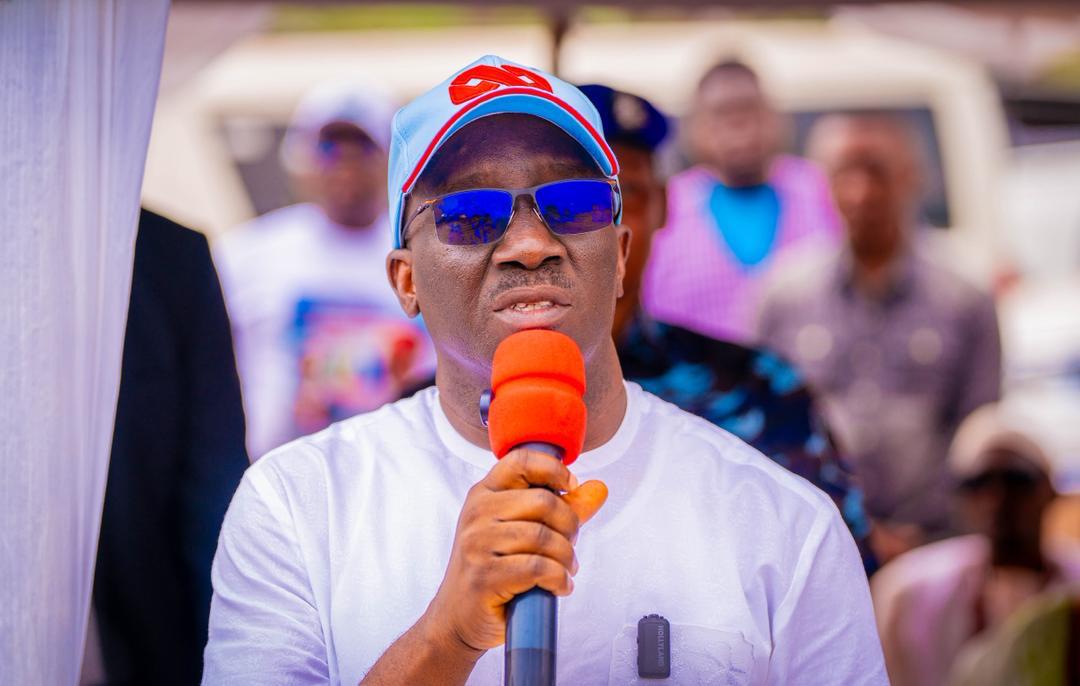
“This initiative is a strategic intervention designed to empower council leadership, stimulate economic activity in rural communities and deliver tangible dividends of democracy across Edo’s three senatorial districts,” Okpebholo said.
He spoke during the inauguration of the equipment, performed by the Minister of the Federal Capital Territory, Nyesom Wike.
Further underscoring his commitment to infrastructure development, the governor allocated N305 billion for road projects in the 2026 state budget.
His willingness to engage some of the country’s leading construction firms also signals a determination to deliver durable and high-quality infrastructure.
The Ewuare II recently acknowledged these efforts, commending the governor’s developmental strides on behalf of the Edo people.
While urging the administration to sustain people-centred projects, the monarch remarked: “We haven’t seen an overhead bridge like this in Edo before.
“It is during his tenure that we are seeing this kind. Some people deliberately criticise the governor.”
A popular Bini proverb says that when a man pounding yam sees his strength appreciated, he is encouraged to give even more.
The message from across Edo State is clear: people are responding not to rhetoric, but to visible results.
Roads are opening up communities, drainage projects are addressing long-standing flooding, and new infrastructure is gradually restoring confidence in governance.
If the current pace is sustained, Governor Okpebholo’s infrastructure drive may well mark a turning point in the state’s development trajectory — echoing the enduring legacy of purposeful leadership once associated with the old Bendel State.
For the governor, however, the task is far from complete. The real test will be consistency: maintaining the momentum, ensuring quality delivery and keeping faith with the people whose expectations have now been raised.
______________________
Okunzuwa Kevin, a journalist, writes from Lagos.