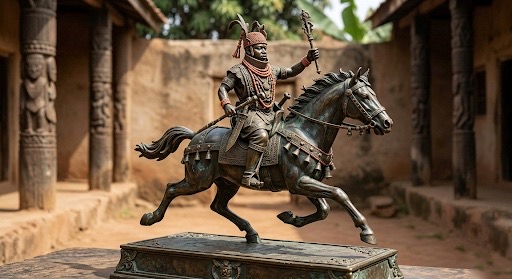
The artistic heritage of the Edo people, which is reflective of its presence around us, centered in the ancient Kingdom of Benin in present-day Nigeria, actually represents one of the most sophisticated and culturally significant traditions in human history. For centuries, the Edo have utilized sculpture, not merely as a form of aesthetic expression, but as a robust medium for historical documentation, spiritual mediation, and the consolidation of political authority. These and more are boldly seen in every book of history written about these unique people.
Through the masterful manipulation of bronze, brass, ivory, folklore, dances, songs and wood, Edo sculptors have been able to create a visual language that narrates the complexity of their world. To study Edo sculpture is to read the biography of a civilization that viewed the art as an indelible bridge between the mortal realm and the divine.
In the Edo worldview, the Oba (King) is the terrestrial representative of the gods, ancestors and the people. Consequently, the vast majority of Edo sculpture was commissioned by the royal court and at various historical periods. This “Court Art” was characterized by its permanence and its proximity to power. The Guild of Bronze Casters (Igun Eronmwon), operating under the direct patronage of the Oba, utilized the lost-wax casting technique, to create classic works of unparalleled precision.
The sculptural process itself was considered a sacred act and however still is till date. When an artisan cast a commemorative head of a deceased Oba, he is not just making a likeness; he is creating a vessel for the king’s spirit. These king’s heads, often cast in bronze, featured stylized but unique features: large, a symbol of vastness, almond-shaped eyes to denote spiritual alertness, and thick, beaded collars that symbolized the weight of royal responsibility. By placing these sculptures on ancestral altars, the Edo culture and its philosophy ensures that the wisdom and protection of past rulers remained accessible to the living.
Perhaps the most famous manifestation of Edo sculpture is the series of rectangular brass plaques that once adorned the pillars of the Oba’s palace in Benin City. You may remember these if you grew up in Benin during the reign of Oba Akenzuwa. The doors to every entrance of an Edo man had carved history of the lineage of that family. This was a carry-over of how pillars door frames, doors, windows and their frames carried history around the palace of the Oba of Benin. These art works were done in bronze and wood. The palace also had spots for sculpted statues as well. These plaques and artworks serve as a “library in motion”, depicting historical events, court ceremonies, and the hierarchy of the Edo state.
The use of hieratic scale—where the most important figure, usually the Oba, is depicted assignificantly larger than attendants or foreign traders—illustrates the Edo sociopolitical structure and belief systems. Through these sculptures, we see the first encounters with Portuguese explorers in the 15th century, meticulously detailed with their distinct clothing and weaponry. The plaques capture the evolution of Edo military might and the expansion of the
empire, proving that sculpture was the primary tool for Edo historiography long before writtenrecords were popularized in the region.
In Edo culture, the choice of material in sculpture is never accidental; it carries deep symbolicweight. Take for instance the Bronze and Brass; metals that do not rust or decay. The choice is deliberate as they symbolize the permanence and “everlastingness” of the kingship. The reddish hue of copper was also associated with the “fearsome” power of the Oba.
The Ivory from elephant tusks are not left out, as they were reserved almost exclusively for the Oba. Ivory represents purity, strength, and the cool-headedness required for leadership. It certainly takes an organized leader to be able to have an empire, engage in wars and still maintain peace, order and spirituality in the Edo Kingdom. The famous 16th-century ivory pendant mask of Queen Mother Idia is a testament to this. It depicts her with a crown of stylized mudfish symbolizing her ability to navigate both the human and spirit worlds and Portuguese heads, marking her diplomatic and mystical prowess.
The Wood, used primarily by commoners or for less formal ceremonial objects, were alsosymbolic in the entirety of the Benin Kingdom. Wood carvings depicted the daily life and folk beliefs of the Edo people, grounding the high art of the court in the lived reality of the populace.
Edo sculpture is rich with zoomorphic symbolism. The leopard is a recurring motif, representing the “King of the Forest” and serving as a direct parallel to the Oba, “the King of the Home.”
Sculptures of leopards were often used as water vessels during purification rituals, emphasizing the king’s power over life and death.
Similarly, the mudfish appears frequently in Edo carvings. Because the mudfish can live on landand in water, it symbolizes the Oba’s dual nature as a human and a deity. These symbolsintegrated into sculpture, often allowing even the illiterate observer to understand the complex theological and political ideologies of the state. The art as a form, was a mechanism of
education, reminding the citizens of their history and their place within the cosmic order.
The narrative of Edo sculpture cannot be told without addressing the British Punitive Expedition of 1897. Thousands of bronze and ivory artifacts were looted from Benin City and dispersed across the globe. While this act was a cultural heist and catastrophe for the Edo people, it inadvertently introduced the world to the genius of African art, especially the Edo People of the Benin Empire.
The arrival of these sculptures in Europe challenged the prevailing “primitive” stereotypes of African culture. Western artists like Picasso and Matisse were forced to reckon with a tradition that had mastered complex metallurgical techniques and abstract symbolism centuries before the European Renaissance. Today, the struggle for the restitution of these “Benin Bronzes” remains a central theme in Edo cultural identity, as the sculptures are viewed not as museum pieces, but as the “stolen ancestors” of the Edo people.
Sculpture in Edo culture is not a dead tradition confined to history books. Modern Edo sculptors in Benin City still practice the lost-wax technique, passed down through generations within the same guilds. While contemporary works may incorporate modern themes, they maintain the classical proportions and symbolic integrity of their ancestors. You cannot grow up from childhood under a father who belongs to any of the art guilds and not be a master in it.
Today, sculpture is used to commemorate modern heroes, celebrate festivals like the Igue Festival, and decorate public spaces in Benin City. It remains the most visible badge of Edo identity, a way for the people to assert their presence in a globalized world while remaining rooted in a glorious past. To use sculpture to depict Edo culture is to engage with a medium that is both a mirror and a shield. It mirrors the sophisticated social hierarchy and deep spiritual convictions of the people, as well as shields their history from the erosion of time. From the haunting beauty of the Queen Mother’s ivory mask to the imposing strength of the bronze warrior plaques, Edo sculpture stands as a monumental achievement. It is a testament to the fact that for the Edo, art was never for “art’s sake”, it was for the sake of the soul, the state, and the survival of a legacy.