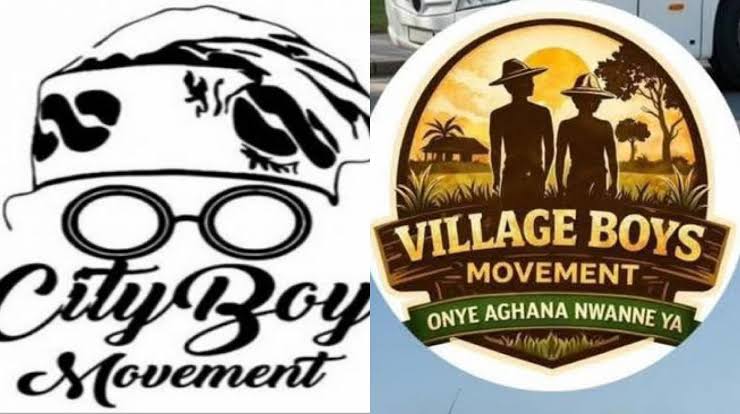
What began as a loosely defined social media expression has gradually evolved into a cultural marker of identity among young Nigerians. The “City Boys vs Village Boys” movement, though often presented in humorous tones across digital platforms, reflects a deeper divide; one that speaks to class perception, exposure, lifestyle, and, ultimately, belonging. Beneath the banter lies a conversation that deserves closer examination, particularly in a country where youth identity is constantly shaped by both economic realities and political narratives.
The emergence of the movement can be traced to Nigeria’s evolving social media culture, where identity is shaped and amplified through humour, trends, and viral language. What started as casual expressions in online banter gained traction among young users on platforms like X and TikTok. The phrase “City Boys” had earlier associations with confidence, urban sophistication, and influence, and over time became a label young men adopted, sometimes ironically, sometimes aspirationally. In contrast, “Village Boys” emerged as a counter-label, often used to describe those perceived as less exposed or less aligned with urban culture. As both terms gained popularity, they moved beyond humour into a more defined social commentary, reflecting underlying attitudes about class, exposure, and identity in contemporary Nigeria. At its core, the distinction appears simple. “City Boys” are often portrayed as urbane, polished, socially aware, and attuned to modern trends. They are seen as individuals who understand the language of soft life, networking, and strategic positioning. On the other hand, “Village Boys” are framed, often unfairly as less refined, more traditional, and lacking exposure. However, this binary, while catchy, is deeply reductive. It compresses the Nigerian experience into two opposing extremes, ignoring the fluidity between them and the reality that many young people exist somewhere along a broad spectrum of identities.
What makes the movement particularly significant is how quickly it has been adopted and internalised by the youth. It has moved beyond jokes and hashtags into a subtle framework through which young people assess themselves and others. In social interactions, professional environments, and even romantic relationships, these labels now carry weight. They influence perception, who is seen as desirable, who is considered informed, and who is deemed worthy of opportunity. In many ways, it has quietly become a social filter.
This is where the implications become more serious. In a society already grappling with inequality, unemployment, and limited access to opportunity, reinforcing such labels can deepen existing divides. The “City Boy” becomes aspirational, while the “Village Boy” risks being reduced to a stereotype to outgrow or escape. This creates pressure, particularly among young people to perform a version of sophistication that may not align with their reality. It also risks eroding the value of authenticity, replacing it with curated identities shaped by trends, rather than lived experience.
A closer look reveals that the movement is also tied to the growing influence of digital culture in Nigeria. Social media has become a powerful tool for shaping perception, often rewarding visibility over substance. In this environment, the “City Boy” identity thrives because it aligns with easily consumable aesthetics — fashion, confidence, urban lifestyle, and social awareness. The “Village Boy,” by contrast, is often positioned outside this visual economy, making it easier for stereotypes to persist and spread without challenge.
However, reality on the ground tells a more nuanced story. Many individuals who may be labelled as “village boys” are, in fact, highly adaptive, resourceful, and deeply connected to their environment. They navigate challenges with a level of resilience often overlooked in surface-level conversations. Conversely, the “City Boy” identity, while aspirational, does not automatically translate into competence or depth. This contrast exposes the danger of reducing identity to appearance alone.
Beyond the social dimension, there is a political undertone that cannot be ignored. Nigerian political culture has long relied on identity, perception, and influence. Movements like this, even when they originate informally can be absorbed into broader narratives about power, class, and access. The language of “City Boys,” for instance, can subtly align with ideas of elitism and influence, while “Village Boys” may be framed within populist or grassroots identities. What appears to be a harmless social trend can, over time, evolve into a framework for political messaging.
This becomes particularly relevant when considering the role of young people in Nigeria’s democratic process. The youth constitute a significant portion of the electorate, yet their political engagement is often shaped by simplified narratives. When identity-based labels like “City Boys” and “Village Boys” gain traction, they risk influencing how young people perceive leadership, competence, and representation. It raises concerns about whether political choices are being guided by substance or by perception.
Furthermore, the movement highlights an ongoing tension between aspiration and origin. For many young Nigerians, there is a desire to evolve beyond their immediate environment, gain exposure, and access better opportunities. This is natural in a developing society. However, when aspiration is framed in a way that devalues one’s background, it creates a disconnect, suggesting that growth must come at the expense of identity, rather than alongside it.
There is also a cultural dimension to consider. Nigeria is rich in tradition, diversity, and community values. The term “village” carries meanings beyond geography; it represents heritage, connection, and shared history. Reducing it to a symbol of inferiority risks eroding an important aspect of cultural identity. At the same time, the “City” as a space of sophistication and advancement is not without its own complexities, as urban life brings its own challenges and contradictions.
For the next generation, the signals are layered. On one hand, there is encouragement to be informed, evolve, and engage with the wider world. On the other, there is implicit pressure to conform to a narrow image of success; one shaped by visibility, aesthetics, and perception. This duality can shape self-worth in ways that are both motivating and limiting.
It is also worth considering how language reinforces these ideas. The repeated use of “City Boys” and “Village Boys” in everyday conversation, even in jest normalises the distinction. Over time, what begins as humour can solidify into belief. This is how social constructs take root: not through formal definitions, but through repetition and shared understanding.
Ultimately, the movement is not just about labels. It reflects how a generation is negotiating identity in a rapidly changing society. It captures the influence of social media, the realities of economic disparity, and the enduring importance of perception in Nigerian life. It also raises important questions about what it means to belong, to succeed, and to be seen.
If there is a key takeaway, it is the need for a more balanced narrative; one that acknowledges growth and exposure without dismissing origin, encourages development without enforcing conformity, and allows young Nigerians to define themselves on their own terms.
In the end, the conversation should not be about choosing between “City” and “Village,” but about recognising that identity is far more complex than such distinctions allow. The strength of a generation lies, not in how neatly it fits into a label, but in how confidently it can exist beyond one.