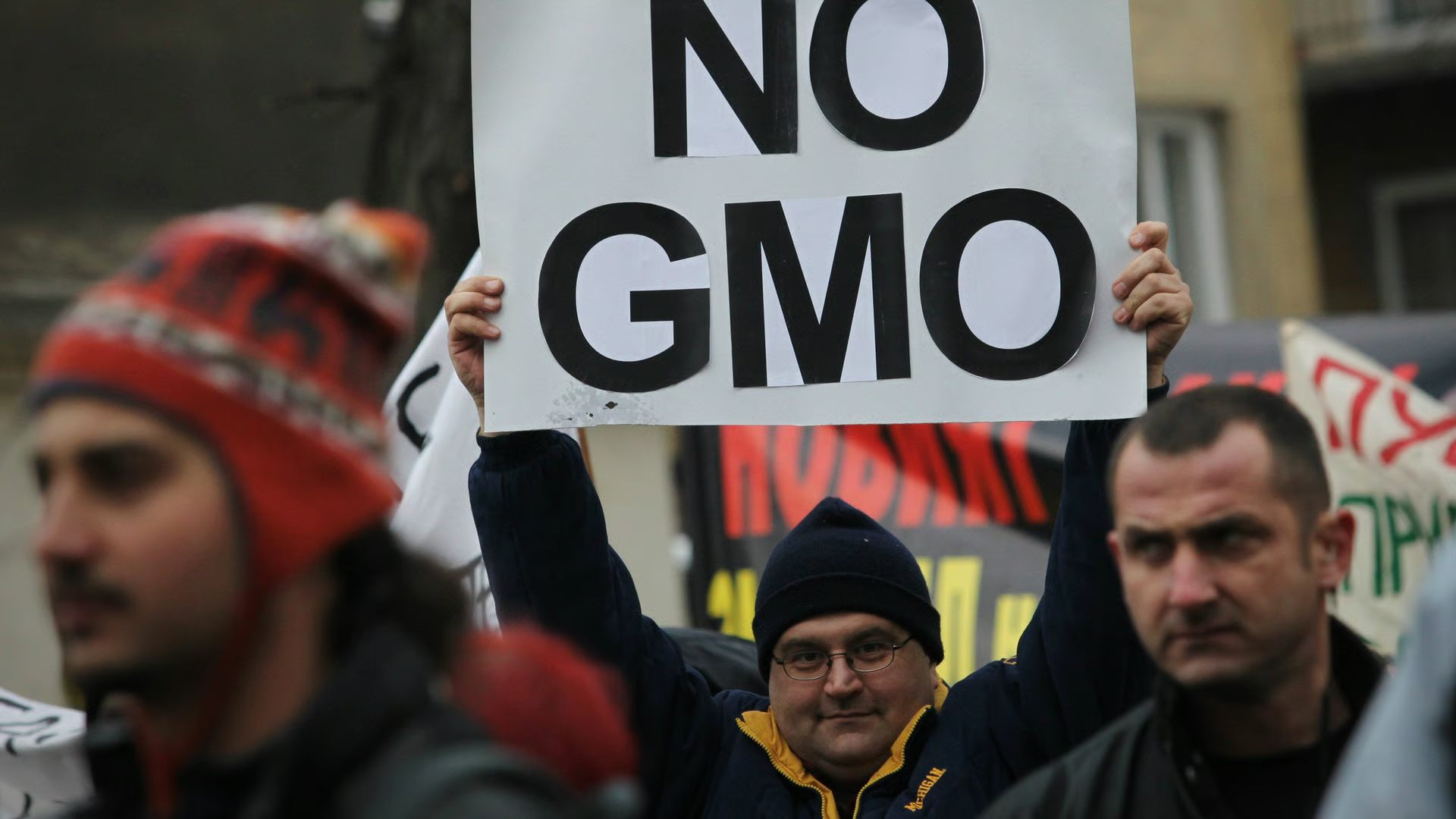
Nigerian dinner tables are at a fascinating crossroads, caught between the promise of agricultural innovation—including Genetically Modified Organisms (GMOs)—and a growing demand for consumer transparency.
In recent years, the conversation around GMOs has intensified, culminating in a significant push for mandatory GMO labelling.
This movement, driven by key government agencies and spurred by public discourse, aims to demystify the origins of what Nigerians eat and empower citizens to make informed choices.
Nigeria is moving to introduce mandatory labelling for genetically modified organisms (GMOs), a policy shift that places the country within a global debate on transparency, consumer rights, and biotechnology regulation.
The journey toward clearer plates is being meticulously charted by bodies like the National Biosafety Management Agency (NBMA) and the National Agency for Food and Drug Administration and Control (NAFDAC).
Public and private sector stakeholders demonstrate a firm commitment to enacting and enforcing robust labelling regulations for products containing genetically modified ingredients.
At a sensitisation workshop in Abuja, Director of Food and Drug Services at the Federal Ministry of Health and Social Welfare, Mr John Atanda, announced that the government would enforce mandatory labelling and traceability of GM crops.
He said that the ministry would work closely with the National Agency for Food and Drug Administration and Control (NAFDAC) and the National Biosafety Management Agency (NBMA) to ensure compliance.
“Labelling is not just about consumer choice, it is about building trust in science and ensuring accountability in our food systems,” Atanda said.
In addition, the National Agency for Food and Drug Administration (NAFDAC) has reassured Nigerians that GM foods are safe once they undergo rigorous scientific evaluation.
Its Director-General, Prof. Mojisola Adeyeye, stressed that safety and transparency must go hand in hand.
“GMOs are not bad for us, depending on what type of foods they are and whether the safety considerations have been taken. But they must be clearly labelled,” she said.
The National Biosafety Management Agency (NBMA), established under the National Biosafety Management Act, also restated its commitment to safe and transparent GMO practices, aligning Nigeria’s framework with international biosafety standards such as the Cartagena Protocol on Biosafety.
Nigeria’s move mirrors practices in advanced countries, though with notable differences.
Jerome Obiebi, a biotechnician, said it was not merely bureaucratic red tape.
“It is a strategic response to a complex interplay of scientific advancement, public apprehension, and the foundational right of consumers to know,” he said.
At its core, this regulatory push embodies the principle of informed consent in the marketplace.
Proponents argue that unambiguous labelling is the bedrock upon which consumers can build trust and exercise genuine choice.
According to Obiebi, whether a family prefers the familiar comfort of traditionally farmed produce, the ethical assurances of organic, or the innovative efficiencies of biotechnology, clear labels serve as their guide.
This transparency is particularly crucial in a nation where past experiences, coupled with the global debate surrounding GMOs, have fueled considerable skepticism.
Abraham Isa, a prominent research scientist and the national public relations officer for the Open Forum on Agricultural Biotechnology in Africa (OFAB), provides insights.
“Consumers should have access to comprehensive information about the products they choose, whether they are genetically modified or organic,” he said.
This sentiment underscores a universal yearning for clarity in an increasingly complex food system.
In the EU, all GM foods are labelled, with a threshold of 0.9 per cent GMO content. Australia and New Zealand enforce similar rules, with a one per cent threshold.
The U.S, after years of debate, introduced the National Bioengineered Food Disclosure Standard in 2022, allowing companies to disclose GMO content through QR codes or digital links rather than text labels.
In contrast, Canada maintains a voluntary labelling system, while countries like China and Brazil enforce strict mandatory labelling and traceability.
Experts say Nigeria’s framework is still evolving, with enforcement gaps remaining a concern.
Prof. Celestine Aguoru, former President of the Nigerian Biosafety and Biotechnology Consortium, argued that GMOs were safe and necessary for food security.
“GMOs are safe for consumption; they are genetically modified to boost food security and enhance farmers’ profits.
“But continuous research and development should be encouraged,” he said.
From the regulatory side, NBMA officials stress that Nigeria’s framework is designed to balance innovation with safety.
Dr Agnes Asagbra, former Director-General of the NBMA, remained firm that Nigeria’s safety checks were world-class.
She noted during a stakeholder forum that no GMO entered or was used in Nigeria without passing through the agency’s strict, science-based approval process.
Asagbra underscored that labelling was already mandatory by law to safeguard Nigerians’ freedom of choice, and that the agency was strengthening its post-release monitoring to ensure compliance.
It is worth noting that industry stakeholders see opportunity in the new rules.
A recent agribusiness report highlighted TELLA Maize, a GM crop with a 50 per cent yield increase, as evidence of biotechnology’s potential.
However, the report cautioned that enforcement gaps in labelling compliance could undermine consumer confidence.
In spite of regulatory assurances, skepticism persists among consumers.
Civil society groups argue that weak oversight and inadequate labelling in informal markets expose Nigerians to risks.
Public misconceptions and mistrust continue to fuel controversy, echoing debates in advanced economies where consumer rights and corporate interests often clash.
Experts hold that Nigeria’s decision to mandate GMO labelling is a significant step toward aligning with global best practices. Yet, experts warn that success will depend on enforcement, public education, and transparency.
As Adeyeye puts it, “clear labelling is not negotiable. Nigerians must know what they are eating.”
With this policy shift, Nigeria joins a global conversation on biotechnology, consumer rights, and food security.
Dr Joel Itauma, an agribusiness expert, said that the implications of robust labeling extended beyond individual consumer choices.
“It could catalyse investment in supply chain traceability technologies, encourage local producers to differentiate their products, and potentially foster a more dynamic and competitive food market,’’ he said.
According to Itauma, for agribusiness, understanding and complying with the regulations will become a critical component of market access and consumer acceptance.
The challenge now lies in bridging the gap between regulation and practice, ensuring that Nigerians can make informed choices in a rapidly changing food landscape.
Itauma argues that real logistical hurdles in effectively enforcing labelling requirements across Nigeria’s diverse and often informal markets exist.
He said a typical example was that products were bound to change hands multiple times before reaching the final consumer.
Itauma said that that studies had highlighted existing gaps in compliance, indicating that many foods containing GM ingredients might currently be slipping through the cracks without proper identification.
Even with the power to make informed choices, concerned stakeholders say the question remains whether shelf labelling will end the GMO controversy in Nigeria.
(NANFeatures)