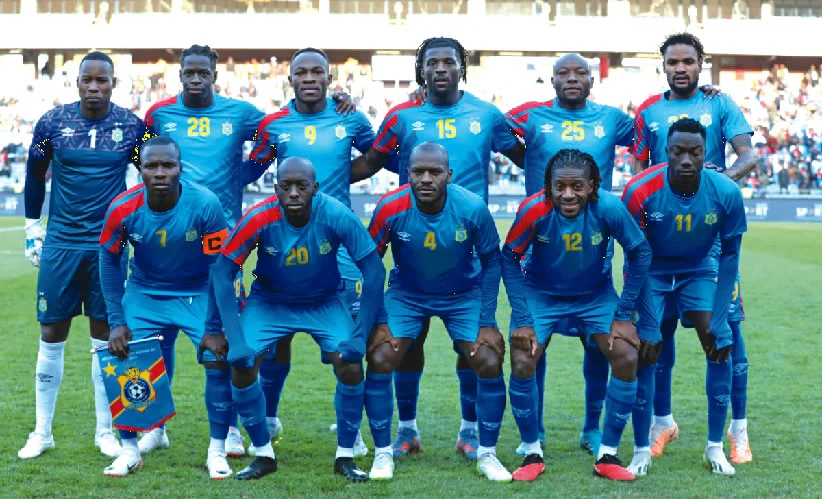
The Democratic Republic of Congo has named several players at the centre of Nigeria’s eligibility protest in its squad for the decisive inter-continental play-off for the 2026 FIFA World Cup, underlining the lingering controversy surrounding the Leopards’ qualification campaign.
DR Congo will face the winner of the play-off between Jamaica and New Caledonia in Guadalajara, Mexico, on March 31, 2026, in a match that could send the Central African nation back to the World Cup for the first time in 52 years.
But the squad announced by coach Sébastien Desabre has drawn attention because many of the players whose eligibility Nigeria questioned after last November’s African play-off defeat have again been included.
Players at the centre of Nigeria’s protest
Nigeria’s protest to FIFA following the African play-off in Morocco focused most strongly on three players whose nationality switches were approved only days before the decisive match: Michel-Ange Balikwisha, Mario Stroeykens and Matheu Epolo
Balikwisha and Stroeykens, both Belgian-born and former Belgium youth internationals, were granted FIFA approval to switch allegiance to DR Congo in the days leading up to the November 16 play-off against Nigeria.
Epolo, a Belgian-born goalkeeper who also represented Belgium at the youth level, had his nationality switch approved within the same period.
Nigeria argued that the Congolese federation had called up the players before FIFA had formally approved their change of association, raising questions about whether proper procedures had been followed.
Of the three players at the centre of the protest, Epolo has been included in the squad for the Guadalajara play-off, while Balikwisha and Stroeykens have not been listed among the selected players.
Several other contested players retained
Beyond the three players highlighted in Nigeria’s complaint, several other footballers whose eligibility was questioned by the Nigeria Football Federation (NFF) have also been retained in the squad.
These include: Lionel Mpasi, Aaron Wan-Bissaka, Axel Tuanzebe, Arthur Masuaku, Samuel Moutoussamy, Noah Sadiki, Ngal’ayel Mukau, Nathanaël Mbuku, and Cédric Bakambu
Most of those players were involved in the controversial African play-off match against Nigeria last November, with Mpasi, Wan-Bissaka, Tuanzebe and Masuaku forming part of the starting defence.
Midfielders Sadiki, Moutoussamy and Mukau also started the match, while Mbuku and Bakambu featured in the attacking line.
Substitute appearances were made by Edo Kayembe, Michel-Ange Balikwisha and Fiston Mayele, with Balikwisha scoring one of the penalties in the shoot-out that ultimately eliminated Nigeria.
Legal basis of Nigeria’s complaint
Nigeria’s petition to FIFA was based on two principal arguments.
The first concerned the timing of FIFA approval for nationality switches.
According to the NFF, the Congolese federation called up several dual-nationality players around November 1, 2025, but FIFA only approved their change of association between November 11 and 12, just days before the match on November 16.
Nigeria argued that this raised questions about how the players could have been selected before their eligibility was officially confirmed.
The second argument related to DR Congo’s constitutional position on dual nationality.
The NFF contended that because the Congolese constitution does not formally recognise dual citizenship, players who still held European passports might not have been eligible to represent the country unless they had renounced their other nationalities.
Historic opportunity in Guadalajara
Despite the controversy, DR Congo now stands within touching distance of its first World Cup appearance since 1974, when the country competed under the name Zaire.
Desabre’s squad blends experienced European-based players with emerging talent as the Leopards attempt to secure a historic return to the global stage.
In defence, Wan-Bissaka and Masuaku are expected to provide width, while Chancel Mbemba and Tuanzebe offer experience and physical presence at the heart of the backline.
Midfielders Sadiki and Moutoussamy will be tasked with controlling the tempo, supported by attacking outlets such as Grady Diangana and Edo Kayembe.
Up front, DR Congo will rely on the firepower of Bakambu, Fiston Mayele, Simon Banza and Yoane Wissa.
If the Leopards prevail in Guadalajara, they will become the tenth African nation to qualify for the 2026 World Cup, joining Morocco, Tunisia, Egypt, Algeria, Ghana, Cape Verde, South Africa, Côte d’Ivoire and Senegal.
Yet as they prepare for the decisive match, the presence of several players named in Nigeria’s protest ensures that the controversy surrounding last November’s play-off remains part of the broader narrative of DR Congo’s quest for a place at football’s biggest tournament