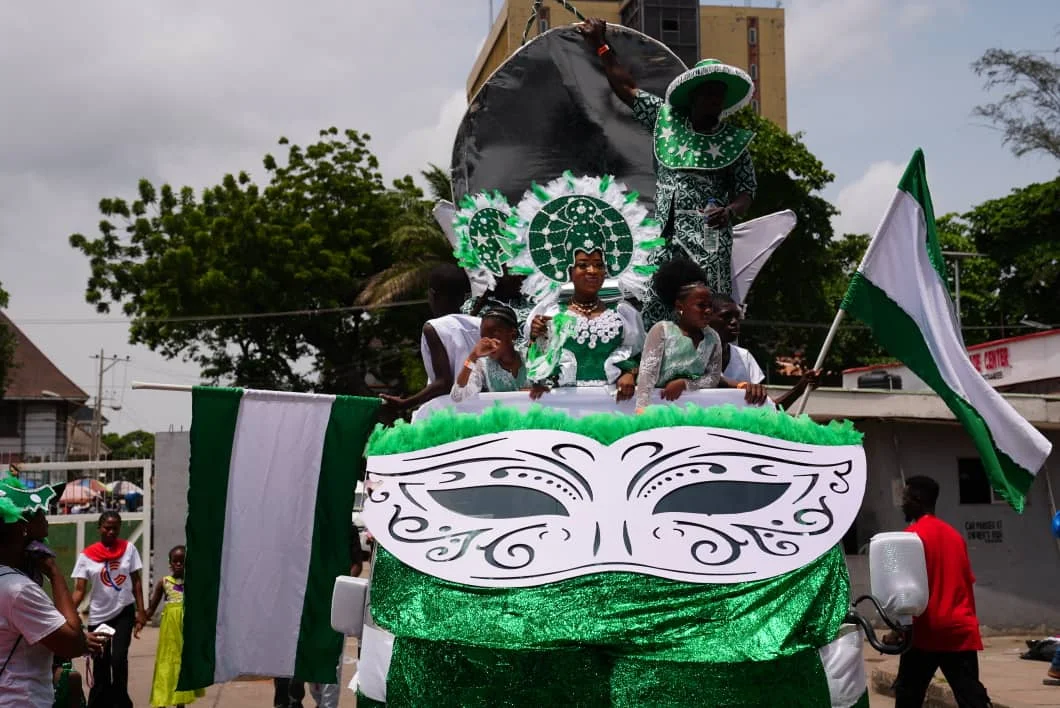
Lagos: The 2026 Lagos Fanti Carnival brought Lagos Island to life on Monday, with foreign visitors and locals coming out to experience the vibrant culture, colourful floats, and traditional performances that turned historic communities into a tourism hub.
The News Agency of Nigeria (NAN) reports that the carnival offered a rich blend of Afro-Brazilian heritage, community pride and artistic performances, reinforcing the growing reputation of Lagos as a cultural tourism destination.
The carnival procession kicked off at about 2.40 p.m. with the Okepopo Fanti Carnival Association, representing the home community of the Lagos State Governor, Mr Babajide Sanwo-Olu.
Okepopo Fanti Carnival Association led the parade with a drum-themed float and horses, setting the tone for a lively cultural display.
Other participating communities are: Okoo-Faji Carnival Association, Epetedo United Youth Forum, Isale Eko Woro Carnival Association, Lafiaji Fanti Association, Olowogbowo Fancy Carnival Association, and Brazilian Campos Carreta Carnival Association.
The different groups dazzled the crowd with floats and performances reflecting their livelihoods and heritage.
Okoo-Faji showcased a float featuring a canoe, shrines and cultural displays in red and blue costumes, while Epetedo wowed spectators with skaters waving flags and choreographed dance routines in blue and white attire.
Isale Eko highlighted fishermen’s heritage; Lafiaji paraded red and white cultural displays, and Olowogbowo kept the crowd dancing throughout their performance.
Campos drew loud cheers with colourful costumes and animal-themed displays, including dragons, ostriches, and peacocks, alongside decorated umbrellas that added to the festive atmosphere.
Marion Kibler, a tourist from France, described the experience as unforgettable.
Kibler said the carnival exposed her to a cultural atmosphere she had never witnessed before.
“This experience is amazing because in France, we don’t have any carnival like this.
“There is a Brazilian culture, the African culture. We don’t have this, so it’s very cool to dance, to see.
“The colours are beautiful and I love it,” she said.
Speaking on her visit to the country and the people she had interacted with, she said Nigerians are very welcoming and joyful.
Another visitor, Julie Vanoni, also from France, said her visit to Nigeria was primarily to introduce her son to his Nigerian roots, but the carnival turned out to be a memorable cultural experience.
“It’s a very cultural experience. It’s very nice.
“We can see different people from different communities in Nigeria,” she said.
Vanoni also said she ate jollof rice and it was fine.
A Lagos resident, Rosemary Simai, said the carnival was an eye-opening experience in spite of living in the state for years.
“For my first time seeing it, I think it’s so amazing.
“I’m seeing different colours, multiple colours of a lot of outfits.
“I wish to come next time to see more views,” she said.
Simai added that the carnival showcased Yoruba traditions and community identity, describing it as well done.
Dignitaries at the event included the wife of the Lagos state governor, the deputy governor, and the commissioner for tourism, underscoring the government’s commitment to promoting cultural tourism in Lagos.
Popular Nigerian artistes, including 9ice, Niniola, Terry Apala and Teni, also entertained the crowd.
Traders and vendors capitalised on the large turnout to sell food, drinks and souvenirs, further boosting the tourism value of the event.
NAN recalls that Mrs Toke Benson-Awoyinka, Lagos State Commissioner for Tourism, Arts and Culture, had earlier said at a media conference announcing the carnival, that cultural festivals such as the Fanti Carnival play a vital role in stimulating commerce, supporting Small and Medium Enterprises (SMEs) and empowering local traders across communities.
Benson-Awoyinka said tourism-driven cultural events go beyond revenue generation to strengthen grassroots economic activities and improve livelihoods within host communities.
“It is enhancing SMEs; it’s for the man selling boli by the roadside.
“It’s for the woman who is selling her soft drinks.
“It’s for the ice cream seller in the community, because a lot of children are there on the streets.
“So, it’s bringing a lot of commerce,” she said.