ABUJA – The Nigerian Senate on Wednesday passed the Electoral Act (Amendment) Bill, setting the framework for federal, state, and Area Council elections in the Federal Capital Territory (FCT).
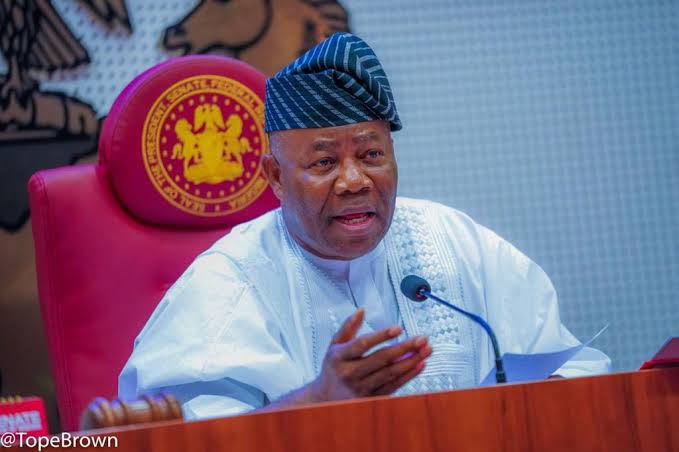
The passage followed a clause-by-clause consideration of the bill in the Committee of the Whole. Senate President Godswill Akpabio praised the committee for its diligence, particularly Committee Chairman Sen. Niyi Adegbonmire.
“I salute you for your dexterity, hard work, patriotism, and love for our country,” Akpabio said.
“There were no deliberate attempts to delay the amendment. Our aim has always been to ensure the law reflects the aspirations of all Nigerians.”
Clarifying reports circulating on social media, Akpabio confirmed that the Senate had retained Clause 60 on electronic transmission of results.
“Electronic transmission has always been part of our system. What we did was retain the existing provision used in 2020. This Senate has not rejected it,” he stated, emphasising that Nigeria must move forward in the digital age.
Akpabio also announced the membership of a Conference Committee to finalise the bill, with Sen. Niyi Adegbonmire as chairman. Other members include Senators Simon Lalong, Mohammed Monguno, Adamu Aliero, Orji Kalu, Abba Moro, Asuquo Ekpenyong, Aminu Abbas, and Tokunbo Abiru.
The committee is expected to expedite the process for presidential assent and procurement within the month.
Key amendments to the bill include Clause 22(C), which now penalises buying or selling votes with a fine of up to N5 million or two years’ imprisonment.
Clause 28 reduced the notice of election from 360 to 180 days, while Clause 29 requires political parties to submit relevant forms at least 90 days before elections.
Clause 47 formalises the Bimodal Voter Accreditation System (BVAS) as the mode of voter accreditation, with Permanent Voter Cards as identification.
The Senate adjourned until February 24 to allow for budget defence.
Earlier in the day, the Independent National Electoral Commission (INEC) has urged the National Assembly to expedite action on the amendment of the Electoral Act to enable timely preparations for the 2027 general elections.
INEC Chairman, Prof. Joash Amupitan, made the call during the commission’s quarterly consultative meeting with civil society organisations (CSOs).
Amupitan said early passage of the amended Act was critical to INEC’s election planning, including the release of the timetable and schedule of activities for the 2027 polls.
He disclosed that while the commission had already concluded work on the election timetable, it was awaiting the conclusion of the amendment process.
According to him, Section 28(1) of the Electoral Act, 2022 empowers INEC to issue a notice of election not later than 360 days before polling day.
According to him, “While the National Assembly is currently working on amendments to the Electoral Act, the commission has made its submissions as required.”
Amupitan noted the growing public interest in the release of the election timetable, assuring political parties and Nigerians that it would be issued in full compliance with the Constitution and the Electoral Act.
“We have hesitated because some proposed amendments may affect the schedule. But if the process is delayed further, we may have to proceed under the extant laws,” he said.
On the Federal Capital Territory (FCT) area council elections, the INEC chairman said the commission would conduct a mock accreditation exercise on Saturday, February 7, in 289 selected polling units across the six area councils.
He said 83 domestic and five foreign observers had been accredited for the polls, which would involve 1,680,315 registered voters across 2,822 polling units.
Amupitan added that 570 candidates were contesting elections in 68 constituencies for chairmanship, vice-chairmanship and councillorship positions across the councils.
He urged CSOs to mobilise residents to collect their permanent voter cards (PVCs) ahead of the end of the ongoing distribution on February 10, stressing that no eligible voter should be disenfranchised.
The INEC chairman also called on CSOs to monitor political parties’ activities, urging restraint from hate speech, vote buying, misinformation, disinformation and violence during campaigns.
He said non-sensitive materials had been delivered to all area councils, recruitment and training of ad hoc personnel concluded, while BVAS devices were being configured, with sensitive materials to be delivered a day before the election.
Speaking on behalf of the CSOs, Mrs Grace Jerry pledged continued support for INEC in strengthening democracy and ensuring a seamless conduct of the FCT area council elections.
She also called on the National Assembly to expedite action on the Electoral Act amendment, warning that delays could affect preparations for the 2027 general elections.