I remember how talks about films are usually seen from two perspectives: tangible and intangible. I also indeed remember how the script, a blueprint like the house design by an architect, is called tangible while other film elements are squeezed into intangible space. I am not talking about tangibles and intangibles from the point of view of the banks when it comes to investment and loans to filmmakers. Right here, lam talking about script a tangible film element in the form of a blueprint from which the producer, director and others come in as intangible film elements.
Have we noticed as filmmakers that in the glittering, fast-paced world of cinema, it is easy for those in the creative industry to get caught up in the tangible markers of success? I am talking about the box office numbers, the return on investments, the fanciful festival laurels, the paparazzi and red-carpet madness, as well as the upfront pay-checks for the investors. But, sincerely, in all these when the lights fade and the theatre empties, what truly remains? It is the scrolling of white text against a black screen. Your film credit.
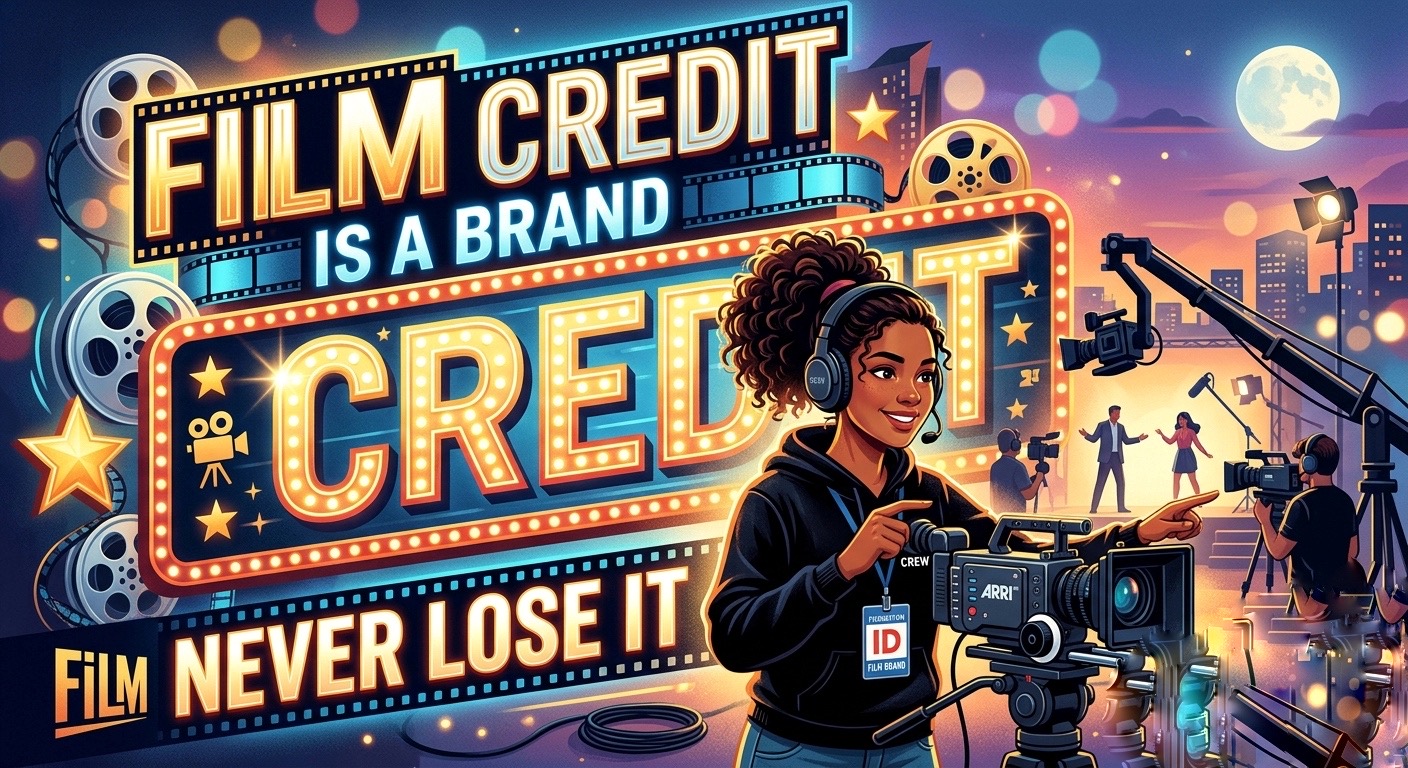
To the uninitiated though, a film credit is nothing but merely a legal obligation to fulfil all righteousness, a rolling list of cast followed by crew names that the cinema audiences use as a cue to exit the theatre Whereas, to the industry professional, a film credit is something infinitely more powerful than a bullet. It is currency. It is both private and public signature. Film credit is a brand for everyone involved in the creation of a film and in the creative industry, it is the only thing you truly own. It is the scars of your creative ingenuity and identity. Lose it, and you lose your face, your relevance and future in film history .
In the corporate world, a brand is defined by trust, consistency, and identity. Some promise innovation while others promise performance. In the film industry, your name functions exactly the same way a brand functions in the corporate world. When a producer sees “Edited by Broadsides Productions” or “Cinematography by Davidson Izegaegbe” on a deck, trust me, they are not just reading a resume. They are buying into a promise.
The Director’s name as a Brand signals a specific kind of film vision, leadership style, and storytelling capability via the camera compositions. It is also in the same way the Producer’s Brand signals financial stewardship, problem-solving, and the ability to lead a film project to the finish line. The film Crew Member’s Brand also signals technical mastery, professional efficiency, and collaborative synergy.
Always learn to know that each time your name appears in the credits of a finished project, you are adding boldly adding a brick to the foundation of your personal brand. If the film is a masterpiece, your brand appreciates. If the film is a troubled production but you delivered exceptional work under pressure, your brand as a reliable professional skyrockets sharply.
The film industry sadly, thrives on a paradox. Oh yes! It is an incredibly massive global business , yet it operates like a small, unrecognised tight-knit village. However, word travels faster than a digital script leaks. We see this happen around in Nollywood every time, especially when it comes to hiring cast and crew. Filmmakers alike rely confidently on word-of-mouth as well as track records of the cast and crew, and in this regards, your film credit is your passport. We see how in a field where hundreds of people vie for a single film audition, the producer and director look for reasons to narrow the field. A compromised brand easily become the decisive factor. This could be due to a reputation for being difficult on set, delivering subpar work, or walking away from a film project mid-way, fighting or molesting other members of cast and crew, ultimately this becomes the fastest way to get blacklisted. Conversely, a reputable film credit history acts as an automated recommendation letter.
As your film credits grow through each film you are involved in, so does your brand through your creative and financial leverage. A strong brand allows you to command higher fees, secure creative balance and control, and get your passion projects green lit. Once you are able to guard your creative integrity early on, trust me, your film credit would dictates the market. Every filmmaker knows that his pay-check funds his present, while his film credit finances his future. Therefore, do not ever trade long-term brand equity for a short-term payout. If you do that, you just comfortably shot you kneel cap off with a pump action rifle.
In our film chaotic ecosystem, our brand will constantly face threats like, compromised visions, toxic sets, budget cuts, and creative disputes. Therefore, guarding our film credit would require strategy, emotional intelligence, and sometimes even, a fierce backbone. Always remember that no matter the budget, the size of the role, or the chaos behind the scenes, your work must remain uncompromised because it is your brand. If the film hits the cinema l, it won’t tell the audience the chaos that fought you hard. If you are a sound designer on a low-budget film, let the film still sound like millions of dollars production. Certainly, you cannot control the director’s cut, but at least you can control the quality of creative assets you deliver.
In the early stages of a career, it is tempting to take every job that comes your way. But as you grow, you later realises that you have become your own gatekeeper for your own name. You will find it very difficult attaching your credit to a project that violates your ethical standards, treats your crew members poorly, or fundamentally fraudulent and may tarnish your brand by association. No matter how brilliant a cinematographer you may be, but if your creative work is a nightmare to your director or other members of crew, you will eventually stop getting hired. Always know that your brand is not just what you create; it is how you make people feel on any film set while creating it. Protect your brand by being the person who brings solutions to the set, not ego.
Sometimes, walking away with your name not appended in a film can help protect your brand. This could be a hard choice to make as a filmmaker, but if a film project you are handling has been butchered to the point that it no longer reflects your professional standards, or creative integrity, you must be prepared to walk away. I strongly believe it is better to have a blank space in your filmography than a permanent stain on your brand.
The film industry is fickle. Many may not believe this. Don’t fashions change, as technology evolves, and box office trends come and go at will? In all, one thing is constant, your name. Therefore, learn to treat your film credit with the same reverence a major corporation treats its trademark. Protect it fiercely, polish it constantly, and never, under any circumstances, let it be compromised. After all, when the final frame of your creative ability fades to black, your credit remains; it is your legacy. NEVER LOSE IT.