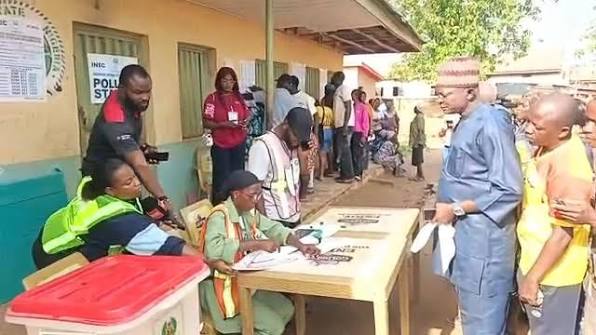
Ado-EKiti: A civil society organisation (CSO), Yiaga Africa says the official results of Saturday’s Ekiti governorship election announced by Independent National Electoral Commission (INEC) are consistent with its Process and Results Verification for Transparency (PRVT) estimates.
The CSO made this known in its post-election news conference on Sunday in Ado-Ekiti.
The News Agency of Nigeria (BAN) reports that the news conference was addressed by the Chair of the 2026 Ekiti Election Observation Mission, Dr Aisha Abdullahi.
Abdullahi that the election recorded significant improvements in election-day administration, including early deployment of officials and materials, timely commencement of accreditation and voting as well as the generally peaceful conduct of the process across the state.
She also commended security agencies, particularly the Nigeria Police Force, for maintaining professionalism throughout the election, noting that reports from its 250 stationary and 22 mobile observers showed a largely orderly process.
Abdullahi, however, expressed concern over what she called widespread reports of vote buying and voter inducement, describing them as serious threats to the integrity of elections and the ability of voters to freely exercise their democratic rights.
She also identified gaps in results management, voter turnout computation and inconsistencies in sensitive election materials, including ballot papers and result sheets, which it said did not fully align with the final list of political parties cleared to participate in the election.
On the deployment of technology, Abdullahi stated that Bimodal Voter Accreditation System (BVAS) functioned properly in 87 per cent of the observed polling units, while malfunctions recorded in some locations were subsequently resolved by election officials.
She said that the organisation’s statistical analysis showed that the vote shares announced by INEC for major political parties fell within its projected ranges, indicating that the official results reflected ballots counted at polling units and were not significantly altered during collation.
She, however, alleged that there was a discrepancy in voter turnout figures, observing that INEC used a registered voter figure of 988,251 for turnout computation instead of the updated 2026 register of 1,059,360 voters.
This, she said, resulted in a slight variance between its estimate and the commission’s official turnout figure.
Abdullahi urged INEC to clarify the turnout discrepancy, strengthen quality assurance in the production of sensitive election materials and improve implementation of electoral guidelines.
She called on security agencies to intensify efforts against vote buying and electoral intimidation, ahead of future elections and the 2027 general elections.