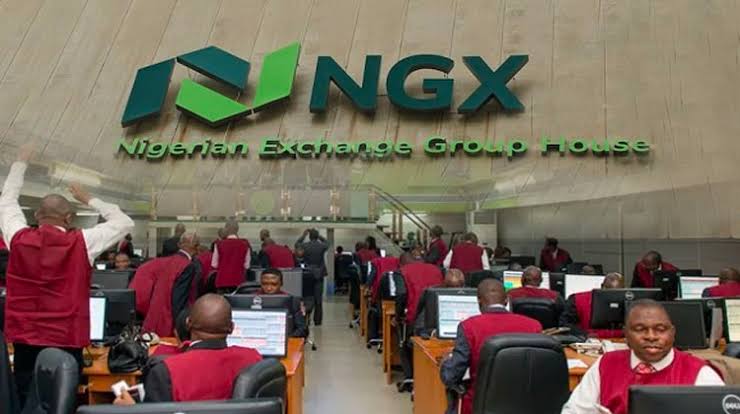
Nigeria’s equities market opened trading for July on a bearish note, with investors losing N2.39 trillion as fresh profit-taking in medium and large-cap stocks dragged key market indicators lower on the Nigerian Exchange Limited (NGX).
At the close of trading on Wednesday, the NGX All-Share Index (ASI), fell by 3,729.11 basis points, or 1.63 per cent, to close at 225,690.07 points, down from 229,419.18 points recorded on June 30. Market capitalisation also declined by 1.63 per cent to N144.82 trillion from N147.22 trillion, effectively wiping out the modest rebound recorded in the previous session.
The latest decline means the market has now opened the second half of 2026 on a weak footing, with the year-to-date return easing further to 45.03 per cent.
Analysts attributed the downturn to renewed profit-taking pressure across major sectors of the market, especially in oil and gas, industrial goods and banking stocks.
The Oil and Gas Index led sectoral losses with a 4.41 per cent decline, followed by the Industrial Goods Index which shed 3.65 per cent. The Banking Index lost 1.49 per cent, while the Consumer Goods Index fell 0.93 per cent. Only the Insurance Index posted a positive outing, rising by 0.42 per cent.
Among the major stocks that weighed on the market were Aradel Holdings, which fell by the maximum 10.00 per cent; NASCON, down 9.98 per cent; Dangote Cement, which shed 7.48 per cent; Transcorp, down 6.99 per cent; Zenith Bank, which declined 4.50 per cent; and FCMB Group, down 4.35 per cent.
On the broader losers’ chart, Neimeth, McNichols and Aradel all closed with 10.00 per cent losses each, while International Breweries, Livestock Feeds, Universal Insurance and Champion Breweries also recorded notable price declines.
Trading activity was mixed, with market turnover weakening significantly despite relatively strong volume. Investors exchanged 488.11 million shares valued at N13.96 billion in 46,929 deals. However, compared with the previous trading day, total volume dropped by 49.50 per cent, while value traded fell sharply by 65.09 per cent.
Sterling Financial Holdings led the activity chart by volume with 124.61 million shares, followed by UPDC with 40.09 million shares, Access Holdings with 36.84 million shares, Honeywell Flour with 33.77 million shares, and United Capital with 28.35 million shares.
By value, Zenith Bank topped the chart with transactions worth N2.13 billion, followed by Aradel Holdings at N2.07 billion, MTN Nigeria at N1.61 billion, Sterling Financial Holdings at N980.63 million and Dangote Cement at N876.01 million.
Despite the broad weakness, a few counters posted gains. Austin Laz led the advancers with a 10.00 per cent gain, while Guinea Insurance rose 9.89 per cent, Abbey Mortgage Bank gained 9.66 per cent, Daar Communications appreciated 9.60 per cent and Regency Assurance advanced 9.52 per cent.
Market breadth remained negative as losers outnumbered gainers, underlining the cautious sentiment among investors at the start of the new month.
Analysts said the decline reflects continued portfolio reshuffling after the strong rally recorded in the first half of the year, with investors locking in gains in heavyweights while rotating into selective defensive or low-priced counters.
In a related development, market attention is also turning to ongoing capital-raising activity in the insurance sector. Regency Alliance Insurance Plc is currently offering 3.201 billion ordinary shares of 50 kobo each to existing shareholders at 95 kobo per share on the basis of one new share for every five held as of May 8, 2026. The rights issue, which opened on June 24 and closes on July 7, is aimed at strengthening the company’s capital base in compliance with the Nigerian Insurance Industry Reform Act 2025.
Also boosting sentiment around selected blue chips, Agusto & Co. recently upgraded MTN Nigeria’s long-term rating to Aaa from Aa+, while affirming its short-term rating at A1+, with a stable outlook. The development followed an earlier affirmation of the telecom company’s AAA (NG) long-term and A1+ (NG) short-term ratings by GCR, reinforcing its status as one of the market’s strongest corporate credits.
Market watchers say investors will continue to monitor profit-taking trends, sector rotation and corporate actions in the coming sessions as the market searches for direction in the second half of the year.