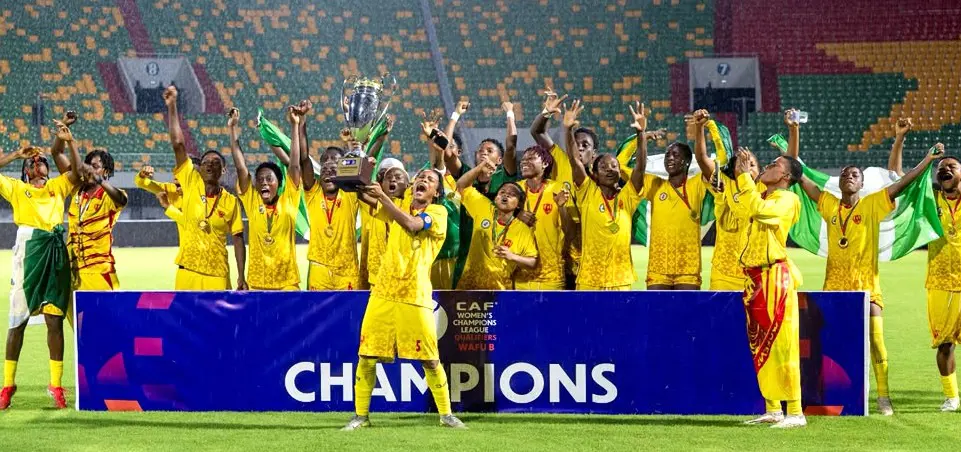
The Confederation of African Football’s decision to annul Edo Queens’ 4-1 penalty-shootout victory over Ghana’s Ampem Darkoa Ladies in the WAFU-B final has triggered serious questions — particularly because the Nigerian champions were not responsible for the procedural error that led to the penalties.
CAF ruled that the final, which ended 2-2 after 90 minutes on September 5 in Ouagadougou, should not have gone directly to penalties. According to the ruling, Article 72.4 required two 15-minute periods of extra time before penalties could be taken.
However, the circumstances surrounding the decision raise fundamental questions about fairness, responsibility and the consequences of an administrative error.
Most significantly, the Ghana Football Association itself published CAF’s decision, which states that the failure to play extra time resulted from an administrative instruction and that neither Edo Queens nor Ampem Darkoa was responsible for the error.
The strongest argument against the manner in which the decision has affected Edo Queens is simple: the club did not create the situation CAF is now correcting.
According to the Ghana FA’s account of CAF’s decision, the match went to penalties following an administrative instruction, and CAF expressly confirmed that neither club was responsible.
Yet the consequence of that error has fallen directly on the Nigerian champions.
Edo Queens won the shootout 4-1 after 90 minutes ended 2-2. CAF’s own official report initially recorded the Nigerian side as the WAFU-B champion and stated that the victory secured qualification for the 2026 CAF Women’s Champions League.
The question therefore becomes: why should a club that followed the instructions of the competition officials lose the benefit of the result because of an administrative failure by those same officials?
This is perhaps the most striking aspect of the saga.
On September 6, CAF published an official report titled, “Edo Queens beat Ampem Darkoa on penalties to win WAFU B women’s title.”
That report did not describe the shootout as provisional. It stated that Edo Queens won 4-1 on penalties, secured the regional title and qualified for the CAF Women’s Champions League.
CAF’s broader qualification overview, published on September 7, also listed Edo Queens as the WAFU-B representative for the 2026 CAF Women’s Champions League.
That creates another important question.
If CAF officially announced the result, recognised the champion and listed the club among the qualified teams, what changed afterwards that was not the result of anything Edo Queens did on the field?
The subsequent ruling effectively reopens a final that CAF had already declared concluded.
There is another crucial distinction.
Edo Queens did not unilaterally decide to ignore the regulations and conduct a penalty shootout.
The match officials controlled the procedure.
The available reports state that the final went directly to penalties after the 2-2 draw and that CAF later determined that this was contrary to the applicable competition provisions.
Therefore, the issue is not simply whether extra time was required.
It is also about who was responsible for ensuring that the correct procedure was followed at the stadium.
If the clubs were not responsible, then nullifying the outcome obtained under official instructions raises a legitimate question of proportionality.
Edo Queens entered the penalty shootout believing, based on the instructions given at the time, that the match had reached its decisive stage. The players then took the penalties and won 4-1.
CAF now wants the teams to return to the same 2-2 scoreline and play 30 additional minutes, with penalties again if necessary.
That requirement itself illustrates the difficulty of recreating the conditions of the original match.
The final whistle has already sounded. The players have left the pitch. One team celebrated victory, while CAF announced the result.
Trying to recreate the final weeks later is inherently different from correcting a referee’s decision during a live match.
CAF is right to be concerned about compliance with its regulations. The rules governing how a final is decided cannot simply be ignored.
But there is a significant difference between correcting an administrative error and asking the teams to effectively resume a final because of that error.
The central issue, therefore, is not whether Article 72.4 exists. Reports of the ruling make clear that CAF relied on the provision requiring two 15-minute periods of extra time before penalties.
The bigger question is whether annulling the shootout and ordering 30 minutes of additional football is the appropriate remedy when CAF itself says the clubs were not responsible for the procedural mistake.
That is where the decision becomes contentious.
There is also another significant issue.
CAF initially treated the final as properly concluded.
Its September 6 match report stated that Edo Queens had defeated Ampem Darkoa 4-1 on penalties and won the WAFU-B title. The following day, CAF’s qualification overview listed Edo Queens as the WAFU-B representative for the Champions League.
Only after Ampem Darkoa’s protest did CAF reverse its position and order the contest to continue.
That sequence inevitably raises questions about consistency in CAF’s administrative procedures.
If the procedural irregularity was serious enough to invalidate the shootout, why was the result initially accepted, published and used in CAF’s official qualification information?
There is little dispute that CAF regulations provide for extra time in a tied final before penalties. CAF’s ruling is based on that provision.
The disputed issue is responsibility and remedy.
Edo Queens did not decide to bypass extra time.
Ampem Darkoa did not decide to bypass extra time.
The available account of CAF’s decision says the clubs were not responsible.
Yet Edo Queens, having won the shootout 4-1 and been officially recognised as champions, has lost the immediate benefit of that victory.
That is why the decision has become highly contentious.
Then comes another question: why not sanction those responsible for the administrative error and allow the winner of the WAFU-B final to proceed with its continental campaign, instead of creating another layer of uncertainty around the competition?
There is another question that deserves attention.
Ampem Darkoa Ladies exercised their right to protest the procedure used to determine the winner. CAF has upheld that protest, ruling that the direct move from 2-2 after 90 minutes to penalties breached the competition regulations.
But if the decision to proceed directly to penalties was made through an administrative instruction, as CAF has now established, what position did Ampem Darkoa take at the stadium when that instruction was given?
Did the Ghanaian champions object before the penalty shootout began?
Did they formally notify the match officials that the regulations required extra time?
Or, like Edo Queens, did they accept the procedure communicated by the officials and proceed to the shootout?
These questions matter because CAF’s own finding is that neither club was responsible for the procedural error.
The available account says the officials had initially been informed that extra time was required, but a subsequent instruction directed the referee to proceed directly to penalties if the match ended level.
Ampem Darkoa then participated in the shootout, which Edo Queens won 4-1.
The issue therefore becomes one of timing and consistency.
If Ampem Darkoa believed throughout the match that the procedure was contrary to the regulations, did the club raise that objection before the penalties were taken?
And, perhaps more pointedly:
If Ampem Darkoa had won the penalty shootout, would the club have taken the same procedural objection to CAF and sought to have its own victory annulled?
It is also important not to lose sight of the journey that preceded the controversy.
Edo Queens reached the final after defeating Burkina Faso’s USFA 5-1 in the semi-final, while Ampem Darkoa defeated Dynamique FC 4-1 in the other semi-final.
In the final, Ampem Darkoa twice took the lead, but Edo Queens fought back to make it 2-2 before prevailing 4-1 in the shootout.
CAF itself reported that Oluebube Umejiaku’s late equaliser forced the contest into penalties.
The Nigerian champions therefore did not merely stumble into the shootout.
They recovered twice, forced the decisive stage and then won it emphatically.
The strongest case for Edo Queens is consequently not that the regulations should be ignored.
Rather, it is that the consequences of an official administrative mistake should not automatically be transferred to a club that complied with the instructions given to it during the match.
CAF has now rejected Ampem Darkoa’s request for a complete replay and ordered the contest to continue from the 2-2 scoreline with 30 minutes of extra time.
That decision at least preserves the validity of the first 90 minutes.
But it also wipes away the 4-1 shootout result that CAF itself initially recognised.
And therein lies the controversy.
Edo Queens did not breach the rule.
The match officials made the procedural call.
CAF later acknowledged that the clubs were not responsible.
Yet the consequence is that the Nigerian champions must now return to the battlefield to fight for a title they had already been officially declared to have won.
That is the real issue at the centre of the Edo Queens controversy.
The question is no longer simply whether extra time should have been played.
The bigger question is whether justice can be achieved by making a club that did not create an administrative error pay the price for it.