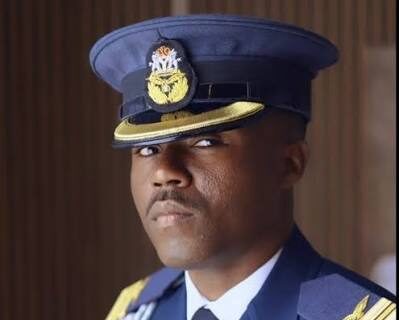
On Friday, Squadron Leader Mamud I. Aburimen sat quietly at the back row of a lecture hall at the University of Benin, cap firmly on his head, writing what was to be his final make-up examination.
Like many students, he may have been thinking about the work still ahead of him — the result he hoped to receive, the degree he was close to completing, and the life waiting for him beyond the classroom. There was nothing to suggest that the ordinary examination would become his last known moment as a student.
Two days later, he was dead.
Aburimen, a Nigerian Air Force pilot and Master’s student of Mass Communication at the University of Benin (UNIBEN), was among the officers killed when a NAF aircraft crashed at Igbokoda, Ondo State, on October 5, while on its way from Benin to Lagos.
He was just 48 hours removed from his last classroom.
The distance between the examination hall and the crash site was not only measured in kilometres. It was the distance between expectation and grief, between a man preparing to complete one chapter of his life and a family suddenly forced to confront its end.
For Aburimen, the cockpit and the classroom were two demanding worlds. Yet, he managed to give both the same discipline, commitment and determination.
To his classmates, he was more than a military officer. He was a quiet, humble and unassuming colleague who never allowed the demands of his profession to stand in the way of his education.
“He was a perfect gentleman. He sat at the back, always with his cap on. He never troubled anyone,” said Desmond Odiah, his class representative.
There was something almost ordinary about the way Aburimen occupied the classroom. He did not seek attention or announce the weight of the responsibilities he carried outside it. He simply came, listened, wrote his examinations and remained part of the quiet rhythm of student life.
Odiah had journeyed with Aburimen from the Postgraduate Diploma programme to the Master’s level. He recalled how the late officer successfully balanced military responsibilities with academic commitments.
“Despite his tight schedule as a military officer, he always created time for lectures. He was always in touch about academic work. The last time he contacted me was Friday — he told me he was already in school for the make-up test.”
It was the last time his classmates would hear from him.
Perhaps, at the time, the message seemed like nothing more than an update from a colleague trying to complete an academic obligation. There was no farewell in it, no warning that the next communication would come through news of a crash, no indication that the man who had just written an examination would soon be remembered in the past tense.
In the Department of Mass Communication, Aburimen was remembered as disciplined, respectful and quiet. At the Air Force Base in Benin, he was remembered as a committed officer who gave his duty his best.
The two descriptions reveal the fullness of a life that cannot be reduced to the circumstances of its death. He was a pilot, but he was also a student. He was an officer, but also a colleague, a friend, a husband, a son and a member of a family whose future has been permanently altered.
He was among several officers aboard the ill-fated aircraft, including Squadron Leader Ahamefule Aham Man-Ugwueje, who had reportedly married just 16 days earlier; Flight Lieutenant M. Akintoye, who had celebrated his mother’s birthday only hours before the flight; and Flight Lieutenant I. S. Bako.
Each name carries a life beyond the uniform — conversations left unfinished, plans interrupted, homes suddenly quiet and families forced to mourn people they expected to see return.
The tragedy has left two institutions in mourning.
At the Nigerian Air Force Base in Benin, flags flew at half-mast on Tuesday. At the University of Benin, the seat where Aburimen once sat remains empty—a quiet reminder of a student whose academic journey ended just when he was preparing to take its final steps.
An empty seat can appear insignificant in a crowded lecture hall. But after a death, it becomes a kind of memorial.
It holds the outline of the person who once occupied it: the cap, the books, the familiar posture, the quiet presence that classmates may have taken for granted because they believed there would always be another lecture, another examination, another opportunity to say hello.
Aburimen carried flight manuals and textbooks with equal seriousness.
In the skies, he served his country as a pilot. On the ground, he pursued knowledge and sought to understand the society and stories he was helping to shape through his study of Mass Communication.
He was building two legacies at once.
Then, in the space of one weekend, both journeys came to an abrupt end.
The cruelest part of the tragedy may be its timing. He had endured the demands of military service and postgraduate study, had remained committed through the pressures of both, and had reached the threshold of completion. He had done the work. He had shown up. He had written the examination.
All that remained, it seemed, was to wait for the result.
Instead, those who knew him are left waiting for a return that will never come.
His last examination was on Friday.
His final flight was on Sunday.