For too long, Nigerian football has been trying to get a real home.
We have wandered from Uyo to Kaduna to Calabar to Benin to Asaba to Abuja. From the Godswill Akpabio Stadium to quiet, comfortable arenas, chasing form, chasing luck, chasing a feeling we left behind. We have struggled to qualify for tournaments which were a stroll in the past. But when we look back at our glory days in the 80s and 90s, our national team has an address in Nigeria, and that address has always been Lagos.
The news that the Teslim Balogun Stadium is back should not be treated as a footnote. It should be a national football decision. It is time to bring the Super Eagles home.
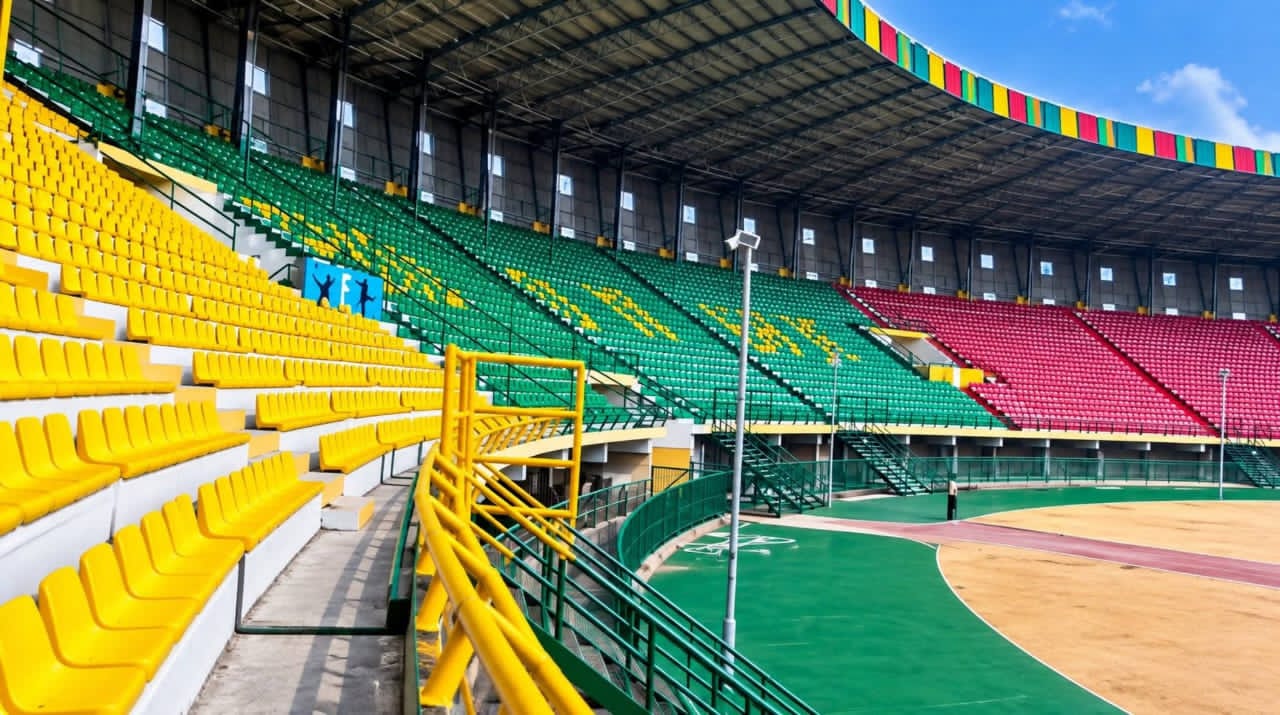
We must thank the Governor of Lagos State, Babajide Sanwo-Olu, for the beautifully refurbished Teslim Balogun Stadium. With its green, lush grass, modern seats and improved facilities, Lagos has again shown why it sets the pace. The stadium is ready, and it is befitting of the Super Eagles.
And the timing could not be more perfect. The Confederation of African Football (CAF) has confirmed that the 2026 edition of its annual awards ceremony will take place in Lagos, Nigeria, on December 7 at the Wole Soyinka Centre for Culture and Creative Arts, formerly the National Theatre, in Iganmu.
That is not a coincidence. That is confirmation. Africa is already coming to Lagos to celebrate its best. That CAF chose Lagos for its biggest night of the year signifies a city determined to return to the centre of African football and reclaim the glory of the national team. The continent’s eyes will be on Lagos in December. The question is: will our own Super Eagles be home to welcome them?
Lagos is not just a city. It is the spiritual headquarters of Nigerian football. Every great football nation has a spiritual home. Brazil makes history at the Maracana, where their soul lives. England has Wembley, the sacred home that no Three Lions team needs a map to find. Argentina has the Monumental in Buenos Aires, where they bury opponents with noise and passion. Germany has the Olympiastadion in Berlin, where legends are crowned. These countries don’t just play at these stadiums, they draw power from them. Nigeria had that, and we abandoned it.
This is where our legend was built. At the old National Stadium in Surulere, Nigeria became invincible. From the early 1980s to the mid-2000s, for almost 25 years, the Super Eagles did not lose a competitive match in Lagos. It was a fortress in the truest sense. Teams did not come to Lagos to play Nigeria; they came to survive Lagos.
That unbeaten run was not luck. It was Lagos itself. The noise, the talking drums, the traders who shut their shops early, the thousands who trekked to the stadium under the sun, the famous Lagos pressure that sat on the necks of opponents before the referee even blew his whistle. When you played in Lagos, you felt 20 million people breathing down on you. That kind of pressure does not break real players; it builds them.
And that pressure is what made legends. Legends were not just discovered in Lagos, they were formed in Lagos. Christian Chukwu marshalled the defence there. Segun Odegbami flew down the wing and became Mathematical. Sylvanus Okpala, Henry Nwosu, Stephen Keshi, Jay-Jay Okocha who made the ball talk, Mutiu Adepoju, the great Rashidi Yekini, Sunday Oliseh — they all became superheroes wearing green and white in Lagos. Lagos did not just host them; Lagos anointed them.
Here is the painful truth: this generation of Super Eagles has never really played under that pressure. Victor Osimhen, Ademola Lookman, Alex Iwobi, Ola Aina — they have carried Nigeria across the world, but they have never felt a true, roaring Lagos crowd behind them in a competitive game. They have played in good stadiums with polite crowds. They have never played where a misplaced pass is booed and a brave tackle is worshipped like a goal.
Maybe that is why we have not gotten the results we want. Maybe that is part of why we missed two World Cups and the Olympics. We removed our best weapon — our crowd. We made the Super Eagles comfortable, and comfortable teams do not qualify.
Even after winning the AFCON in 2013 with a Sunday Mba-inspired victory, we failed to qualify for back-to-back AFCONs in 2015 and 2017, while trying out Calabar, Kaduna and Uyo as makeshift venues for qualifiers. We had the same talent, the same badge, but we had lost our home. This was definitely not about the players, it was about the atmosphere and planning.
Bringing football back to Teslim Balogun also makes football sense. In an era when 90 percent of our squad flies in from Europe, Lagos is logic. No connecting flights to Uyo. No wasted hours in transit to Abuja. They land at Murtala Muhammed International Airport and are in camp within an hour. They sleep better, recover faster, and Eric Chelle gets an extra training session to drill his pressing, high-intensity philosophy.
For Chelle, Lagos is the perfect ally. He is a coach who wants intensity. What better place to demand intensity than a stadium that will demand it with him? Lagos will not accept laziness or sideways football. The fans will push, shout, drag the team forward when legs are tired. That is not hostility. That is accountability. And this team needs it.
And Lagos is not just ready for the Eagles, Lagos itself is ready for football again. For the first time in 32 years, Lagos will have three clubs in the top flight at the same time – Ikorodu City, Sporting Lagos and Inter Lagos – in the 2026/27 NPFL season. It is a restoration of a glory that was lost. It takes us back to 1992 and 1993, when Lagos ruled Nigerian football with four top-flight clubs at once – Stationery Stores, Julius Berger, First Bank FC and ACB Lagos – turning Onikan Stadium into a weekly theatre of Lagos derbies.
Then as the 90s wore on corporate football died and Lagos was left with only Mountain of Fire Ministries carrying the flag for years. Now the city that gave us the Flaming Flamingoes and the Bridge Boys is buzzing again with privately-owned clubs built for the modern era. If Lagos can sustain three clubs in the top flight, it can certainly sustain the Super Eagles and bring an electric atmosphere.
The refurbished Teslim Balogun sits in the shadow of the National Stadium, a daily reminder of when Nigeria never lost at home. And now, with the National Theatre reborn as the Wole Soyinka Centre ready to host Africa’s football royalty in December, the message from Lagos is clear: the city is ready for its glory days again.