BENIN CITY — Edo State has earned national recognition for its strong revenue performance, emerging as the sixth most revenue-independent subnational government in Nigeria for 2025.
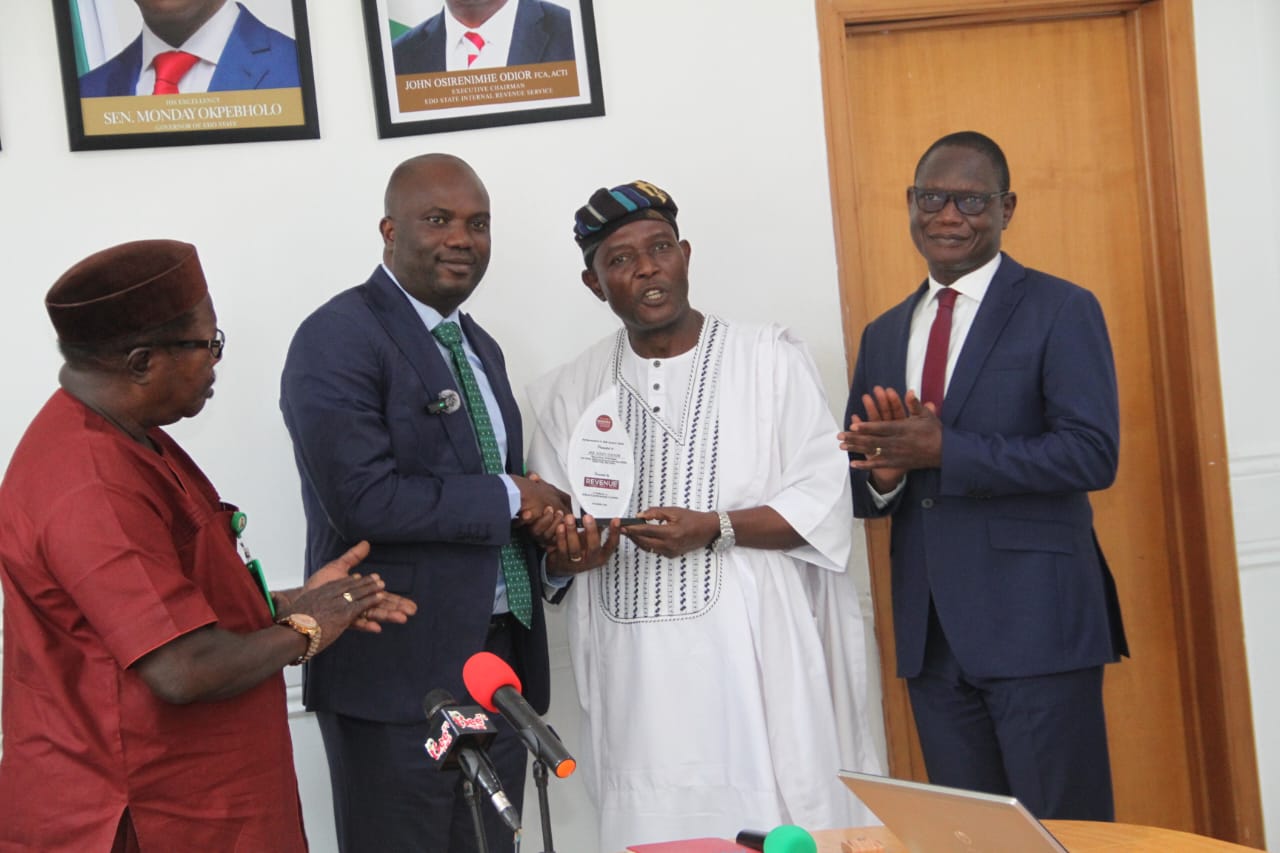
The accomplishment was marked by the presentation of the prestigious Achievement in IGR Award 2026 to the Edo State Internal Revenue Service (EIRS).
Receiving the award on behalf of the agency, the Executive Chairman of EIRS, Mr. John Odior, attributed the breakthrough to the operational independence granted by Governor Monday Okpebholo, alongside the strategic adoption of innovative, technology-driven tax administration.
In a press release issued to the Nigerian Observer newspaper on November 6, Odior expressed deep appreciation to Governor Okpebholo for his commitment to tech-driven governance and the comprehensive modernization of the state’s tax system. He noted that key institutional backing has enabled EIRS to deploy modern technological solutions, boost operational efficiency, and plug revenue leakages.
Highlighting a flagship digital innovation, Odior pointed to the automated processing and issuance of Tax Clearance Certificates (TCCs). Under this streamlined system, taxpayers apply online, receive processing within 24 hours, and download digital or printable certificates without physically visiting EIRS offices.
Odior commended Governor Okpebholo for upholding complete professional independence within the agency, revealing that since assuming office in March 2026, he has not received a single request from the governor seeking preferential treatment or political intervention for non-compliant associates, family members, or friends. He stressed that decoupling tax collection from politics is essential to building a sustainable, tech-enabled revenue model.
Presenting the award, Chief Frederick Olukayode Apeji—Chairman/CEO of Alford Conferences Limited, publishers of REVENUE Magazine and conveners of the annual Nigerian States IGR Awards (NSIA)—disclosed that Edo State generated ₦132.21 billion in internally generated revenue in 2025. This accounted for 40.39 percent of its combined revenue of ₦327.31 billion from IGR and Federal Allocation (FAAC).
According to Apeji, this performance ranks Edo State second in the South-South geopolitical zone, fifth among Nigeria’s 17 southern states, and sixth overall out of the country’s 37 subnational governments (including the Federal Capital Territory).
Beyond its revenue independence ranking, Edo State has maintained a position among Nigeria’s top 10 IGR performing states for seven consecutive years:
* Governor of the Year in IGR Awards 2026 (2 recipients)
* Excellence in IGR Awards 2026 (10 recipients)
* Achievement in IGR Awards 2026 (10 recipients)
* Excellence in Municipal IGR Awards 2026 (3 recipients).
Chief Apeji described this consistency as particularly impressive given that Edo State does not receive the 13 percent oil derivation fund enjoyed by neighboring South-South states like Delta, Rivers, Akwa Ibom, and Bayelsa.
Edo recorded a 45.05 percent year-on-year growth in IGR, rising from ₦91.15 billion in 2024 to ₦132.21 billion in 2025—marking the first time the state has surpassed the ₦100 billion annual threshold since NSIA tracking began.
Commending both past and present EIRS leadership, the award conveners recommended Edo State as a model for subnationals across Nigeria. Chief Apeji noted that stronger state revenue bases are critical to powering Nigeria’s broader ambition of achieving a $1 trillion Gross Domestic Product (GDP) by 2035.
Established in 2020, the Nigerian States IGR Awards relies on verified data from the National Bureau of Statistics (NBS) and the Office of the Accountant General of the Federation (OAGF) to celebrate state governments driving sustainable economic self-reliance.