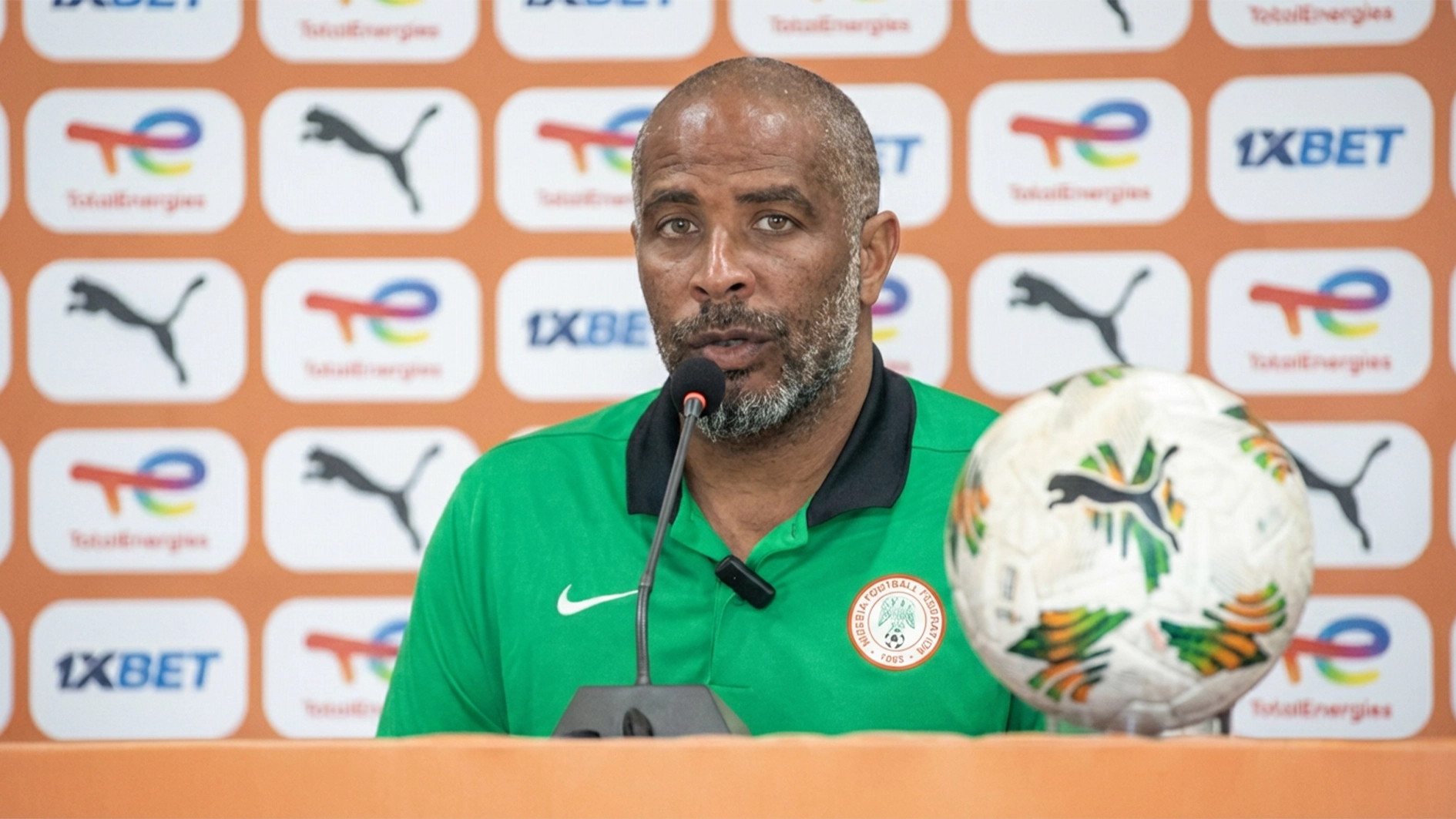
There is a growing feeling that the Super Eagles are sleepwalking towards another football disaster. Nigeria’s journey to the 2027 Africa Cup of Nations (AFCON) is becoming increasingly precarious, and the man entrusted with steering the team, Eric Chelle, is beginning to look like a coach running short of answers. What was supposed to be a campaign of redemption is gradually turning into another exercise in frustration, tactical uncertainty and unfulfilled expectations.
The two encounters against Tanzania should have provided Nigeria with an opportunity to establish its authority in the group, secure maximum points and put the qualification debate beyond doubt. Instead, Chelle’s team managed a home victory and an away draw, a return that has left the Super Eagles in an uncomfortable position. At this stage of the campaign, dropping points, particularly against opponents Nigeria should ordinarily be capable of overcoming, is a luxury the team cannot afford.
The situation is even more troubling because Guinea-Bissau have emerged as serious contenders in a group where qualification is expected to be fiercely contested. Nigeria, with its football pedigree, superior individual talent and considerably greater resources, should not be looking over its shoulders in a qualification race of this nature. Yet that is precisely where the Super Eagles have found themselves. They now face an uphill task in rescuing a campaign that should never have become this complicated.
Beyond the results, however, it is the quality of football on display that should concern Nigerians. Chelle’s tactical decisions have increasingly raised questions about his understanding of the personnel available to him and his ability to maximise their strengths.
How does a coach approach a home fixture with three defensive midfielders when the responsibility is to dominate possession, create chances and impose authority on the opposition? What was the attacking ambition behind such a selection? Football is not won by simply accumulating defensive midfielders. It requires the right balance between defensive protection, creativity and attacking penetration.
The return fixture against Tanzania offered another illustration of Chelle’s questionable tactical judgement. He opted to start with two strikers, Taiwo Awoniyi and Tolu Arokodare, whose playing profiles and strengths have considerable similarities, while leaving one of Nigeria’s most creative players, Alex Iwobi, on the bench.
The logic behind that decision was difficult to understand. Having two forwards on the pitch does not automatically translate into attacking superiority. Sometimes, what a team needs is a creative midfielder capable of unlocking a compact defence, supplying the forwards and dictating the rhythm of the game.
This is where questions about Chelle’s tactical maturity become unavoidable. A national team coach must understand that selecting the best available players is not necessarily the same as selecting the best combination. Nigeria possesses sufficient attacking talent to trouble virtually any defence in Africa. The coach’s responsibility is to organise that talent into a cohesive and functional unit. When a system consistently fails to bring out the best in its players, questions must inevitably be asked about the man designing it.
March 2027 may still appear some distance away, but the atmosphere surrounding the Super Eagles is already becoming increasingly tense. Nigerians are growing impatient, and understandably so. The country has invested too much emotion, resources and football history in this team to accept another campaign defined by uncertainty and disappointment. The wounds of recent setbacks have yet to heal, and every questionable performance reopens them.
There is also a more uncomfortable conversation to be had about the mentality of this generation of players. Talent is certainly not the problem. Nigeria has footballers playing for some of Europe’s biggest clubs, competing in demanding leagues and enjoying the privileges associated with elite professional football. But international football demands more than technical ability and club reputation. It requires resilience, mental toughness and the capacity to withstand moments of intense pressure. This generation has repeatedly struggled to demonstrate those qualities when the stakes are highest.
The scars of Nigeria’s 2022 FIFA World Cup qualification failure remain particularly painful. In the decisive home encounter against Ghana, the Super Eagles failed to produce the performance required to secure the victory that would have taken them to Qatar. It was not simply a failure of tactics or individual ability; it was also a failure to manage the occasion. Nigeria had home advantage, the backing of its supporters and the opportunity to settle the contest, yet the team could not rise to the challenge.
Two years later, at the 2023 Africa Cup of Nations in Côte d’Ivoire, the same psychological vulnerability resurfaced. Having taken the lead against the host nation in the final, Nigeria had an opportunity to secure a historic triumph. Instead, the Super Eagles surrendered their advantage and eventually lost the trophy. It was another painful reminder that reaching a final is one thing; possessing the mental strength to cross the finishing line is quite another. For a country that has won the competition three times, another silver medal offered little consolation.
The 2026 FIFA World Cup qualification campaign provided yet another opportunity for this generation to rewrite its story. Despite receiving a lifeline through the qualification process, Nigeria ultimately failed to secure a place at the tournament. The consequences were enormous. A country with Nigeria’s population, football culture and abundance of talent was once again left watching the world’s biggest football competition from home.
The recurring pattern is becoming increasingly difficult to ignore: when the pressure intensifies, the Super Eagles struggle to deliver.
This is why Chelle’s present predicament cannot be separated from the wider history of Nigerian football management. There is a growing perception that the current coach has enjoyed a degree of patience and institutional protection that was not extended to some of his predecessors. Samson Siasia was not afforded the same opportunity.
Emmanuel Amuneke has not been given a comparable opportunity to establish himself at the highest level of the national team, while Finidi George was shown the exit after just two matches in charge of the Super Eagles during the 2026 World Cup qualifying campaign.
These comparisons raise legitimate questions about consistency in the Nigeria Football Federation’s (NFF) treatment of national team coaches. Why should one coach be judged almost immediately while another enjoys extended patience despite disappointing performances and questionable tactical decisions? If results are the standard, that standard must apply to everybody. If coaches are to be given time to build teams, that consideration should not be reserved for selected individuals. The NFF cannot operate a system in which patience becomes a privilege rather than a clearly defined policy.
Chelle must also understand that managing Nigeria is not an ordinary coaching assignment. It is a responsibility that comes with enormous expectations. The Super Eagles cannot be treated as a laboratory for endless tactical experimentation. Every international window matters, every qualification point is precious, and every opportunity to build confidence must be taken seriously.
The Nigerian football public is not demanding miracles. It is demanding competence, consistency and visible progress.
There is nothing inherently wrong with giving a coach time to implement his philosophy. Indeed, successful national teams are rarely built overnight.
However, time must be accompanied by tangible evidence of improvement. The question is no longer simply whether Chelle has a plan; it is whether that plan is producing the desired results. His team selections, substitutions, tactical adjustments and management of difficult matches must demonstrate a clear understanding of the demands of the job.
The NFF must equally accept responsibility for the situation. A football federation cannot appoint a coach, celebrate his arrival and subsequently abandon its responsibility to establish measurable expectations. There must be clear performance benchmarks, regular technical assessments and effective accountability mechanisms. The coach must understand what constitutes success, while the federation must be prepared to act when those expectations are not met. Sentiment, personal relationships and contractual convenience must never become excuses for institutional indecision.
Nigeria’s precarious position in the AFCON qualification race should therefore serve as a serious warning.
The remainder of the campaign must be approached with urgency rather than complacency. Chelle must demonstrate that he can make difficult decisions, identify the right combinations and extract the maximum from the players at his disposal. He must also rediscover the attacking identity Nigerians expect from their national team. A side blessed with so much attacking talent should not consistently appear short of ideas.
The players, too, must accept their share of responsibility. Coaches can organise teams, devise strategies and provide motivation, but they cannot play the decisive passes, win every duel or summon courage on behalf of the footballers. The Super Eagles must rediscover the competitive hunger that once made Nigeria a feared opponent across Africa.
Wearing the national colours must mean more than reporting to camp, collecting match bonuses and returning to club football. It must come with an obligation to deliver for the country.
There is still time to rescue the situation, but time is not an unlimited resource. The remaining qualification campaign and the March 2027 deadline will provide Chelle with an opportunity to demonstrate that he is the right man to lead Nigeria into the next phase of its football journey. By then, the questions surrounding his tactical judgement, squad management and ability to deliver results must have been answered. The country cannot afford to enter another major tournament with a team whose identity and direction remain uncertain.
For the NFF, the message should be equally straightforward: Chelle must be judged by results and the quality of football his team produces, not by the comfort of his contract or the convenience of retaining him. If he fails to deliver the required results by March 2027, there should be no justification for extending his tenure. The same standards applied to Siasia, Amuneke and Finidi must apply to him. No coach should be bigger than the national assignment.
Nigeria has suffered enough football disappointments in recent years. Missing the World Cup, surrendering an AFCON final and now facing uncertainty over qualification for another continental championship represent an accumulation of setbacks that demands serious reflection and a fundamental rethink.
The Super Eagles cannot continue to live on past glory while the present generation struggles to meet the country’s expectations. Chelle was brought in to change that narrative. He must now prove that his appointment was not another expensive experiment.