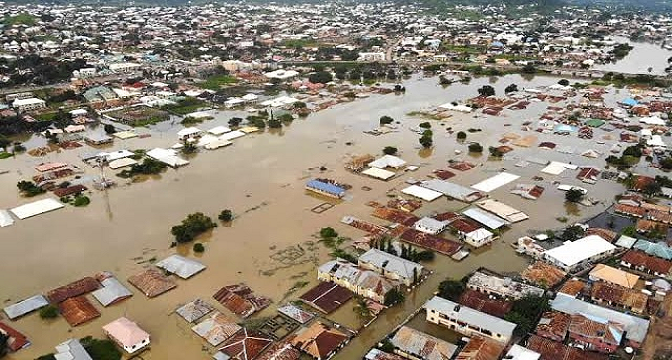
The Minister of Water Resources and Sanitation, Joseph Utsev, has clarified that the recent flooding and loss of lives in Mokwa, Niger State, were not caused by any water releases from the Kainji or Jebba Dams.
Addressing a press conference in Abuja on Tuesday, Utsev attributed the incident to intense rainfall and the failure of residents to heed flood warnings.
He extended the ministry’s condolences to the people and government of Niger State, especially those affected in Mokwa, emphasising that both Kainji and Jebba Dams remain safe and structurally intact.
He commended the prompt response of the state government, local authorities, and first responders in providing relief and support to the victims.
Utsev explained that the flooding was caused by extreme weather conditions resulting from climate change, which overwhelmed the local drainage systems.
He pointed out that unregulated building and construction activities had obstructed an ephemeral tributary of River Dingi, a minor watercourse that only flows during periods of rainfall and is a tributary of the River Niger.
The absence of efficient alternative channels to redirect the excess water significantly worsened the flood’s impact on the affected communities.
The minister recalled that the Nigeria Hydrological Services Agency (NIHSA), under the Federal Ministry of Water Resources and Sanitation, had issued the 2025 Annual Flood Outlook (AFO) on 10 April 2025, which predicted flooding in 19 Local Government Areas in Niger State, including Mokwa.
Citing the same report, he said 1,249 communities in 176 local government areas across 33 states and the Federal Capital Territory fall within High Flood Risk Areas, while 2,187 communities in 293 LGAs across 31 states and the FCT are classified under Moderate Flood Risk Areas.
States listed under the High Risk category include Abia, Adamawa, Akwa Ibom, Anambra, Bauchi, Bayelsa, Benue, Borno, Cross River, Delta, Ebonyi, Edo, FCT, Gombe, Imo, Jigawa, Kebbi, Kogi, Kwara, Lagos, Nasarawa, Niger, Ogun, Ondo, Osun, Oyo, Rivers, Sokoto, Taraba, Yobe, and Zamfara.
Utsev used the occasion to reiterate key warnings and recommendations from the 2025 AFO, urging states and local governments to strengthen drainage infrastructure, relocate vulnerable communities, sustain public awareness campaigns, and enforce land-use regulations to prevent encroachment into flood-prone areas.