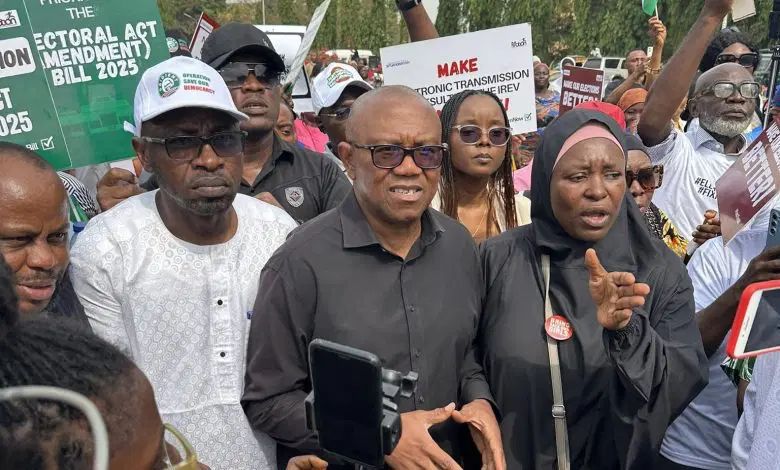
Former Labour Party presidential candidate, Peter Obi, on Monday joined hundreds of protesters at the National Assembly Complex in Abuja to oppose the Senate’s decision to alter provisions on electronic transmission of election results in the proposed amendment to the Electoral Act.
The protest, branded “Occupy the National Assembly,” was organised by members of the Obidient Movement and pro-democracy groups, who accused lawmakers of attempting to weaken electoral transparency ahead of the 2027 general elections.
The agitation followed the Senate’s passage last week of the Electoral Act 2022 (Repeal and Reenactment) Amendment Bill, 2026. Central to the controversy is the removal of the phrase “real-time” from clauses dealing with electronic transmission of election results, a move critics say could encourage manipulation of outcomes.
Despite repeated explanations by the Senate that it did not discard electronic transmission of results entirely, demonstrators argued that the omission of “real-time” transmission leaves room for post-election interference and abuse.
Carrying placards bearing messages such as “Our votes must count,” “No to electoral robbery,” and “Protect democracy now,” the protesters marched from the Federal Secretariat toward the National Assembly while chanting solidarity songs.
Security operatives drawn from the Nigeria Police Force, the Nigerian Army and the Nigeria Security and Civil Defence Corps, however, blocked access to the complex, barricading the main entrance and forcing the protesters to stage their demonstration outside the gates.
Addressing journalists at the protest venue, Obi warned that Nigeria’s democratic progress was being steadily eroded, stressing that credible elections are the bedrock of national development and stability.
“We must dismantle this criminality and prove that we are now a nation that shows light in Africa,” he said.
Obi’s participation further energized the crowd, many of whom regard him as a symbol of the youth-led political awakening that emerged during the 2023 elections and challenged Nigeria’s entrenched political order.
The National Coordinator of the Obidient Movement Worldwide, Dr Yunusa Tanko, said the protests would continue until the National Assembly clearly reinstates real-time electronic transmission of results in the amended law.
“If there is no electronic transmission of results, there will be no election. Our elections must be credible,” Tanko said.
He noted that past elections were often compromised during manual result collation, a challenge electronic transmission was meant to address following reforms introduced after the 2011 and 2015 polls.
Nigeria’s electoral reform efforts gained momentum after the disputed 2007 general elections. Subsequent innovations, including the introduction of card readers in 2015 and the Bimodal Voter Accreditation System (BVAS) in 2022, were widely seen as steps toward improving transparency, despite persistent implementation challenges.
Electronic transmission of results was also a major demand of civil society organisations during debates preceding the passage of the 2022 Electoral Act, with advocates arguing that it would reduce human interference and restore public confidence in elections.
Also speaking at the protest, activist Randy Peters accused the political class of betraying democratic ideals and vowed that demonstrators would continue to mobilise until their demands are met.
“Tomorrow, we will be back here until the Senate do the right thing. The current administration supported the June 12 campaign. It was about free and fair elections,” he said.
Recalling the June 12, 1993 election widely regarded as Nigeria’s freest and fairest Peters questioned why elected leaders would resist reforms designed to guarantee credible electoral outcomes.
“Do we have democrats who are afraid of losing elections? In 2027, our votes must count. The most important thing is that our votes must count. Tomorrow, they will meet us here again,” he added.