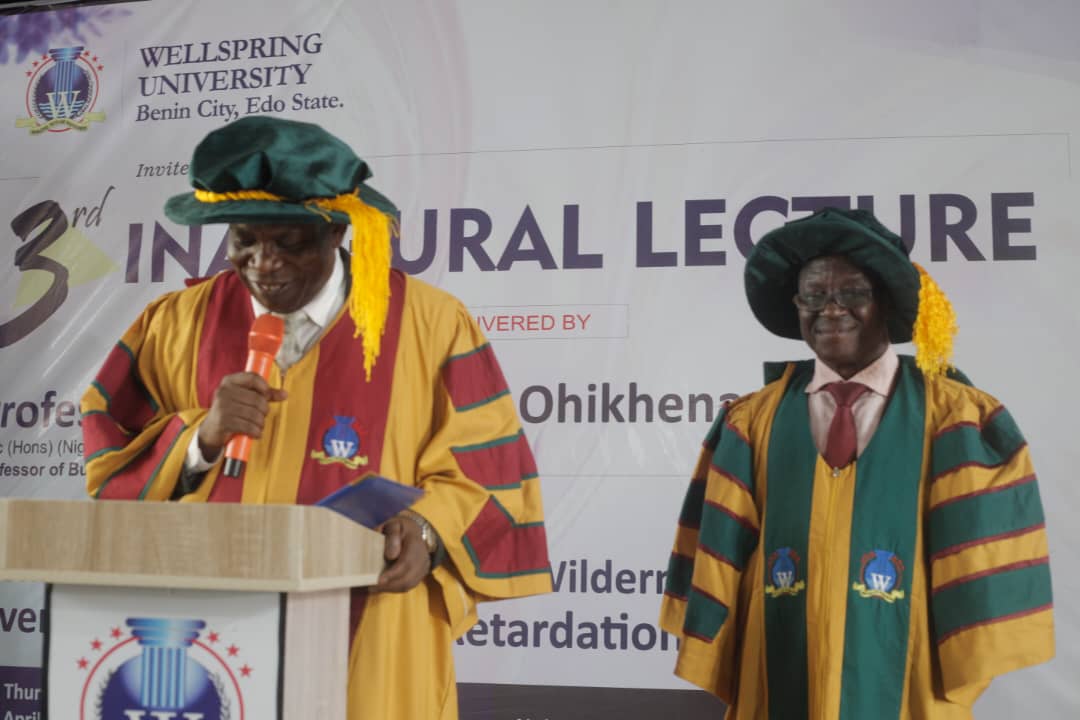
BENIN CITY — A Professor of Business Administration at Wellspring University, Patrick Stephen Ohikhena, has called for urgent reforms to dismantle structural and cultural barriers hindering Nigeria’s economic independence.
Delivering the institution’s third inaugural lecture, Ohikhena warned that decades of reliance on oil and foreign systems have left Nigeria a vulnerable, consumption-driven economy, insisting that a shift to innovation and production is imperative.
In his lecture titled “From Nigeria’s Entrepreneurship Wilderness to Wealth: Overcoming the Five Key Retardation Forces,” he identified pre-colonial leadership legacies, colonialism, government failures, a complacent national mindset, and the emerging digital neo-colonial order as key impediments to progress.
The don argued that Nigeria’s over-dependence on crude oil has entrenched a monoculture economy and weakened local enterprise, urging a transition to a diversified, production-based system.
He rejected claims that Africa lacks entrepreneurial capacity, maintaining that pre-colonial Nigeria had thriving indigenous enterprise systems before colonial distortions.
Ohikhena also blamed successive policy failures, corruption, weak education and poor infrastructure for deepening the crisis, warning that the “Japa” trend and rise in fraudulent ventures signal a decline in productive values.
He described the prevailing “suffering and smiling” culture as a major psychological barrier to innovation and productivity, cautioning that the rise of artificial intelligence and robotics could further marginalize Nigeria if urgent reforms are not undertaken.
Among his recommendations were visionary leadership, curriculum reforms to produce job creators, improved funding for small and medium enterprises, and the adoption of indigenous models such as the Igbo apprenticeship system.
He also advocated expanded access to education, particularly for girls and Almajiri children, stronger university-industry collaboration, and reduced dependence on foreign direct investment.
The professor called for improved power supply, enhanced security, regional integration, and strategic investments in key sectors, including mining, energy and indigenous medicine.
Vice-Chancellor of the university, Isaac Rotimi, described the lecture as timely and reaffirmed the institution’s commitment to research that addresses national challenges.