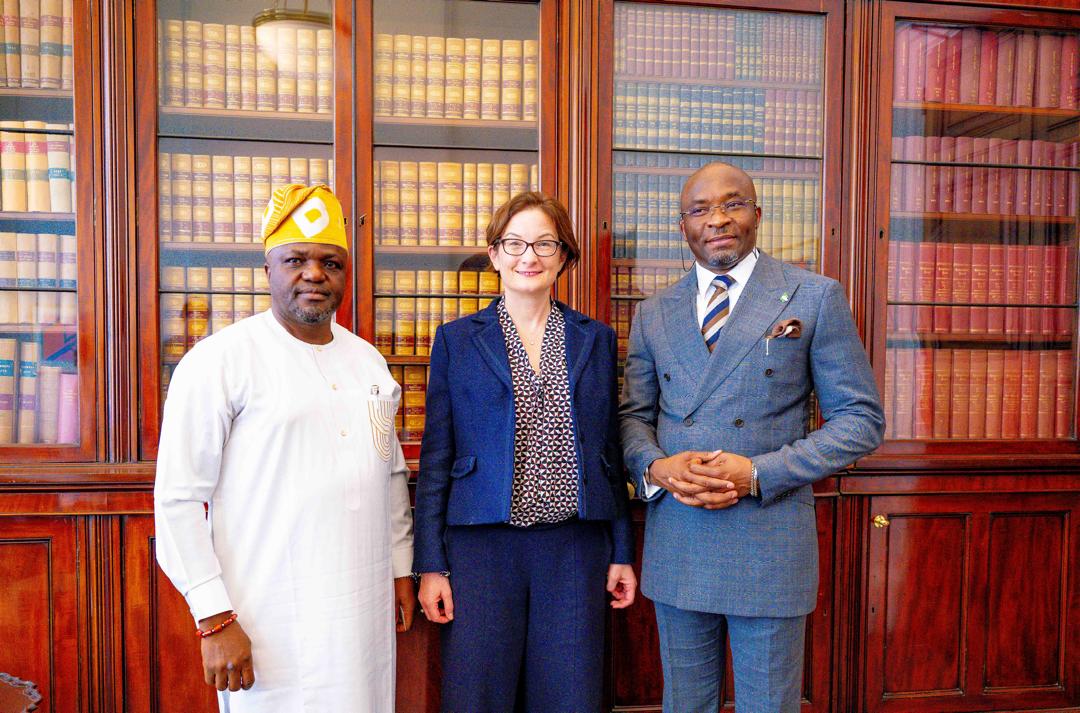
LONDON — Deputy Speaker of the House of Representatives, Rt. Hon. Benjamin Okezie Kalu, has called on the United Kingdom’s Foreign, Commonwealth and Development Office, FCDO, to sustain its support for electoral integrity, legislative strengthening and institutional reforms ahead of Nigeria’s 2027 general elections.
Kalu made the appeal during a high-level meeting with senior officials of the FCDO led by its Director General, Network, Christina Scott, in London, where he outlined Nigeria’s ongoing efforts to strengthen democratic governance and rebuild public confidence in the electoral process.
The meeting, which held on the sidelines of Kalu’s engagement at Chatham House, focused on the future of Nigeria’s democracy, the role of strong institutions and the need for continued international collaboration.
The Deputy Speaker said the relationship between Nigeria and the United Kingdom goes beyond diplomatic ties, describing it as a partnership rooted in shared values, historical links, trade interests and commitment to constitutional democracy.
He expressed appreciation to the UK Government and the FCDO for their support in strengthening Nigeria’s democratic institutions through electoral reforms, civic participation, conflict prevention, peacebuilding and legislative capacity development.
Kalu said democracy requires more than the conduct of elections, stressing that strong institutions, accountable leadership and active citizen participation are essential to sustaining democratic growth.
“Strong legislatures are key to strong democracies. Support for parliamentary capacity, transparency, evidence-based policymaking and citizen engagement strengthens the democratic relationship between the government and the people,” he said.
The Deputy Speaker, who also chairs the House Committee on Constitution Review, said Nigeria’s reform agenda is focused on critical national issues such as federalism, devolution of powers, local governance, security structures, inclusion and representation.
He noted that technical assistance, comparative experience and broad public consultation remain important tools in shaping reforms that reflect the aspirations of Nigerians.
Speaking on electoral reform, Kalu said Nigeria had drawn important lessons from the 2023 general elections, particularly in the areas of technology, transparency, dispute resolution and public trust.
He disclosed that the 2026 Electoral Act had strengthened the legal framework for technology-driven elections by formally recognising the use of the Bimodal Voter Accreditation System, BVAS, and electronic transmission of results.
According to him, additional legislative actions have also helped to reduce uncertainties surrounding pre-election litigation by clarifying timelines and jurisdictional issues.
“Our partnership has contributed meaningfully to strengthening the legislative environment for democratic governance in Nigeria,” Kalu said.
As preparations gather pace for the 2027 elections, Kalu said the National Assembly is working to ensure that the legal framework is concluded early enough to support voter education, election planning, institutional readiness and greater public confidence.
He said the overall goal is to deliver elections that are peaceful, transparent, inclusive and reflective of the genuine choice of Nigerians.
“The 2027 general elections are already a major priority for the National Assembly, the electoral management body, political parties, civil society organisations and citizens,” he added.
Kalu warned that the stability of Nigeria’s democracy has implications far beyond its borders, describing the country as a strategic force for peace and democratic resilience in Africa.
He said that as Africa’s largest democracy and one of the continent’s biggest economies, Nigeria’s political stability has direct implications for regional security, trade, migration, counter-terrorism cooperation and economic growth.
“Nigeria’s democracy is important not only to Nigerians but also to West Africa, Africa and the international community,” he said.
He added that a stable Nigeria would continue to serve as a foundation for stronger democratic values and regional cooperation within the Economic Community of West African States, ECOWAS.
Kalu reaffirmed Nigeria’s commitment to constitutional governance, peaceful political competition and the rule of law, while calling for deeper strategic partnership between the National Assembly and the FCDO.
He said continued collaboration between both countries would help ensure that Nigeria’s democratic institutions remain resilient, responsive and capable of delivering stability and opportunity for citizens.
“Together, we can strengthen democratic institutions that work for the people and safeguard Nigeria’s future,” he said.