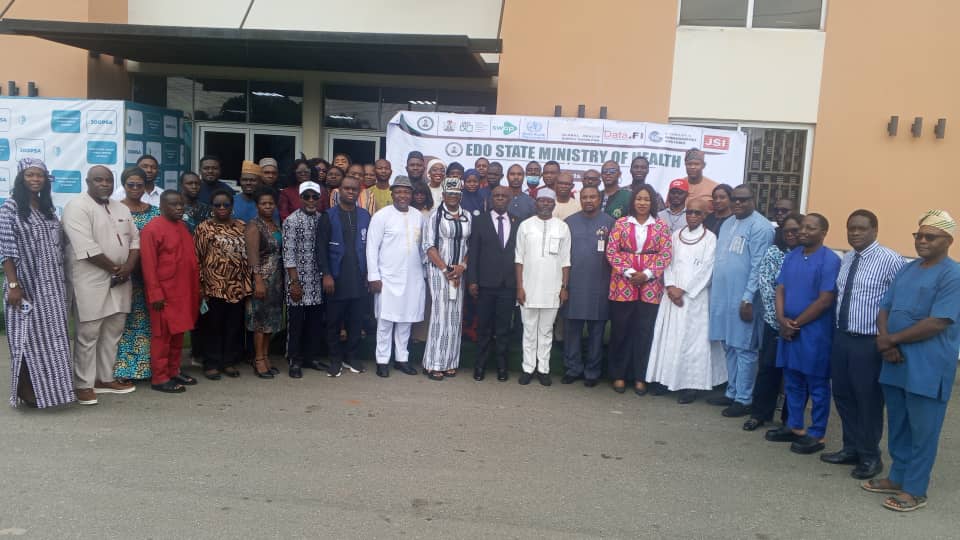
BENIN CITY – Edo State Commissioner for Health, Dr. Cyril Adams Oshiomhole, the Federal Ministry of Health and the National Health Insurance Authority (NHIA) have called for accelerated health insurance enrolment, stronger health information systems and sustained investments in healthcare as critical drivers for achieving Universal Health Coverage (UHC) in Edo State.
The call dominated deliberations at the two-day Edo State Joint Annual Review (SJAR) held at the John Odigie Oyegun Public Service Academy, Benin City, where government officials, development partners and health stakeholders evaluated the state’s health sector performance, identified implementation gaps and adopted strategies to improve healthcare delivery.
Addressing participants, Dr. Oshiomhole described the annual review as a vital accountability mechanism for measuring progress, strengthening evidence-based planning and driving reforms that will guarantee equitable access to quality healthcare. He reaffirmed the Edo State Government’s commitment to sustained collaboration with the Federal Government and development partners to improve health outcomes through efficient implementation of health programmes.
Representing the Coordinating Minister of Health and Social Welfare, Technical Assistant to the Federal Ministry of Health, Mrs. Igbigbi Jacinta, commended the Edo State Government for institutionalising the review process, describing it as an important platform for accountability, performance assessment and evidence-based decision-making. She reaffirmed the Federal Ministry’s commitment to supporting Edo State’s drive towards Universal Health Coverage.
Representatives of the World Health Organization (WHO), Global Health Supply Chain–Procurement and Supply Management (GHSC-PSM), Data.FI and Corona Management Systems also pledged continued technical support to strengthen healthcare service delivery across the state.
A major highlight was the presentation by the Edo State Health Insurance Commission (EDOHIC), which reported progress in expanding health insurance coverage through the Basic Health Care Provision Fund (BHCPF), extending protection to vulnerable groups, establishing a corporate office in Irrua, implementing the Philanthropist Initiative and deploying digital innovations to improve service delivery.
However, the NHIA expressed concern over low health insurance enrolment, inadequate vehicular logistics and delays in the release of the State Equity Fund, urging EDOHIC to intensify advocacy, strengthen stakeholder engagement and expand enrolment across the state.
Sectoral presentations recorded gains in HIV treatment and viral suppression, GeneXpert expansion for tuberculosis diagnosis, free weekly hypertension and diabetes screening, routine immunisation, primary healthcare revitalisation, digital health information management and health workforce recruitment.
Health performance data for January to June 2026 showed 966,803 outpatient visits, 44,891 admissions and 18,962 deliveries, with 95.5 per cent attended by skilled birth attendants. The review also recorded 24,667 new family planning acceptors and 87,963 clients counselled.
Despite the progress, stakeholders identified inadequate funding, weak data quality, manpower shortages, poor reporting from secondary health facilities, commodity stock-outs, inflation, inadequate ICT infrastructure and the rising burden of non-communicable diseases as major obstacles.
The review concluded with far-reaching resolutions to strengthen the State Data Governance Framework, expand health insurance coverage, improve primary healthcare infrastructure, intensify routine immunisation in low-performing local government areas, establish dedicated funding for non-communicable diseases and deepen collaboration among government, local councils and development partners to fast-track Universal Health Coverage in Edo State.