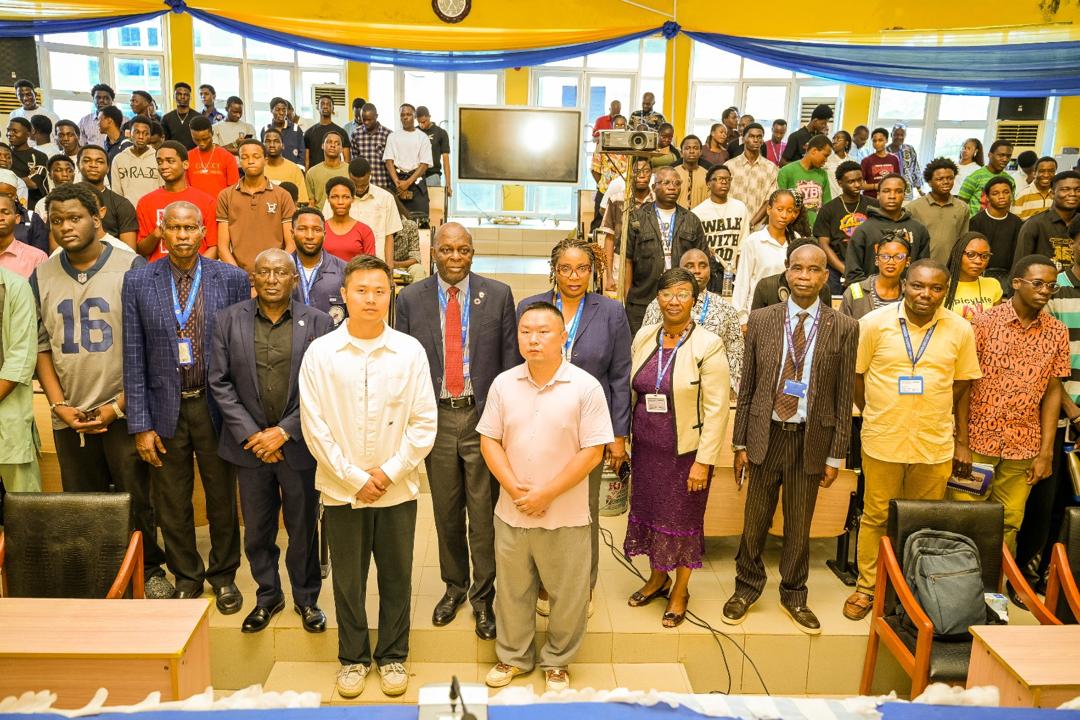
OKADA — Igbinedion University, Okada (IUO), has deepened its strategic academic partnership with Jiangxi College of Vocational and Foreign Studies, China, with a specialised technology training programme designed to equip staff and students with practical skills in Python Programming, Big Data Analysis and Artificial Intelligence (AI).
The capacity-building programme, held on Monday at the university’s Main Library Hall, is part of the Tiangong Workshop Initiative, an expanding Nigeria-China academic collaboration focused on technology transfer, knowledge exchange, entrepreneurship and the development of digital competencies required to compete in the global economy.
Welcoming the Chinese facilitators and participants, the Vice Chancellor of Igbinedion University, Professor Lawrence Ezemonye, described the partnership as a significant milestone in the institution’s pursuit of academic excellence, technological advancement and internationalisation.
Professor Ezemonye noted that the relationship between the two institutions had continued to yield impressive results, highlighting the enormous potential of Nigeria-China academic cooperation.
He recalled that the partnership reached a major milestone last year when two members of staff and 10 students of Igbinedion University travelled to China for an exchange programme, during which a Memorandum of Understanding (MoU) was formally signed between the institutions.
According to him, the agreement has provided a strong foundation for sustained cooperation in academic training, research, capacity building and skills development.
“Our partnership with Jiangxi College of Vocational and Foreign Studies represents our commitment to creating meaningful international opportunities for our staff and students. We are particularly pleased that this collaboration is translating into practical skills development and knowledge exchange,” the Vice Chancellor said.
Professor Ezemonye said the training would provide participants with relevant technological competencies needed to thrive in an increasingly digital global economy.
He explained that the Python component would expose participants to foundational and applied coding skills essential for software development and automation, while Big Data Analysis would strengthen their capacity to collect, process and interpret information for informed, data-driven decision-making.
The AI component, he added, would introduce participants to core artificial intelligence concepts and their growing applications across different sectors of the economy.
“The world is rapidly becoming technology-driven, and universities must remain at the forefront of this transformation. This hands-on training will enhance the technical competencies of our staff and students and position them to compete favourably in the global digital economy,” he stated.
The visiting facilitators are Ouyang Pan and Wu Weixiang, who are leading the specialised training programme.
Speaking during a session titled “Big Data: New Business and Entrepreneurship Opportunities for Nigerian Youths,” the team lead facilitator, Ouyang Pan, challenged participants to look beyond the traditional perception of big data as a specialised field reserved for computer programmers and technology experts.
Pan explained that big data is essentially the continuous stream of digital information generated through everyday activities such as education, business, social media, online shopping and other human interactions.
“You do not need to be a programmer. Data is a thinking skill for every teacher and every student—the ability to see patterns and make better choices,” he said.
According to him, the growing digital economy presents Nigerian youths with significant opportunities to build businesses, improve productivity and make informed decisions by leveraging data that is already freely available.
He cited online vendors who use search trends and seasonal demand to determine products to stock, as well as content creators who analyse views, likes, comments and audience engagement to build successful digital brands.
Pan further highlighted the application of data analytics in education and institutional management, including the use of attendance and assignment records to identify students requiring additional support, learning analytics to improve course content, and campus data to enhance resource allocation and planning.
He stressed that lack of access to sophisticated software should no longer be regarded as a barrier to acquiring data skills, urging participants to begin with simple and freely accessible digital tools.
“No coding, no cost—start today,” Pan declared, encouraging participants to make use of platforms such as Google Trends, TikTok Creative Center and Meta Business Suite.
He advised youths to dedicate as little as 10 to 15 minutes weekly to developing their data skills, noting that consistent small steps could translate into significant opportunities in the digital economy.
In his concluding charge, Pan urged Nigerian youths to embrace data literacy as a pathway to entrepreneurship, innovation and active participation in the emerging digital economy.
“The digital economy is rapidly expanding, and your participation is key. Embrace data literacy and become an active contributor to this transformative wave,” he said.
The Tiangong Workshop Initiative is expected to extend beyond the current physical training, with plans for online courses in Big Data Analytics, cross-border e-commerce and digital marketing, as well as expert-led practical workshops and exchange opportunities designed to expose Nigerian students and educators to Chinese academia, technology and industry.
The Vice Chancellor expressed appreciation to Jiangxi College of Vocational and Foreign Studies for its continued commitment to the partnership, stressing that Igbinedion University remained committed to expanding the collaboration into other areas of mutual academic, technological and research interest.
“We look forward to more impactful collaborations that will deepen our international partnerships and contribute significantly to academic excellence, research development and technological advancement at Igbinedion University,” Professor Ezemonye said.