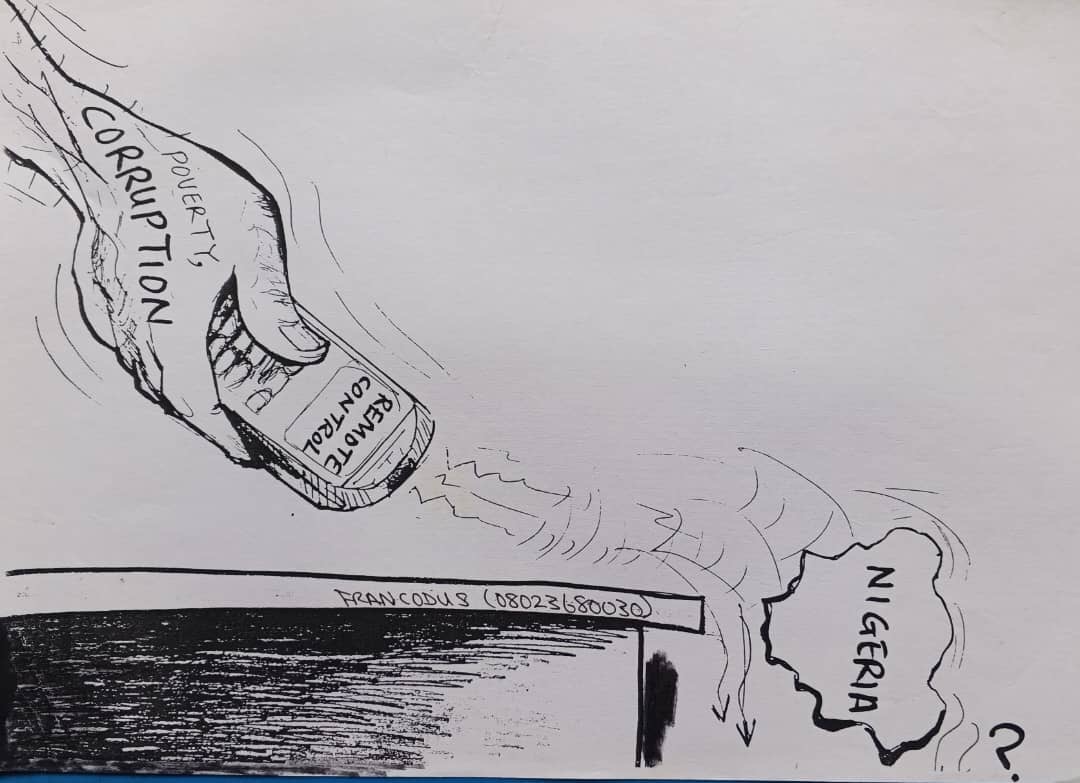
…yet prospects abound say experts
Wednesday, May 29, will mark one year in office of the President Bola Ahmed Tinubu-led Federal Government running the affairs of Nigeria. The Nigerian Observer team employed socio-economic metrics to rank the performance of the Tinubu administration since assuming office and found his economic scorecard to be a mixed bag.
Nigeria’s Gross Domestic Product (GDP) grew by 2.98 percent at the end of the first quarter of 2024, which was the third quarter of the leadership of the Tinubu administration.
In the third quarter of 2023, which was the first quarter of the leadership of the Tinubu administration, Nigeria’s real GDP growth rate was 2.54 percent. The economy recorded 3.46 percent in the fourth quarter of 2023. In the first three quarters of his administration, which were Q3’ 2023, Q4’ 2023 and Q1’ 2024, the average real GDP growth rate was 2.99 percent.
Even if there is a miraculous economic growth in the Q2’ 2024, which will mark President Tinubu’s one year in office, the resultant economic growth rate will still fall short of the President’s campaign promise of ensuring 10 percent real growth annually. President Tinubu had promised to grow the Nigerian economy up to $586.7 billion by the end of 2024, which is a long vault away.
However, records show that overshoot-projections are a common feature of new leaders in office, especially in Africa, until they are faced with the often wide gulf between illusion and reality.
This is said to often manifest by way of the headwinds of time and tide, the interplay of contending economic forces, local and global interests, sundry limitations, the drag of official red tape and strong opposing channel forces and leakages along the line.
President Tinubu emphasised the strategic role of agriculture, which from time immemorial, has been the backbone of the Nigerian economy. For the three quarters he has been in office, productivity in the nation’s agriculture sector has been lacklustre. The sector grew by 1.30 percent at the end of the Q3’ 2023, and by 2.10 percent in the last quarter of 2023. In Q1’ 2024, agricultural real GDP growth rate was just 0.18 percent.
When disaggregated, crop production, where the bulk of the sectoral activities take place and forestry, recorded 1.88 percent and 1.77 percent real growth, respectively, in 2023. On the other hand, livestock production and fishing ended 2023 in the red, as real GDP growth rates for the two sub-sectors were at -8.61 percent and -1.36 percent, respectively, in 2023.
Capital importation into the agriculture sector was $19.91 million in 2023 as against $95.80 million in 2022. However, domestic investment inflows into the nation’s agriculture sector continue to be very strong, as more players become aware of the huge opportunities in the sector. For instance, British International Investment (BII) signed an agreement last October with a Singapore-based agro-allied firm to invest $15 million for the development of warehouse infrastructure in Nigeria. The agreement further created the option of investing additional $35 million in the same project. Also, USAID mobilised N9.6 billion in December 2023 for fintech, agribusiness and MSMEs in the northeast part of the country.
The cost of lending has soared since President Tinubu assumed office, making it more expensive for existing businesses to expand, while many bankable ideas have been abandoned because their internal rate of return is now lower than the cost of capital. As at the last Monetary Policy Meeting (MPC) of the Central Bank of Nigeria (CBN), the Monetary Policy Rate (MPR) was further hiked to 26.25 percent.
MPR was 18.75 percent in December 2023, but was raised to 22.75 percent in February 2024. It was further increased to 24.75 percent in April 2024 before hitting 26.25 percent in May 2024.
The hawkish stance of the CBN was not unconnected with the ravaging inflationary pressures in the country, as the CBN favoured price and exchange rate stability over higher cost of capital. As of April, headline inflation set a new record, reaching 33.69 percent, while the food inflation was at an all-time high at 40.53 percent, thus exerting more pressures on government, businesses and households through reduction of their purchasing power.
Exchange rates have deviated from the initial plan in the 2024 budget, which assumed an average of N800/$. With the naira float, the national currency exchanges at around N1500/$ at the official market, prompting the CBN to ask bureau de change operators to recapitalise.
On the positive side, investors continue to reap huge benefits from the capital market. From a market capitalization of N30.37 trillion on May 30, 2023, the market capitalization of listed equities has grown by N24.85 trillion and now stands at N55.22 trillion as at Friday, May 24, 2024. The All-share Index (ASI), which currently stands at 97,612.51 points, has added 41,843.23 points, to its 55,769.28 points as of May 30, 2023.
In the aviation sector, Air Peace’s commencement of flights on the London route and plans to expand to other international routes with the backing of the Federal Government portends well for the local economy, as the competition it poses has already led to a remarkable slash in the airfares that Nigerians pay to the UK and promises to impact on other routes going forward.
It is expected that this will incentivise investment and growth into the country’s aviation sector, gradually generate foreign exchange earnings into the country and stem outflows.
The solid minerals sector also displays strong prospects for uplifting the economy. Nigeria is home to 44 globally sought-after and highly priced minerals, conservatively estimated to be worth over $750 billion. This makes the country a prime destination for mining investments, especially with the government’s focus on diversification in the sector.
Here, government speaks of the prospects of the Nigerian Solid Minerals Corporation, Joint Ventures with Mining Multinationals, Big Data on specific seven priority minerals and their deposits, 30-day grace for illegal miners to join artisanal cooperatives, Mines Surveillance Task Force and Mine Police, Comprehensive review of all mining licences and the creation of six Mineral Processing Centres to focus on Value-Added products and projects that the sector will add at least 50 percent value to the Nigerian economy.
In the area of food production, the Federal Government is being encouraged to increase food production and lower prices through the deployment of the nation’s 264 dams, more for farm irrigation to facilitate year-round cultivation and harvests.
Industry groups say that better attention to the nation’s 264 dams, which are currently poorly applied to crop irrigation, would open a window to increasing food production and lowering prices.
“Farmers in Nigeria have been impacted by the lack of access to water to the extent that there is no real enabling environment for sustainable all-year-round agricultural production in the entire country,” said Ibrahim Kabiru, national president, All Farmers Association of Nigeria.
Despite the push for increased local food production, most dams across the country are still dysfunctional and irrigation schemes are not working, Kabiru said.
Experts say Nigeria’s several dams will boost food production, lower prices to table and reduce dependency on food imports if properly serviced and managed.
They add that food production would increase significantly, as cultivation and harvesting could be conducted twice a year for some crops and three times a year for others, especially as many crops grown in the country, including maize, beans, tomatoes and other fruits, vegetables and some varieties of legumes mature in three months.
They add that dams that provide irrigation year-round would further attract investment into mechanised farming and food processing from home and abroad, as well as create jobs and encourage foreign exchange earnings from food and other farm produce exports.