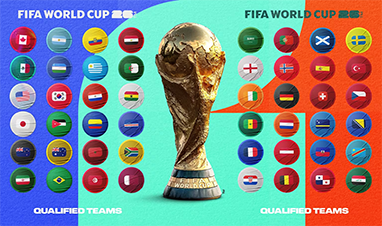
The road to the 2026 FIFA World Cup has begun to take definitive shape, with a blend of traditional powerhouses, emerging nations and first-time qualifiers securing places at the tournament to be jointly hosted by the United States, Mexico and Canada from June 11 to July 19.
The three host nations — the United States, Mexico and Canada — automatically qualified, each bringing contrasting World Cup pedigrees.
While the United States’ best finish remains a third-place outing in 1930, Mexico boast two quarter-final appearances (1970 and 1986), and Canada continue their search for a first knockout-stage breakthrough after previous group-stage exits.
Defending champions Argentina headline the South American contingent after sealing qualification on March 25, aiming to add to their three titles (1978, 1986, 2022). Five-time winners Brazil also return, extending their record as the only nation to feature in every World Cup, while Uruguay — champions in 1930 and 1950 — reinforce South America’s rich pedigree.
Asia has produced a mix of regulars and newcomers. Japan and South Korea continue their consistent presence, with the latter’s fourth-place finish in 2002 still the continent’s benchmark. Iran and Australia also return, while Uzbekistan and Jordan make history with their first-ever World Cup qualifications, underlining the region’s growing competitiveness.
Africa has emerged as one of the biggest stories of the qualification series, with a strong and diverse representation. Morocco, fresh from their historic semi-final run in 2022, lead a pack that includes Egypt, Ghana, Senegal, Ivory Coast and Tunisia. South Africa also returns to the global stage, while Cape Verde are set for a historic debut. DR Congo’s late qualification adds further depth to Africa’s presence, continuing the continent’s upward trajectory in global football. Soccer
Europe’s contingent is, as expected, packed with elite nations. Former champions France, Germany, Spain and England are all safely through, alongside finalists Croatia and the Netherlands.
Portugal, Belgium and Switzerland maintain their consistency, while countries like Norway, Scotland and Austria mark notable returns. Turkey, Sweden and the Czech Republic also secured qualification on March 31, adding further depth to UEFA’s representation.
The CONCACAF region, beyond the host nations, sees Panama, Haiti and Curaçao progress, with Curaçao making a landmark first appearance at the finals.
Elsewhere, New Zealand confirmed Oceania’s presence, while Iraq and Qatar will represent West Asia alongside Saudi Arabia, all seeking to improve on modest past performances.
The expanded tournament — the first to feature 48 teams — is already reflecting FIFA’s broader global reach. With debutants such as Uzbekistan, Jordan, Cape Verde and Curaçao joining seasoned campaigners, the 2026 edition is shaping up to be one of the most inclusive and competitive in the tournament’s history.
As qualification continues to conclude across confederations, attention will soon shift to the draw, where football’s giants and newcomers alike will discover their paths in what promises to be a landmark World Cup. Soccer