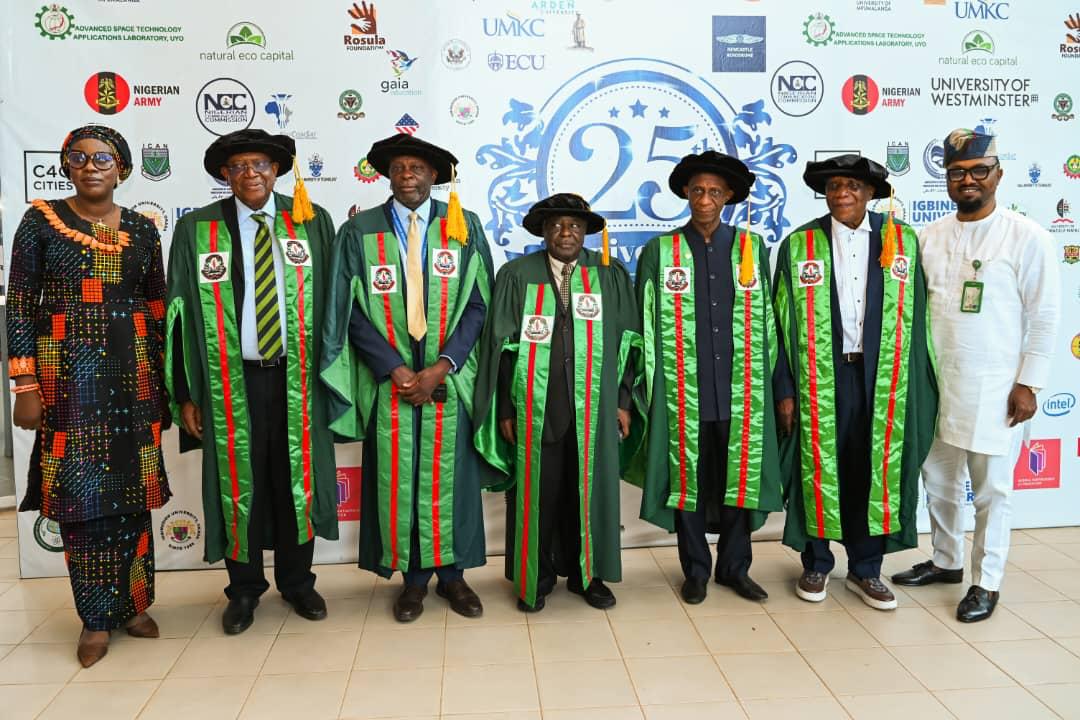
OKADA — Igbinedion University, Okada (IUO), and the Nigerian Academy of Science (NAS) have called for massive investment in technology-driven agriculture, agro-processing and research commercialisation to help Nigeria achieve its $1 trillion Gross Domestic Product (GDP) target by 2030.
The call was made at the 5th NAS Ambassadorial Lecture, hosted by IUO on Thursday, October 8, in Okada, Edo State.
Welcoming participants, IUO Vice-Chancellor, Prof. Lawrence Ikechukwu Ezemonye, described the lecture, themed “The Existential Imperative of Agro-Value Chain: Deploying Innovative Technology Towards Nigeria’s US$1tr GDP Target,” as critical to Nigeria’s pursuit of sustainable development, food security and economic prosperity.
Ezemonye stressed the need to bridge the gap between scientific research, public policy and practical development, noting that innovation must translate into solutions capable of addressing national challenges.
He said the university’s hosting of the lecture aligned with its founding vision of knowledge and excellence and its commitment to advancing science, innovation and service to humanity over more than 27 years.
The Vice-Chancellor credited the university’s Founder and Chancellor, Sir Chief Dr. Gabriel Osawaru Igbinedion, the Esama of Benin, for his commitment to education and the establishment of Nigeria’s first private university.
He described the NAS Ambassadorial Lecture series as an important platform for bringing scientific knowledge into national development discourse, while commending the academy for sustaining engagement between researchers, policymakers and society.
Ezemonye said the presence of distinguished fellows of the academy would inspire students and young scientists to pursue excellence and contribute meaningfully to Nigeria’s scientific and technological advancement.
He said the engagement could deepen institutional collaboration in research, mentorship and science, technology, engineering and mathematics (STEM) advancement.
Ezemonye described the participation of the state government officials as evidence of the importance of collaboration between government and academic institutions, stressing that stronger links between the two were essential to national progress.
Delivering the lecture, former Executive Secretary of the Tertiary Education Trust Fund (TETFund), Prof. Suleiman Elias Bogoro, proposed an annual investment of ₦250 billion over three years to revitalise grazing reserves, modernise ranching and boost livestock production.
He said agriculture, livestock and food security account for about 17 per cent of Nigeria’s GDP, stressing that science, technology and innovation were critical to improving productivity, strengthening food security and transforming raw agricultural produce into high-value industrial products.
Bogoro also advocated improved animal breeding, agro-processing zones, subsidised credit, better rural infrastructure and stronger agricultural extension services, while urging livestock reforms to end open grazing and reduce farmer-herder conflicts.
NAS President and chairman of the lecture, Emeritus Prof. Abubakar Sani Sambo, challenged Nigeria to move beyond scientific discoveries to commercialise research into marketable products, jobs and export earnings.
He lamented that valuable findings from universities and research institutes often remained uncommercialised, calling for stronger partnerships among government, academia and industry, alongside the establishment of the proposed National Research Fund.
Sambo identified artificial intelligence as a strategic tool for improving productivity, reducing costs and strengthening decision-making.
Similarly, Edo State Head of Service, Dr. Anthony Osas Okungbowa, urged greater investment in processing, packaging and marketing to maximise the economic value of agricultural produce. He said the state government’s SHINE Agenda supports oil palm development, agribusiness and youth entrepreneurship, adding that technology could reduce post-harvest losses, expand market access and generate employment.
The speakers urged policymakers, researchers, industry leaders and young Nigerians to embrace agricultural innovation and agripreneurship, stressing that sustained investment in technology, infrastructure and research commercialisation, backed by effective collaboration among government, universities and industry, would be critical to achieving Nigeria’s $1 trillion GDP ambition.