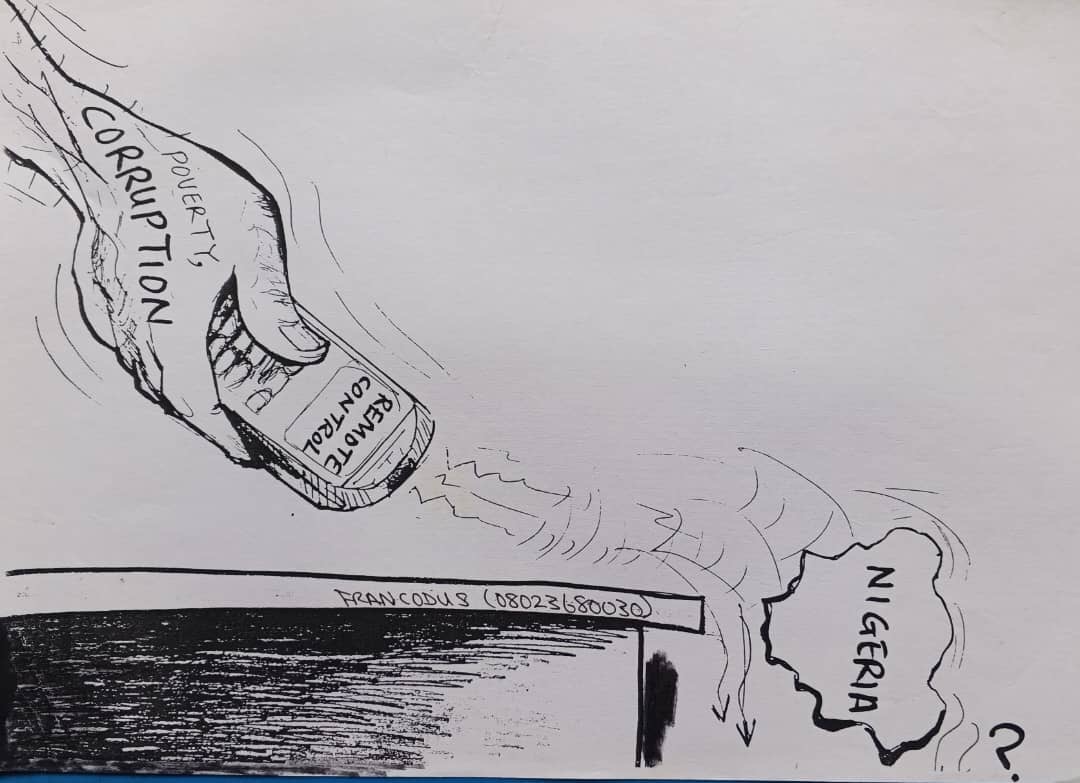
Nigeria’s economy is into recession after it shrank in the first quarter as oil output slumped and the manufacturing, financial and real estate industries declined. With the reduced volume of income of the nation, many states in the country are finding it difficult to pay salaries and meet other obligations while the Federal Government has had to intervene in state finances.
Gross domestic product in Africa’s largest economy contracted by 0.36 percent from a year earlier, according to the Abuja-based National Bureau of Statistics. The last time the economy contracted was the second quarter of 2004, according to data on the central bank’s website. Falling prices of crude, from which Nigeria derives up to 70 percent of state revenues, have caused the nation’s economic outlook to deteriorate as the government struggles to pay salaries and stimulate growth, forcing it to increase borrowing. President Muhammadu Buhari on May 6, 2016 signed a record budget of 6.1 trillion naira ($30.6 billion) with a deficit of 2.2 trillion, or 2.14 percent of GDP.
Gross domestic product in Africa’s largest economy contracted by 0.36 percent from a year earlier, according to the Abuja-based National Bureau of Statistics. The last time the economy contracted was the second quarter of 2004, according to data on the central bank’s website. Falling prices of crude, from which Nigeria derives up to 70 percent of state revenues, have caused the nation’s economic outlook to deteriorate as the government struggles to pay salaries and stimulate growth, forcing it to increase borrowing. President Muhammadu Buhari on May 6, 2016 signed a record budget of 6.1 trillion naira ($30.6 billion) with a deficit of 2.2 trillion, or 2.14 percent of GDP.
Prioritization is the essential skill that Governor Aregbesola has used to make the very best use of his own efforts and those of his team in Osun State. It’s also a skill that he has used to create calmness and space in his tenure so that he can focus his energy and attention on the things that really matter to the people of Osun State. It’s particularly important when Osun state’s resources are limited and demands are seemingly unlimited. It helps him to allocate resources where they are most-needed and most wisely spent, freeing him and his team up from less important tasks that can be attended to later… or quietly dropped.
With good prioritization (and careful management of reprioritized tasks) Aregbesola has brought order to chaos, massively reduce stress, and move towards a successful conclusion. Without it, he will flounder around, drowning in competing demands. At a simple level, he has prioritized base on financial constraints, on the potential profitability or benefit of the task he is facing, or on the pressure he is under to complete a job. Prioritization based on project value or profitability is probably the most commonly-used and rational basis for prioritization by Aregbesola. Whether this is based on a subjective guess at value or a sophisticated financial evaluation, it often gives the most efficient results.
Governor Aregbesola has set priorities and ensure that they are used base on such priority. From Osun educational development to human capital development, Osun is seeing a dramatic transformation. This favorable trend is spurred by, among other things Aregbesola stronger leadership, better governance, an improving business climate, innovation, market-based solutions, a more involved citizenry, and an increasing reliance on home-grown solutions. More and more, Osun people are driving Osun development.
On assumption of office in 2010, Governor Aregbesola of Osun state blocked all the leakages that were existing in the state revenue and jacked up the state internally generated revenue from 200million naira to 1.6billion naira. Federal Inland Revenue Service had noted that though the new 3.4 million roll of new taxpayers is cheering news, it is still a far cry of tax to Gross Domestic Product (GDP) ratio of 30 per cent which is the average in most developed countries.
Osun has a population of 3.2 million in Osun and less than 10 % of the population pay tax. CHAIRMAN of Osun State Internal Revenue Service, has disclosed that only 131,000 of the over three million people in the state pay their taxes. In Nigeria, only 13 million Nigerians pay tax, the National Tax Policy (NTP) document review committee has revealed. The sad thing is that today, Osun State is running a monthly deficit of N3.64 billion based on facts published by Thisday Newspaper of November 27, 2016 page 81 involved with budget data analysis. This fact is arrived from the records of allocation from the federation account and from internally-generated revenue for 2015 and the average recurrent expenditure projection for the current year. This figure may be even more damaging, given that the revenues accruing to each state from the federation account have dipped significantly this year due to poor oil prices and low level of oil production outputs caused by militancy in the Niger Delta. The monthly average revenue generated by Osun State is about N2.95bn and the monthly average recurrent expenditure is N6.59bn. The revenue is based on average FAAC allocation from January to June 2016 and IGR estimates using 2015 collections. The monthly average recurrent expenditure is based on state’s 2016 recurrent expenditure projections. There are three states with recurrent surplus that is good indicator that is they have the ability to meet monthly recurrent expenditure commitments from January-June 2016. They are Rivers, Lagos and Enugu States. Thirty-three states are having recurrent deficits that is bad indicator-monthly average recurrent expenditure is more than average monthly revenue.
Osun now has one of the lowest tax revenue-to-GDP ratios in Nigeria, and it was declining before Aregbesola administration. The state’s tax revenue-to-GDP ratio amounted to 10.2 percent in 2012, after which it increased to 14.5 percent in 2016. The increase is still in large part a reflection of Osun’s poor GDP growth with revenues decreasing in absolute terms from the federation account.
Looking at World Bank data on tax, I find only four other countries in the last ten years which ever had such a low tax revenue like Nigeria: the oil states of Bahrain, Kuwait, and Oman (which together total less than 5% of Nigeria’s population).
For one of the most populous countries in the world to be in this company should be of grave concern. It is no coincidence that Nigeria is also one of the only countries where more than one in ten children die before their fifth birthday. It also has, according to UNICEF, has bucked the trend of MDG progress. Nigeria’s GDP rebasing is worthy of celebration because it reveals more of the true picture. But the picture is certainly not one to celebrate. Instead, it reveals the depth of state weakness. Can that be enough to drive change? The rough rule of thumb used by the IMF and others, which Cotarelli’s (2011) IMF paper traces back to 1963 and the great Cambridge economist Nicholas Kaldor, is that a tax-to-GDP level below 15% is a danger sign. Below such a level of overall revenues, a state will struggle to function; and I would add, below such a level of tax revenues in particular, there is a serious threat to effective political representation and good governance, and so both to the ability of government to challenge poverty and inequality, and the likelihood of it happening.
On this basis, Nigeria’s rebasing reveals two serious issues. First, that despite massive resource wealth Nigeria has been failing in most recent years to reach even the 15% minimum in total revenues. And second, that the non–oil and gas share of revenues has been almost unbelievably low.
“Looking at the non-oil revenue to non-oil GDP ratio in Nigeria currently, it is about 4.6 per cent compared to 15 per cent of low income economies and 19 per cent economies. The tax net in Nigeria is not wide, estimates from the FIRS shows that about 75 per cent of the Small and Medium Enterprises (SMEs) are not in the tax system. This means that there is a potential to expand the tax base. Nigeria and other countries in the continent need to improve the tax administration system. We are suggesting a tax reform just for non-oil revenue mobilisation. There is also a need for a wide public consultation because at the end of the day, it is the public that will pay to get the revenue.
The Personal Income Tax Rate in Nigeria stands at 24 percent. Personal Income Tax Rate in Nigeria averaged 24.00 percent from 2011 until 2016, reaching an all time high of 24.00 percent in 2012 and a record low of 24.00 percent in 2012.
But now with this recalculation, our revenue to GDP ratio is 12 per cent and our non-oil revenue ratio to GDP is four per cent, which means that we live worse than before. “As you know, our revenue ratio to GDP before was 20 per cent, just about in the middle of the emerging market economy, not as good as the 22 per cent that we want to be.
For tax revenue to GDP, we now have to redouble our efforts to get back to the 20 per cent ratio at least to where we were before. The former Coordinating Minister for the Economy, Ngozi Okonjo-Iweala, said that the tax revenue ratio to the country’s Gross Domestic Product, GDP, has declined from 20 per cent to 12 per cent. The minister said that of the 12 per cent, only four per cent was non-oil revenue. She described the situations as not good for the country.
The underperformance of taxation is immensely important to national development as a key source of sustainable revenue and an indicator of economic wellbeing. Compared to other sources of revenue, tax revenues can be relatively predictable and governments are able to plan with a greater amount of certainty than when relying majorly on natural resources.
How could Osun be profligate when its statutory allocation alone cannot meet its obligations on salaries and other emoluments? That was the question Governor Aregbesola once asked. The financial challenge Osun facing is enormous and daunting and a disaster was mitigated by the Governor prudent management and sheer financial wizardry that made him to get so much from so little. We should see the cup as half full, instead of half empty.
Governor Aregbesola is facing a dilemma over the issue of multiple taxes administered by all the three tiers of government which sometimes imposes welfare cost. Furthermore, the issue of the paucity of a data base, which contributes to tax avoidance in the country. The issue of corruption is still a perennial issue in the country; this reduces the confidence and trust of the taxpayers in discharging their civic duty. The issue of infrastructural development is also a crucial issue, in Nigeria, the level of infrastructural facilities is in a deplorable state, most of the facilities are often privately sourced, thus a number of people wonder what the taxes collected are used for, hence the tendency to evade tax payment. Furthermore, the problem of the tax language that is legally codified makes it difficult for an average Nigerian to understand.
The Osun State Governor, Rauf Aregbesola, has said that the current economic crisis has marked the end of prodigal spending in Nigeria. “The era of frivolous spending is gone in this country. No money to throw about anymore. This is not a curse but a fact,” Mr. Aregbesola stated. The Governor said Nigeria must return to agriculture to get out of the economic recession. He decried the past attitude of government to the sector.
The Osun State Governor, Rauf Aregbesola, has said that the current economic crisis has marked the end of prodigal spending in Nigeria. “The era of frivolous spending is gone in this country. No money to throw about anymore. This is not a curse but a fact,” Mr. Aregbesola stated. The Governor said Nigeria must return to agriculture to get out of the economic recession. He decried the past attitude of government to the sector.