… Withholds assent to NDLEA bill over crime proceeds clause
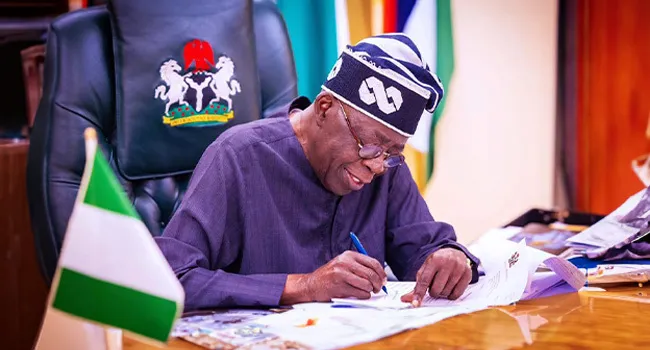
President Bola Tinubu on Thursday signed into law four major tax reform bills, marking what he described as the beginning of a new era in Nigeria’s economic governance.
The signing ceremony, held at the Presidential Villa in Abuja, was witnessed by the leadership of the National Assembly, several governors, cabinet ministers, and top presidential aides.
The four laws — the Nigeria Tax Bill (Fair Taxation), Nigeria Tax Administration Bill, Nigeria Revenue Service (Establishment) Bill, and the Joint Revenue Board (Establishment) Bill were passed by the National Assembly in May 2025 after a prolonged period of stakeholder engagement, legislative negotiations, and political pushback from some quarters.
The reforms were initially introduced in October 2024 as part of President Tinubu’s broader economic recovery strategy following the removal of petrol subsidies.
The administration had argued that Nigeria’s complex and inefficient tax structure was a major barrier to investment, economic productivity, and public trust.
According to the Presidency, the new laws will consolidate and modernise Nigeria’s fragmented tax system, enhance revenue generation without overburdening the public, and promote accountability across all tiers of government.
In a statement posted on his official X handle shortly before the signing, President Tinubu described the new laws as bold and necessary reforms aimed at correcting long-standing inefficiencies and unfairness in the tax regime.
Prior to signing the bills, Tinubu said, “In a few hours, I will sign four landmark tax reform bills into law, ushering in a bold new era of economic governance in our country,” he wrote. “Let the world know that Nigeria is open for business, and this time, everyone has a fair shot.”
The President said the reforms are not merely technical adjustments, but a deliberate intervention to ease the economic burdens of ordinary Nigerians.
He said the new legal framework introduces the first major pro-people tax cuts in a generation, including targeted relief for low-income earners, small businesses, and working families.
One of the key provisions of the Nigeria Tax Bill is a new exemption that shields minimum wage earners from personal income tax.
According to the administration, this measure is expected to bring relief to millions of Nigerians at the bottom of the income ladder.
Tinubu also said the reforms would address redundancy and corruption by harmonising overlapping agencies, reducing the cost of tax compliance, and encouraging formalisation of businesses.
The Nigeria Revenue Service (Establishment) Bill creates a new unified tax authority to replace multiple federal tax collection bodies, while the Joint Revenue Board (Establishment) Bill aims to streamline intergovernmental coordination between federal, state, and local revenue agencies.
The legislative journey to the bills’ passage had been contentious. Several governors, particularly from the northern part of the country, had opposed aspects of the reforms, especially the proposed derivation-based revenue allocation for Value Added Tax (VAT).
Critics argued that the move could shift fiscal advantage to southern states with higher levels of consumption and economic activity.
After weeks of negotiations, lawmakers agreed to retain the VAT rate at 7.5 percent, while introducing compensatory mechanisms to address equity concerns.
During Thursday’s ceremony, President Tinubu acknowledged the initial resistance, but praised the eventual consensus-building efforts that led to the passage of the harmonised versions of the bills.
He thanked members of the National Assembly, the Presidential Fiscal Policy and Tax Reform Committee led by Mr. Taiwo Oyedele, and the sensational governments for their input and support.
He said that the tax laws form part of a larger blueprint to improve Nigeria’s business climate, strengthen public institutions, and reduce over-reliance on oil revenue.
“We are laying the foundation for a tax regime that is fair, transparent, and fit for a modern, ambitious Nigeria,” the President said.
“A tax regime that rewards enterprise, protects the vulnerable, and mobilises revenue without punishing productivity.”
Tinubu added that the reforms would help rebuild investor confidence in Nigeria’s economy, which has suffered from prolonged instability, regulatory uncertainty, and weak infrastructure.
He said the new laws send a signal to both domestic and international investors that Nigeria is ready to engage with the global economy on modern, competitive terms.
He emphasised that the tax overhaul was not a one-off event, but the beginning of a sustained process to realign government revenue with development priorities.
“We are not just signing tax bills; we are rewriting the social contract,” he said. “We are not there yet, but we are firmly on the road.”
The new tax framework is expected to be implemented in phases, with accompanying regulations and institutional restructuring to follow.
The Presidency said details of implementation timelines, guidelines for exemptions, and mechanisms for taxpayer engagement would be released by the Federal Ministry of Finance in collaboration with the new Nigeria Revenue Service.
In another development, President Tinubu declined to sign the National Drug Law Enforcement Agency (NDLEA) Bill, 2025 into law.
The President’s decision was conveyed in a letter to the House of Representatives and read during plenary on Thursday.
The bill, which had been passed by both chambers of the National Assembly, proposed that the NDLEA be allowed to retain a portion of the proceeds recovered from drug-related crimes.
However, Tinubu rejected the clause, saying it contradicts existing financial regulations governing the handling of seized assets.
He cited Section 58(4) of the 1999 Constitution (as amended) which empowers him to withhold assent to bills considered inconsistent with current laws.
The President explained that under the existing system, all proceeds from crime are paid into the government’s Confiscated and Forfeited Properties Account.
He noted that any disbursement to recovery agencies like the NDLEA must be approved by the President and subject to the consent of the Federal Executive Council and the National Assembly.
Tinubu maintained there was no compelling reason to alter a process designed to ensure accountability and oversight.
He warned that bypassing established procedures could undermine transparency and create room for financial abuse.
The rejection of the bill means it will either be amended by the National Assembly or reintroduced in a different form for reconsideration.