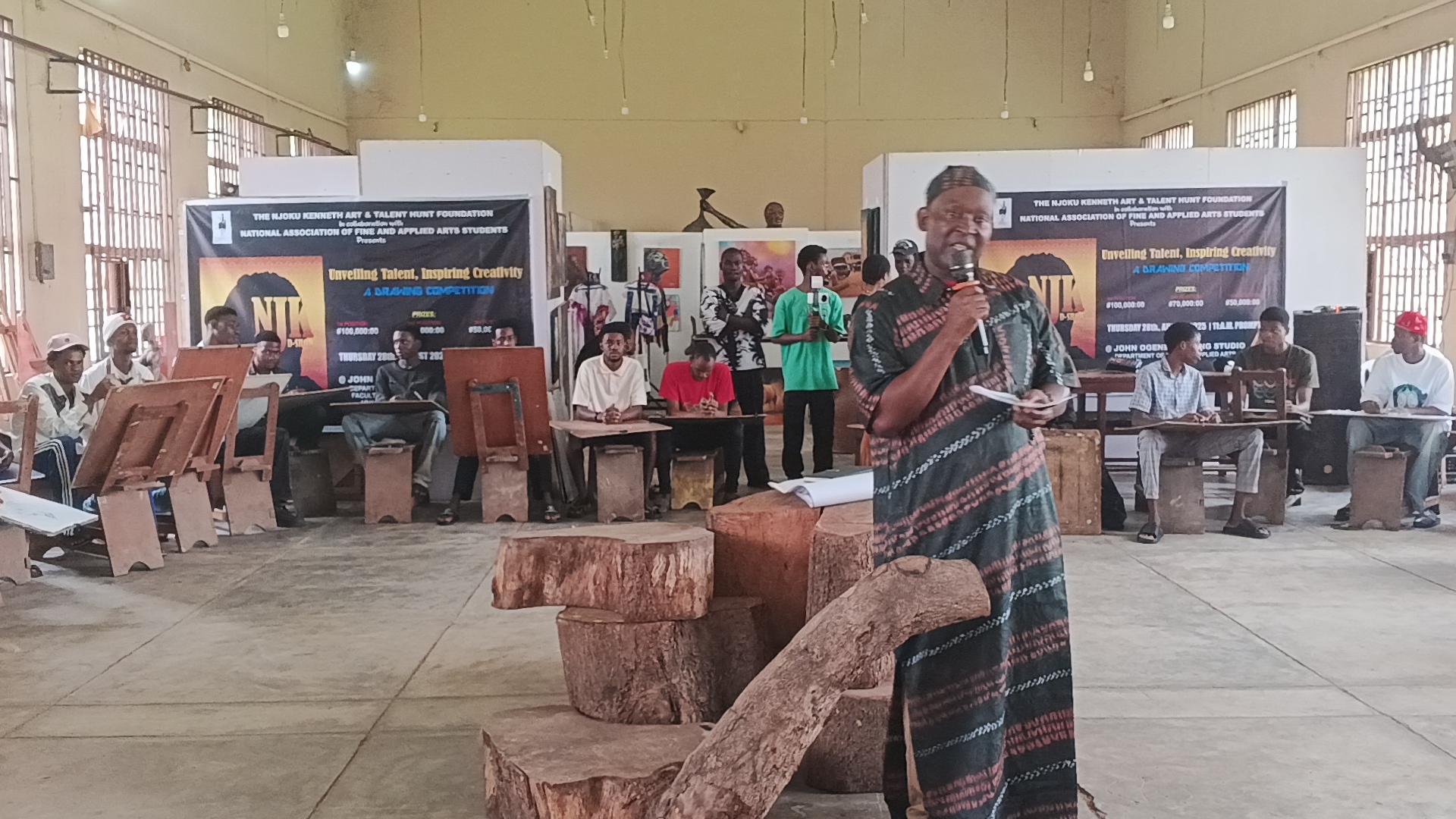
In a period when the relevance of practical studio discipline is increasingly challenged by digital distractions, economic uncertainty, and declining institutional support for the arts, initiatives that seek to revive and sustain foundational artistic practice deserve critical attention. One such intervention is the Njk D-Show, an annual competitive drawing exhibition initiated by Dr. Njoku Kenneth Iheukwumere, a Senior Lecturer at Wigwe University, Isiokpo, Rivers State. Hosted by the Njoku kenneth Art and Talent Hunt Foundation in collaboration with the National Association of Fine and Applied Arts Students (NAFAAS), University of Benin, the initiative has steadily evolved into a significant contribution to contemporary visual art practice and art education in Nigeria.
Conceived as a talent discovery and empowerment platform, the D-Show is rooted in the philosophy of art-dey-pay. This popular expression, deeply embedded in contemporary Nigerian creative culture, rejects the long-held misconception that artistic practice lacks economic viability or social relevance. Instead, it affirms art as a productive enterprise capable of generating value, sustaining livelihoods, and shaping cultural identity. Through the D-Show, Dr. Njoku transforms this philosophy into a practical and educational framework aimed at mentoring younger generations of artists while strengthening the culture of drawing as the bedrock of fine and applied arts.
Drawing has historically remained the foundation upon which artistic mastery is built. Whether in painting, sculpture, graphics, textiles, ceramics, or digital design, the ability to draw effectively reflects a practitioner’s understanding of form, proportion, anatomy, composition, perspective, and visual interpretation. Yet, in many contemporary institutions, drawing is increasingly neglected or treated merely as an introductory exercise rather than a lifelong discipline. The Njk D-Show therefore emerges as a timely intervention that restores attention to drawing as both a technical skill and an intellectual process essential to artistic development.
Structured as a merit-based competition for undergraduate students, the D-Show rewards creativity, technical excellence, originality, and studio discipline. Winners are recognized through substantial cash prizes awarded to first, second, and third positions, while additional finalists receive consolation prizes and certificates of participation. This reward system serves not merely as financial encouragement but also as a symbolic recognition of artistic labour and commitment.
The growth trajectory of the competition demonstrates both vision and sustainability. The first three editions were exclusively open to undergraduate students of the University of Benin, where the initiative quickly gained recognition among emerging artists and educators. Over time, however, the D-Show outgrew its original institutional boundaries. The fourth edition marks a significant expansion through the inclusion of four additional tertiary institutions: Ambrose Alli University, Ekpoma; Delta State University, Abraka; the University of Port Harcourt; and Auchi Polytechnic, Auchi. This regional expansion represents an important shift from a campus-based competition to a broader inter-university cultural platform capable of fostering artistic dialogue and healthy competition across institutions.
Beyond the competitive framework, the D-Show reflects a deeper educational philosophy centered on mentorship, exposure, and professional development. Through the exhibition component of the event, participating students gain the rare opportunity to publicly present their works, interact with audiences, and build confidence in their artistic identity. For many young artists, such opportunities remain scarce within conventional academic settings, where creative outputs are often confined to studio assessments and departmental exhibitions with limited public engagement.
Importantly, the initiative also acknowledges the need for art events to engage wider audiences beyond academic circles. The inclusion of comedy, dance drama, and musical performances as side attractions introduces a multidisciplinary dimension that enhances the social appeal of the event while broadening participation. In doing so, the D-Show positions visual art within a larger ecosystem of creative and cultural production, reinforcing the interconnectedness of Nigeria’s creative industries.
The increasing financial commitment attached to the competition further underscores its seriousness and growing impact. Previous editions offered prize categories of ₦100,000, ₦70,000, ₦50,000, and ₦40,000 alongside gift items and consolation prizes. This year’s edition promises a remarkable upward review, with winners expected to receive ₦200,000, ₦150,000, ₦100,000, and ₦50,000 respectively, in addition to other prizes. In a country where many young artists struggle to access institutional grants, scholarships, or sponsorship opportunities, such incentives represent meaningful investments in artistic potential.
However, the true significance of the D-Show extends beyond monetary rewards. Its broader cultural value lies in its attempt to preserve the vitality of studio practice within Nigeria’s evolving art ecosystem. The initiative responds directly to concerns about declining technical proficiency among younger artists and the gradual erosion of rigorous studio culture. By emphasizing sustained practice, discipline, and creative experimentation, the competition reasserts the importance of craftsmanship in contemporary artistic production.
The continued success and expansion of the Njk D-Show would not have been possible without the generous financial support of several individuals who share the vision of promoting artistic excellence and empowering young creatives. The organizers therefore acknowledge and appreciate the invaluable contributions of Mrs. Nkem Ngbemene, Mrs. Julia Kelechi Amadiobi, Prof. Francis Ikwugbu, Mr. George Edozie, Mr. Godfrey Williams Okorodus, Mr. Joe Oguy Akpene, Mrs. Ufuoma Odiete, Mr. Victor Ibekwe, Ms. Kennette Nwabuoku, Mr. Paul Akhionbare, Mr. Lawrence Nuntah, Mr. Diola Balogun, and Mr. Emmanuel Ubammadu. Through their financial sponsorship and unwavering encouragement, these distinguished supporters have contributed significantly to the realization of the programme’s objectives. Their commitment demonstrates a shared belief in the transformative power of art education and the importance of investing in emerging talents. Such philanthropic support not only sustains the competition but also strengthens the broader culture of mentorship, creativity, and artistic development within Nigeria’s visual arts sector.
The mission statement of the Kenneth Njoku Art and Talent Hunt Foundation captures this vision succinctly. Dedicated to discovering and nurturing young artistic talent through drawing, the initiative seeks not only to reward creativity but also to inspire innovation and prepare emerging artists for impactful contributions to Nigerian and global art. This dual emphasis on local relevance and global engagement is particularly important in an era where African contemporary art is gaining increased international visibility and market recognition.
Indeed, Nigeria’s contemporary art scene has witnessed growing global attention through auctions, biennales, residencies, and international exhibitions. Yet, the sustainability of this visibility depends largely on the ability of institutions and practitioners to cultivate younger generations equipped with strong technical foundations and conceptual depth. Initiatives such as the Njk D-Show therefore function as critical pipelines for artistic continuity and professional growth.
Dr. Njoku Kenneth Iheukwumere’s intervention also reflects an emerging model of artist-led educational philanthropy in Nigeria. Rather than waiting for governmental or institutional structures to provide support, practitioners are increasingly creating independent platforms that address gaps within the creative sector. Such efforts demonstrate how individual commitment can generate meaningful cultural impact, especially within societies where arts funding remains limited.
Ultimately, the Njk D-Show represents more than a drawing competition. It is a cultural movement advocating for the restoration of artistic discipline, the celebration of youthful creativity, and the democratization of opportunity within Nigerian art education. By combining competition, exhibition, mentorship, entertainment, and financial empowerment, the initiative provides a holistic model for nurturing future generations of artists.
As the fourth edition opens its doors to wider institutional participation, the D-Show signals the possibility of becoming one of Nigeria’s most influential undergraduate art platforms. Its continued growth may well inspire similar initiatives across the country, thereby contributing to a stronger, more dynamic, and professionally sustainable visual arts culture in Nigeria.