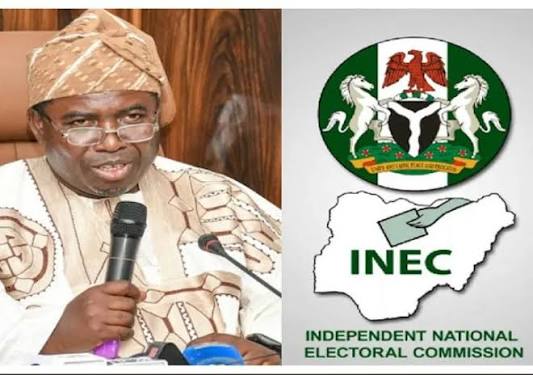
The Independent National Electoral Commission (INEC) says it is finalising arrangements to enable Internally Displaced Persons (IDPs) to participate in the 2027 general elections, as the Commission begins the final process of cleaning up Nigeria’s voter register, which now contains more than 103 million registered voters.
INEC Chairman, Prof. Joash Amupitan, SAN, disclosed this on Friday during an engagement with the ECOWAS Pre-Election Fact-Finding Mission at the Commission’s headquarters in Abuja.
The chairman said the Commission was committed to ensuring that eligible Nigerians, including those displaced by insecurity and other emergencies, were not disenfranchised in the forthcoming elections.
He said arrangements were being finalised to address the voting needs of IDPs as part of INEC’s preparations for an inclusive electoral process.
On the voter register, Amupitan disclosed that the Commission had completed three phases of the Continuous Voter Registration exercise and concluded the physical display of the Preliminary Register of Voters at registration areas nationwide.
He said the preliminary register had also been uploaded to INEC’s dedicated online portal to enable registered voters to scrutinise their details and submit claims and objections before the final register is certified on December 15, 2026.
According to him, the Commission has so far completed nine of the 14 major statutory activities outlined in its revised timetable for the 2027 general elections.
The Presidential and National Assembly elections are scheduled for January 16, 2027, while the governorship and State Houses of Assembly elections will hold on February 6, 2027.
Amupitan said INEC had also conducted readiness assessment tours across the South-West, North-West, South-East and North-East geopolitical zones to evaluate preparations at the grassroots.
He said the assessment exercise would be extended to the South-South, with Port Harcourt, Rivers State, selected as the next destination.
The visits, according to him, are designed to inspect electoral infrastructure, assess logistics, interact with field officials and engage traditional and community leaders ahead of the polls.
On the deployment of technology, the INEC chairman said the Bimodal Voter Accreditation System (BVAS) would be used for fingerprint and facial biometric accreditation.
He also highlighted the electronic result management systems, including the newly introduced eEC8A electronic verification platform, as measures to strengthen transparency in the collation and verification of election results.
Amupitan further disclosed that INEC was working with security agencies under the Inter-Agency Consultative Committee on Election Security (ICCES) to protect voters, election officials and materials.
He said the Commission had introduced an intelligence-driven security framework known as the ICCES Tentacle to identify potential threats and strengthen security across the country’s 176,846 polling units.
He specifically identified the protection of ad-hoc election personnel, particularly members of the National Youth Service Corps, as a priority, alongside ensuring access to polling facilities for persons with disabilities.
On staff welfare, the INEC chairman said the Commission had secured approval for the Consolidated Election Management Body Salary Structure (CEMBSS) and a 150 per cent increase in state operational overheads.
He, however, warned that the improved welfare package would be matched with zero tolerance for negligence, extortion and partisan conduct among electoral officials.
The chairman also called for continued cooperation with ECOWAS in election observation, voter education, combating electoral disinformation and addressing logistical challenges.
He urged political parties, civil society organisations, the media and security agencies to contribute to peaceful and credible elections through responsible conduct and effective collaboration.
Amupitan assured the delegation that INEC had no preferred candidate or political party, declaring that the Commission’s allegiance remained with the rule of law and the will of Nigerian voters.
The ECOWAS Pre-Election Fact-Finding Mission was led by former Sierra Leone Vice-President Victor Bockarie Foh, with former ECOWAS Executive Secretary and former Speaker of the Sierra Leone Parliament, Dr Abbas Chernor Bundu, serving as co-head.
The delegation is engaging relevant stakeholders as part of its assessment of Nigeria’s preparedness for the 2027 general elections.