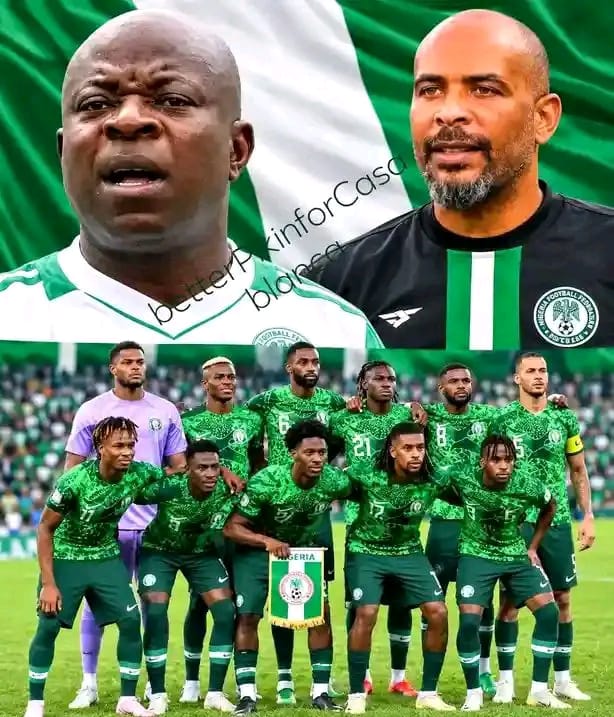
Nigeria’s painful exit from the race for the 2026 FIFA World Cup has now taken a disturbing new dimension. What Nigerians were told was a footballing defeat in Rabat is increasingly looking like a governance controversy that FIFA must answer.
The Super Eagles lost to the Democratic Republic of Congo on penalties after a 1–1 draw, but new revelations indicate that FIFA officials themselves had identified an eligibility problem involving DR Congo goalkeeper Lionel Mpasi.
The significance of the revelation cannot be overstated. According to documents reviewed by The New York Times and reported by the Associated Press, FIFA’s own legal officials determined that Mpasi had not completed the required process to change his international association from France to DR Congo. Yet he continued playing for DR Congo, including in the decisive playoff against Nigeria.
This is no longer simply a Nigerian complaint against another African football federation. Nigeria filed its complaint after the match, challenging the eligibility of several DR Congo players. FIFA rejected the complaint on what has been described as a technicality relating to the timing of the filing. But the new information raises the obvious question: if FIFA itself subsequently identified an eligibility problem, why was the sporting consequence not allowed to follow?
That question becomes even more important because FIFA reportedly considered several possible courses of action. According to the documents reported by the New York Times, those options included sanctioning DR Congo, awarding the match to Nigeria, replacing DR Congo with Nigeria in the intercontinental playoff, or taking no action. The final outcome was that DR Congo continued.
The consequences were enormous. DR Congo went on to defeat Jamaica in the intercontinental playoff and secured its first World Cup appearance in 52 years. Nigeria, meanwhile, remained outside the tournament. In other words, a decision concerning eligibility potentially affected not merely one match but the identity of an entire World Cup participant.
This is why Nigeria deserves more than another explanation from football administrators. If an independent investigation establishes that an ineligible player participated in a match that determined which country proceeded to the next stage, then FIFA must consider an appropriate remedy for Nigeria, even if restoring Nigeria’s place at the 2026 World Cup is no longer practically possible.
Compensation should therefore be part of the conversation. It would not be a substitute for sporting justice, but it could represent a recognition of the financial and institutional consequences suffered by Nigeria. World Cup qualification brings broadcasting opportunities, sponsorship value, commercial exposure, bonuses, preparation opportunities and international prestige. Losing that opportunity because of an eligibility issue is fundamentally different from simply losing a football match.
But there is an even bigger issue here: consistency. Football cannot have one rule for one federation and another rule for another. FIFA has previously imposed sporting consequences in eligibility cases. The AP has pointed to the 2018 World Cup qualifying case involving Bolivia, where matches were forfeited after an ineligible player was fielded. That history makes the handling of the DR Congo case deserving of serious scrutiny.
FIFA’s own regulations make eligibility and changes of association a formal process. Indeed, FIFA published updated guidance on player eligibility and change of association in September 2026, stressing the procedures and documentation required for such cases. That makes the question surrounding Mpasi particularly difficult to dismiss as an obscure technicality.
There is also the question of timing. Nigeria had already complained about player eligibility. FIFA’s later discovery, according to the reports, concerned a player who had participated in the very qualifying campaign that ultimately took DR Congo to the World Cup. If the governing body’s own officials knew there was a problem, Nigerians are entitled to ask why the matter did not receive a sporting resolution before DR Congo’s qualification was completed.
The issue also inevitably brings FIFA President Gianni Infantino into the wider conversation, although an important distinction must be maintained. The reports do not establish that Infantino personally ordered the rejection of Nigeria’s complaint or personally intervened to protect DR Congo. FIFA has maintained that its disciplinary bodies are independent and make decisions according to the regulations and facts before them.
Nevertheless, questions about institutional relationships will not disappear. DR Congo’s football federation president, Véron Mosengo-Omba, has a long professional relationship with Infantino. The two men studied at university in Switzerland and subsequently worked within European and international football structures. That relationship does not prove wrongdoing, but it makes transparency and independent scrutiny even more important when a decision involving DR Congo is being questioned.
That is why allegations of secret payments or “money deals” should not be presented as established fact without evidence. Such allegations are extremely serious. If evidence eventually emerges of bribery, financial inducement or improper interference, then the matter would move from a football eligibility controversy into a potentially much larger corruption investigation. For now, the documented questions about FIFA’s handling of the case are already serious enough without adding claims that have not been proven.
Nigeria’s response should therefore be bigger than anger. The NFF should demand the complete legal record, the reasoning behind the disciplinary decision, the internal assessment of Mpasi’s eligibility, the basis for the filing-deadline argument and the identity of the decision-making bodies involved. If necessary, Nigeria should take the matter through every available appeal and arbitration mechanism.
The NFF also needs to explain to Nigerians exactly what happened after its original complaint. The federation announced in March that it was dissatisfied with FIFA’s rejection and had begun the appeal process. The latest revelations make it imperative that Nigerians are told where that process stands and what legal avenues remain open.
There should also be a call for an independent investigation. FIFA investigating FIFA’s own handling of a controversy will inevitably raise questions about independence. A credible review should examine the eligibility process, the complaint, the internal legal advice, the disciplinary decision, the applicable deadlines and whether the regulations were applied consistently with previous cases.
And DR Congo should not simply walk away from this controversy without consequences if an eligibility breach is confirmed. At the very least, a substantial fine and appropriate disciplinary measures against the responsible football authorities should be considered. If officials knowingly submitted incomplete or misleading information to FIFA, the consequences should extend beyond the player involved.
But justice cannot be reduced to punishing DR Congo. The central issue is what happens to Nigeria. A fine paid by DR Congo would not restore Nigeria’s lost World Cup opportunity. Nor would an apology erase the commercial and sporting consequences of missing the tournament. FIFA therefore needs to confront the question of whether some form of compensation or other meaningful remedy can be provided.
The tragedy is that Nigeria may never know what would have happened against Jamaica. Perhaps the Super Eagles would have qualified. Perhaps they would not. Football does not permit history to be replayed. But that uncertainty cannot become an excuse for ignoring a potentially decisive eligibility violation. The integrity of competition requires that the rules be enforced before the consequences become irreversible.
Nigeria also needs to ask a painful question about its relationship with FIFA. If the revelations are substantiated, Nigerian football cannot simultaneously demand justice from world football’s governing body and behave as though nothing happened. Diplomacy is important, but diplomacy should never mean surrendering legitimate institutional interests.
This is particularly relevant because Infantino is seeking another term as FIFA president. The controversy does not by itself establish personal wrongdoing by him, but it makes transparency around FIFA’s decision-making more important at precisely the moment when football associations are considering the leadership of the organisation. African federations should be asking questions based on evidence, rules and institutional accountability rather than personalities or political friendships.
The story therefore should not end with Nigeria shouting that it was cheated. It should end with football demanding answers. Was the player eligible? Did FIFA know? When did FIFA know? Why was Nigeria’s complaint rejected? Why were the sporting sanctions reportedly considered but not imposed? Were the same standards applied that FIFA has applied in previous eligibility cases? And what remedy is available to the country that lost its World Cup opportunity?
Nigeria deserves answers to those questions. DR Congo deserves a fair process. FIFA deserves scrutiny. And African football deserves a system in which the identity of the country advancing to a World Cup is determined on the football field under rules that are applied equally to everybody.
If the evidence ultimately establishes that DR Congo used an ineligible player and that FIFA knew of the problem but failed to apply the appropriate sporting consequence, then this will be much bigger than Nigeria versus DR Congo. It will become a test of whether FIFA’s promise of fair play applies equally to its most powerful members and its most politically important relationships. And that is a test FIFA cannot afford to fail.