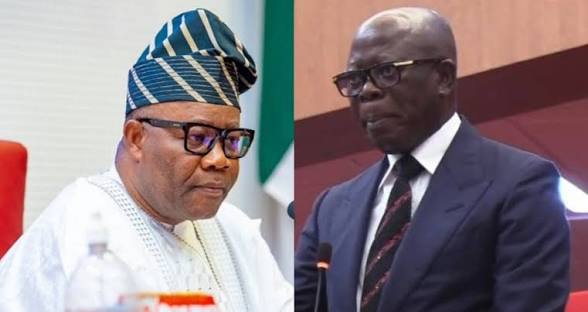
There was uproar on the floor of the Senate, Thursday, as Haliru Nababa, Comptroller General of the Nigerian Correctional Service (NCS), revealed that the department spends more money to feed each of its security dogs than it does on each inmate.
Answering questions on the floor of the Senate, Nababa said the correctional service spends N750 on feeding per day for each of its 81,358 inmates (being N250 per meal per inmate), while it maintains each of its 900 dogs at a daily cost of N800 per day.
Nababa was speaking during the budget defence with the National Assembly Joint Committee on the Interior.
The Committee strongly criticised the Correctional Service for its inhumane treatment of inmates in its custody.
Senator Adams Oshiomhole (APC, Edo North) who chaired the committee demanded a breakdown of inmate numbers, their feeding regime, and the expenses associated with maintaining security dogs.
Nababa revealed there are 81,358 inmates, with 53,362 awaiting trial, and that each inmate is fed thrice a day with an allocation of N750 daily (N250 per meal).
He further claimed that the service maintains 900 security dogs, incurring a daily cost of N800 per dog for their sustenance.
However, dissatisfaction arose when Senator Ireti Kingibe (LP, FCT) questioned the medical and veterinary care available to the inmates and dogs.
Nababa initially seemed unprepared, conferring with his team before disclosing the presence of 75 medical doctors and consultants, and six veterinary doctors, covering multiple states.
Expressing his disappointment, Senator Oshiomhole noted the inadequacies and deplorable conditions faced by inmates, emphasising that the committee would not hastily approve any budget until satisfactory explanations were provided.
Challenging the feasibility of feeding inmates at N750 per day, Oshiomhole questioned the officials, citing the market prices of essential items and the inability of such an allocation to cater to basic needs adequately.
Nababa appealed to lawmakers for assistance, revealing a request to the President for an increase in daily feeding allowances to N3,000 per inmate.
The joint sitting involved lawmakers such as Rep. Adebayo Balogun (APC, Lagos), Senators Oshiomhole (APC, Edo North), Francis Fadahunsi (PDP, Osun East), Senator Yahaya Abdullahi (PDP, Kebbi North), Ezenwa Onyewuchi (LP, Imo East), Ireti Kingibe (LP, FCT), and others.
Edo govt, China-based poly seal deal to strengthen TVET
The Edo State Governor, Mr. Godwin Obaseki, has said that the State Government has formalized a partnership with China’s Shaanxi Polytechnic Institute to strengthen Technical and Vocational Education and Training (TVET) in the State.
The collaboration seeks to establish a mutually beneficial relationship, fostering academic and expertise exchange between Shaanxi Polytechnic and Edo State Polytechnic, Usen, with a primary focus on the enhancement of technical education and the establishment of a Chinese language and cultural centre in the State.
The Governor disclosed this during his budget presentation at the Edo State House of Assembly, while presenting the 2024 budget to the Assembly.
The milestone agreement was sealed during the recent visit of Edo State Governor, Mr. Godwin Obaseki, accompanied by the Commissioner of Education, Dr. Joan Osa Oviawe, and the Rector of Edo State Polytechnic, Usen, Engr. Sylvester Omoruyi, to China for the 10th Anniversary of the Belt and Road Global Chambers of Commerce and Associations Conference.
Highlighting the essence of this collaboration, Dr. Oviawe said, “The Edo State Government actively pursued this partnership to fortify the TVET framework within Edo State Polytechnic, Usen, through cooperation with Shaanxi Polytechnic Institute.”
Dr. Oviawe emphasized that the MOU aims to localize Shaanxi Polytechnic’s curriculum to enrich Edo State Polytechnic’s academic structure and facilitate knowledge transfer, commencing from the 2023 academic session.
The agreement encompasses a comprehensive strategy for capacity building, including the exchange of scholars, joint research ventures, and the establishment of cross-cultural educational programmes. These initiatives are designed to diversify the academic landscape, providing students and faculty with varied perspectives and innovative methodologies.
In a bid to further enhance educational insights, the leadership of Edo State’s education sector, along with officials, will embark on an educational study tour to Shaanxi Polytechnic Institute. This visit intends to expose delegates to both traditional and modern knowledge and learning methodologies employed by the institute.
Moreover, the partnership will lead to the introduction of new programmes and the creation of a dual Diploma Award, enabling Edo Polytechnic students to spend two years in Nigeria and a subsequent year in China upon graduation.
However, this collaboration extends beyond academia; it embraces cultural exchanges. Edo Polytechnic students eagerly await the chance to immerse themselves in Shaanxi’s rich heritage. As part of this exchange, the Institute will collaborate with the Edo State Government to establish a Chinese Language and Cultural Centre in Edo State.