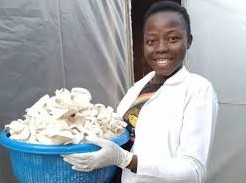
An increasing number of young Nigerians are going into mushroom farming using techniques that are way different from conventional methods, says Etimbuk Imuk, noting that she has taken mushroom farming as a major occupation.
According to Etimbuk, she not only grows mushrooms but she has also diversified into mushroom dishes for the public and mushroom workshop, as she speaks with the press in Calabar.
The traffic of consumers at her Mushroom Hangout in a Lagos suburb includes those patronizing as a result of the nutrients and health values.
Etimbuk explains that “today’s mushroom farming is a soil-less urban farming technique that is grown using sawdust and other agricultural wastes like rice bran. It is grown vertically.”
Etimbuk’s farm sits on a quarter plot of land. Unlike other types of farming, mushrooms do not need much land space for cultivation and no pesticides either.
“You don’t need chemicals or pesticides to grow mushrooms. It’s an organic farming system whose duration is not time consuming. It takes only three months from planting to harvest. Mushroom farming uses up waste. It conserves the environment, so that there is no pollution from chemicals.
“Mushroom farming is now profitable because many have discovered its health benefits,” she states.
In addition, mushrooms are capable of giving those interested considerable comforts of sorts, she notes.
Etimbuk, who has her farm in Lagos, says, “It is a good source of income and one can also earn foreign exchange from mushroom farming,” encouraging more Nigerians, individually and in groups or as government, to venture into this type of farming.
She says because the health benefits are enormous, which is why she has diversified into preparing mushrooms for public consumption, saying, “We’re revolutionizing the way Nigerians and Africans access healthy protein by cultivating organic mushrooms and processing them into NAFDAC certified products.
“Mushrooms are protein sources. This is why we have the concept of Mushroom Meals Hangout where food enthusiasts are welcomed.
“In our farms, we promote mushroom-based dishes, cooking classes and workshops, and people enjoy a healthier alternative to animal protein.”
Mushroom Meals Hangout has become a hub for mushroom enthusiasts to such an extent women and youths have gained employment and sustainable livelihoods, she states.
Etimbuk adds that they share knowledge about mushrooms through training in the ecosystem, tackling food security and climate action through their eco-friendly plant protein source.
She discloses that they have packaged their mushroom to meet international standard, and are sold in supermarkets across Lagos and other states.