OKADA — Africa’s foremost productivity consultant, Dr. Sam Ikoku, has called on the leadership of Igbinedion University, Okada (IUO), to adopt a five-year strategic impact plan aimed at transforming the institution into a “University 2.0” model driven by innovation, research, technology and workforce development.
Ikoku also urged the Federal Government to reconsider the exclusion of private universities from TETFund research grants, insisting that such support should be viewed not as operational subsidies, but as strategic investments in Nigeria’s research competitiveness and innovation ecosystem.
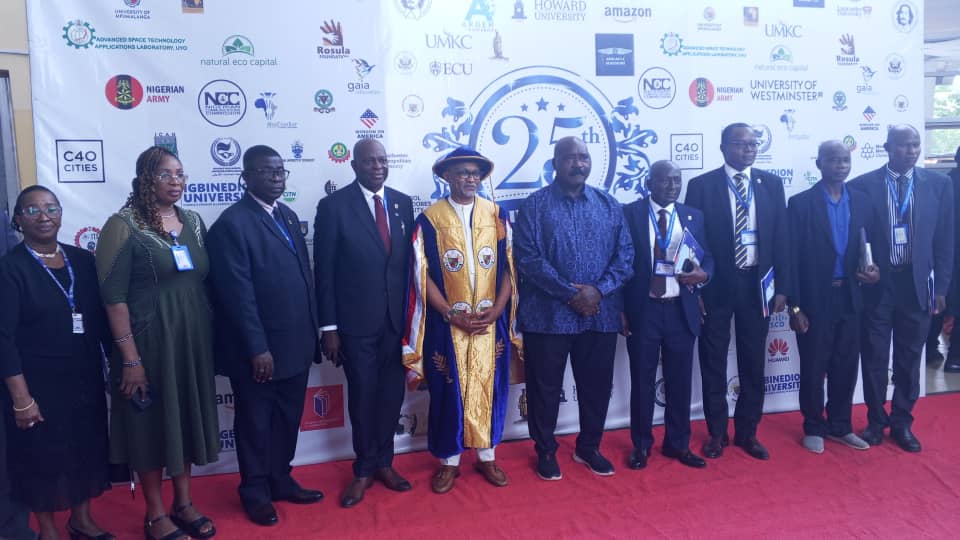
The renowned consultant made the call while delivering the keynote address at the 27th Founder’s Day ceremony of Igbinedion University held at the institution’s Library Conference Hall on Saturday, May 16, in Okada, Edo State.
Speaking on the theme, “Keeping the University Dream in a Fragile Ecosystem,” Ikoku said Nigerian universities must evolve beyond traditional academic structures to meet the realities of a rapidly changing global economy.
According to him, universities established decades ago were designed for a different era and must now reposition to address the demands of a digital economy, energy transition, innovation-driven industries and continuous workforce transformation in a country of over 200 million people.
“The university of 1999 was built for a different Nigeria. The university of 2026 must be designed for the Nigeria we are becoming,” he said.
Ikoku explained that the proposed “University 2.0 Model” is built on eight strategic pillars designed to reposition universities from conventional degree-awarding institutions into knowledge infrastructure hubs serving national and regional development needs.
The pillars, he noted, include Revenue and Resilience, Excellence and Specialisation, Strategic Talent and AI Augmentation, Infrastructure and Innovation, Leadership and Governance, Innovation and Commercialisation, Corporate University and Workforce Transformation, as well as Thought Leadership and Centres of Excellence.
He further challenged IUO to leverage its status as Nigeria’s first private university to galvanise private tertiary institutions into a strong advocacy bloc capable of engaging the Executive and Legislature on reforms to the Education Tax framework.
Ikoku also advocated a five-year moratorium on the approval of new private universities to enable consolidation and improve quality standards within the sector.
“Allow quality to catch up with quantity,” he stated.
He urged agencies such as the Nigerian Content Development and Monitoring Board (NCDMB), TETFund and other federal institutions to prioritise Nigerian private universities for training and research contracts instead of outsourcing such opportunities abroad.
“Stop the leakage of billions to foreign institutions when local capacity exists,” he said.
Addressing students and alumni, Ikoku stressed that education should not merely be about obtaining certificates, but about building institutional legacy and solving societal problems.
“The university dream is not the buildings; it is the human capacity we build and the problems we solve,” he added.
He also called for the preservation of a healthy academic environment free from harassment and distractions, with strong emphasis on knowledge development and innovation.
On the broader education ecosystem, Ikoku maintained that despite existing challenges, Nigeria’s demographic realities present enormous opportunities for private universities to drive national development.
“Nigeria’s demographic dividend demands 21st-century graduates. Private universities can deliver this if we stop treating education as a business and start treating it as nation-building infrastructure,” he said.
In his remarks, the Founder and Chancellor of Igbinedion University, Sir, Chief Gabriel Igbinedion, CON, CFR, the Esama of Benin Kingdom, described Founder’s Day as a moment of reflection, renewal and accountability.
Represented by the Deputy Chancellor, Chief Lucky Igbinedion, the Esama paid tribute to the institution’s Governing Council, academic and non-academic staff, development partners and alumni for their contributions to the university’s growth over the years.
He highlighted major achievements recorded by the institution in the last five years, particularly in accreditation and programme expansion.
According to him, all programmes offered by the university, including Medicine and Surgery, Engineering, Law, Natural Sciences, Social Sciences and Management Sciences, have secured full accreditation from the National Universities Commission (NUC) and relevant professional bodies.
He added that the university has also introduced emerging programmes in Artificial Intelligence, Cybersecurity and Renewable Energy Engineering in line with global trends and the demands of the 21st-century economy.
Chief Lucky Igbinedion urged stakeholders to work collectively towards positioning the institution as a globally competitive university in the coming decade.
“The next decade must be the decade when Igbinedion University becomes not just Nigeria’s premier private university, but a truly global institution,” he said.
Earlier in his welcome address, the Vice-Chancellor of the university, Prof. Lawrence Ezemonye, reaffirmed the institution’s commitment to academic excellence and the production of globally competitive graduates.
He noted that since its establishment on May 10, 1999, Igbinedion University has remained a shining example of the transformative impact of private participation in higher education in Nigeria.
Ezemonye credited the vision and commitment of the Founder for the institution’s enduring success and influence in the education sector.
“Founder’s Day offers us an opportunity not only to celebrate our achievements but also to reflect on the vision, sacrifices and determination that laid the foundation of this great institution,” he said.
The Vice-Chancellor disclosed that the university currently operates seven colleges and three schools with 96 accredited undergraduate and postgraduate programmes.
He added that the institution has produced over 16,000 graduates who are contributing meaningfully across various sectors within and outside Nigeria.