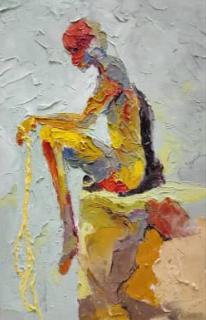
Opening today at the Prof. John Ogene Drawing Studio, University of Benin, Ekehuan Campus, Benin City, “The Anatomy and Physiognomy of the Mundane and the Extra in Ordinary Things”, is a new solo exhibition of miniature oil-on-canvas palette-knife works by UNIBEN Painting lecturer, Mrs. Esther Esizimetor.
Working within a practice-as-research framework, Mrs. Esizimetor interrogates women’s lived realities through material and metaphor. She adapts Italian artist Filippo Sciascia’s craquelure technique and reframes it through Kintsugi, the Japanese art of mending broken pottery with gold. The ordinary kitchen knife (palette-knife) becomes her central tool and symbol. Its edges both scar and shape the painted surface, mirroring how hardship wounds and defines female subjectivity.
The series responds to escalating gendered violence in Nigeria — abduction, domestic assault, betrayal, and femicide — while resisting the aestheticization of women’s pain. Thick, palette-knife impasto marks external bruises that point to deeper interior ruptures. Following Kintsugi logic, each cut is mended with a gold seam. Scars are not hidden but made luminous, asserting resilience over erasure.
Mrs. Esizimetor, a lecturer and head of the Painting Section, grounds the work in personal loss. The exhibition is dedicated to two former students who died in the last two years: one poisoned by a jealous friend, another who “slept and did not wake.”
“Women are at the centre of the good, the bad, and the ugly,” she writes. “Both genders suffer injustice in different ways, but the hurt and dishonour women feel from unhealthy relationships cannot be overemphasized.” In her words, “No woman should be subjected to raise her hands in defense of her person except to admire the paint polish of her fingers.”
Dr. Daniel Nosakhare Osariyekemwen, the Acting Head of Department, Fine and Applied Arts, UNIBEN, says of the works by the exhibitor: “These paintings exemplify evolving practices rooted in material legacies. Mrs. Esizimetor fuses European oil tradition, Japanese repair philosophy, and Nigerian socio-political realities to give survival a visual language. The Department is proud to host this courageous, humane contribution to contemporary art discourse.”