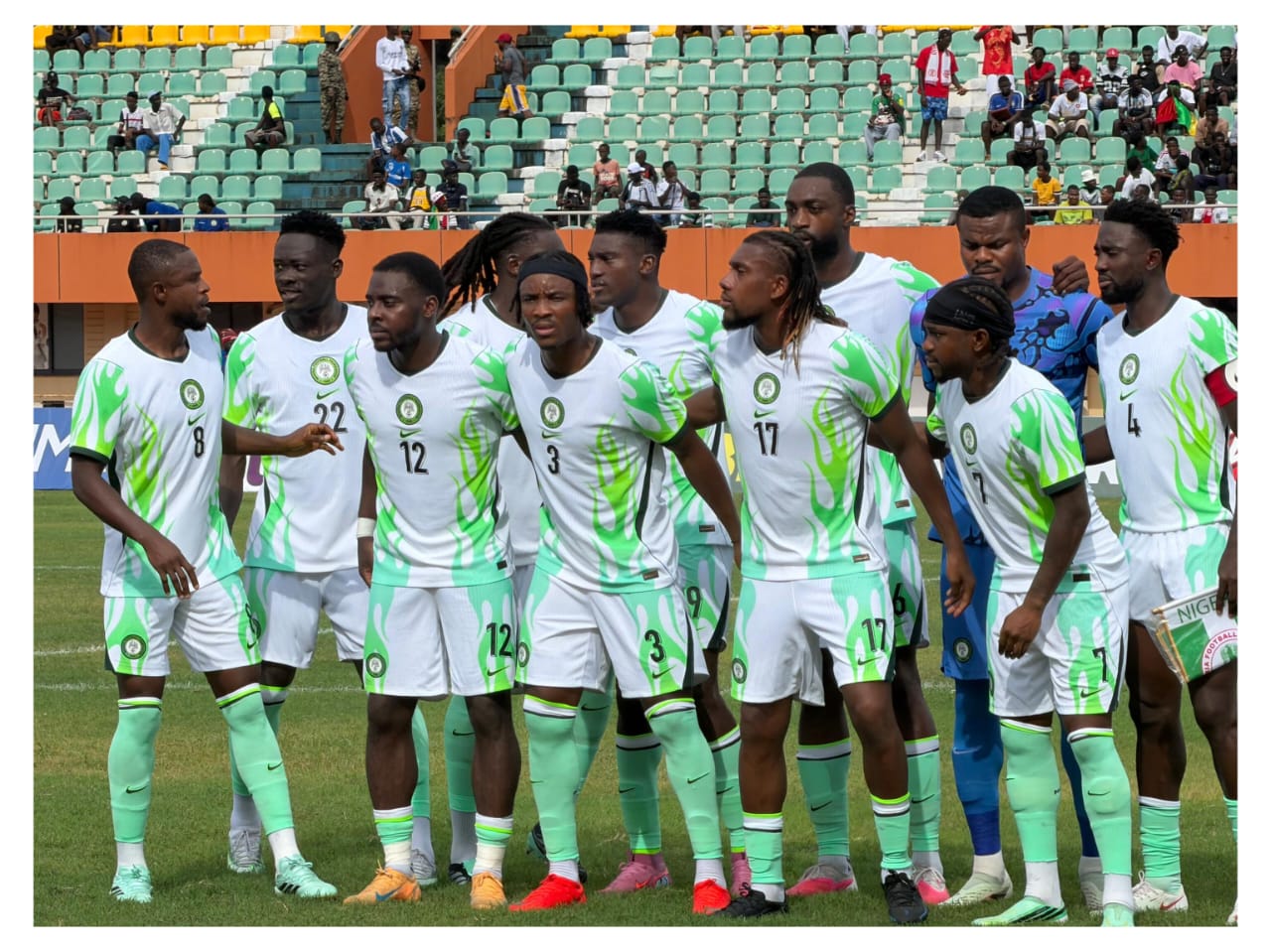
Another non-qualification for major tournament now looms over Nigeria’s football. The Super Eagles 3-0 defeat to Guinea-Bissau in Bissau was not merely a bad result; it was a warning about the complacency that has followed the Super Eagles for too long. Guinea-Bissau scored through Franculino Dju, Mama Baldé and Álvaro Djaló to hand Eric Chelle his first defeat in the ongoing 2027 Afcon qualifiers as Nigeria coach, leaving the Super Eagles on three points after two matches while Guinea-Bissau moved to six. After missing the 2026 World Cup, Nigeria cannot afford another major tournament failure.
The most troubling part is that this was not an opponent Nigeria suddenly discovered on the fixture list. The 2027 AFCON qualifying draw was conducted in Cairo on May 19, 2026, placing Nigeria in Group L alongside Madagascar, Tanzania and Guinea-Bissau. The dates, opponents and venues were known months in advance. So when the explanation after the defeat becomes the poor pitch, bad weather or lack of aggression, the obvious question is: what exactly was the technical department doing between May and September?
Respect your opponent — that should have been Lesson One. You do not stroll onto any African pitch believing that your badge, European-based players or FIFA ranking will win the match for you easily.
Guinea-Bissau are not a footballing giant, but they have repeatedly demonstrated that they can hurt Nigeria. They defeated the Super Eagles 1-0 in Abuja in the 2023 AFCON qualifiers before Nigeria won the return leg in Bissau. The same lesson was available three years ago, yet apparently nobody revisited the file.
The Maggi effect is simple: two or three quality ingredients can change the entire soup. If a supposedly smaller African nation has players competing abroad, you must identify where the danger lies. Guinea-Bissau had enough foreign-based quality to punish Nigeria, and their recent AFCON history should have demanded respect. They qualified for four successive tournaments from 2017 through 2023 before missing Morocco 2025. A serious technical department should know the club backgrounds, strengths, weaknesses and tendencies of the opposition before the team leaves Nigeria which brings us to the team analyst. What was the opposition analysis? Did anyone sit down with Chelle and identify the individual threats? Did anyone analyse how Guinea-Bissau wanted to attack the Nigerian full-backs? Did anyone study the conditions in Bissau and prepare the players for them? When the opposition scores three times, it is difficult to avoid questions about preparation. The pitch did not suddenly become bad on September 29; it was part of the environment in which the match was always going to be played.
Then comes the tactical problem: a diamond without genuine wingers can become suicide. The 4-4-2 diamond requires enormous work from the full-backs because they provide the width. It also requires midfielders who can cover huge areas and strikers who complement each other. Nigeria did not consistently get those ingredients right. The full-backs failed to provide sufficient width going forward and, more importantly, were repeatedly exposed defensively.
Bruno Onyemaechi and Bright Osayi-Samuel had a difficult evening. The argument is not that two players alone caused a 3-0 defeat, because football does not work that way. But the defensive structure repeatedly failed to close down the supply into dangerous areas. At this level, hesitation is punished. If the system depends on the full-backs to defend and attack, they cannot disappear from either responsibility.
The Ola Aina question also deserves attention. After suffering a serious injury on a difficult surface previously, one can understand why a player might be cautious about such conditions. But that raises another question for the coaching staff: if one full-back is unavailable or unsuitable for the conditions, why was there no properly prepared alternative? Abdullahi Bewene and other emerging options were available around the wider squad. Selection should be based on current suitability, not simply reputation.
The midfield was another major concern. Nigeria’s defensive midfield protection disappeared for long stretches. There were not enough tactical fouls to stop transitions, not enough pressure on the ball and not enough protection in front of the centre-backs. Wilfred Ndidi has given Nigeria years of outstanding service, but service cannot become an automatic passport to selection. Even with Frank Onyeka available, the balance was not right. Ndidi has also become more adventurous in his football, which means the team must compensate when he moves forward.
Then there is the decision to start two No. 9s with broadly similar profiles. Akor Adams and Taiwo Awoniyi can both operate as physical, penalty-box strikers, but putting them together without genuine wingers or consistent service can leave both isolated. The 1990s Super Eagles could make a two-striker system work because players such as Finidi George and Emmanuel Amuneke provided width, penetration and quality deliveries. It was better to have started Onyedika in the Midfield ahead of one of the strikers so the team was more compact. Without that supply, two strikers can simply become two passengers waiting for a ball that never arrives.
And this is where the argument that Nigeria simply needed Victor Osimhen misses the point. This defeat was not about Osimhen; it was about poor collective selection, preparation and execution. Guinea-Bissau had already beaten Nigeria in the 2023 AFCON qualifiers, even though the Super Eagles had Osimhen available in that campaign they would have triumphed still. The answer cannot always be to wait for one superstar to rescue the system. Nigeria has enough talent to beat Guinea-Bissau without building the entire team around one player.
Ademola Lookman is another difficult conversation. He has been magnificent for Nigeria at AFCON finals, including successive Team of the Tournament selections, but his qualifying performances have not consistently matched that level. In the absence of Osimhen, the expectation on Lookman becomes even greater. Perhaps he needs a break from these qualifiers and a different role. He could be used as an impact substitute until he rediscovers his rhythm. Nigeria does not lack talent on the wings.
The goalkeeper position should also be open to competition. If Maduka Okoye and other European-based goalkeepers are invited during the same international window, there must be genuine competition for the shirt. Stanley Nwabali has earned his place through his performances, but national-team selection cannot operate on sentiment. The message to every goalkeeper should be simple: perform and compete, and the shirt is yours.
The same principle should apply to defenders and midfielders. Chibuike Nwaiwu and Benjamin Fredrick were among the younger options available, and away qualifiers are precisely the occasions when hungry players can be tested. Sometimes the player desperate to establish himself will run through mud for the badge while an established player is playing within himself. Reputation should open the door; performance should determine who walks through it.
What makes the complaints about the weather and pitch even more difficult to accept is that Guinea-Bissau’s players were playing on exactly the same surface. And many of their players were not playing African club football either. The modern football careers represented in that squad stretched across European environments, including clubs such as Everton, Sampdoria, Trabzonspor and Red Star Belgrade. The conditions were difficult for everyone. The difference was how each side adapted to them.
What were the friendlies for? Nigeria had the Unity Cup and other international windows in which several players performed impressively. Those matches were supposed to provide the technical staff with information about the depth of the squad. If some of those players could not even receive meaningful opportunities when the team travelled to Bissau, then the purpose of those friendly matches becomes questionable. The Russia friendly on October 6 now provides another opportunity to correct that. The NFF has already named a squad containing several fresh faces, including Samuel James, Victory Akpe, Kenneth Igboke, Chibuzo Nwoko and others.
Lookman may need that same reset. If Nigeria eventually qualifies for the tournament proper, he should remain part of the conversation because his AFCON pedigree is undeniable. But qualification football demands current form, not memories. The coach must be brave enough to tell established stars that nobody owns a starting shirt. That is how a competitive national team is built.
There is also a bigger institutional question: who is actually in charge of Nigerian football? The relationship between the Nigeria Football Federation and the National Sports Commission has generated confusion about authority, oversight and direction. Nigerian football needs stability, clear lines of responsibility and a technical structure that allows the coach and his staff to work professionally. Whatever the administrative arrangements are, the public should not have to wonder who is making the major football decisions.
Eric Chelle is not the Messiah some people have made him out to be. He is a descent football coach who can make good decisions and bad decisions. His reported salary and the circumstances surrounding his appointment can be debated without insulting journalists who ask legitimate questions. The honeymoon is over. The coach now has to prove himself on the pitch. Every national-team coach eventually reaches the point where results, preparation and selection become the only arguments that matter.
The calculator is already out again. With Guinea-Bissau on six points and Nigeria on three after the opening two matches, the Super Eagles have made the road to AFCON unnecessarily difficult. And because Tanzania are co-hosts, only the highest-placed non-host in Group L can qualify, making every remaining match enormously important. The Russia friendly must therefore become more than another exhibition: it should be an audition for the future. Give the young legs minutes. Test new combinations. Build competition. Find players hungry enough to fight for the shirt. Nigeria has already missed enough World Cups in recent time. Failing to qualify for AFCON as well would be unacceptable — and it should force a serious examination of the coach, the technical department, the football administration and the entire process that produced this latest complacency.